1.Academic Affairs, International Institute for Languages and Cultures (INLAC), University of Fez, 28, Rue Haiti, Avenue Oran, Montfleuri 1, Fes 30 000, Morocco.
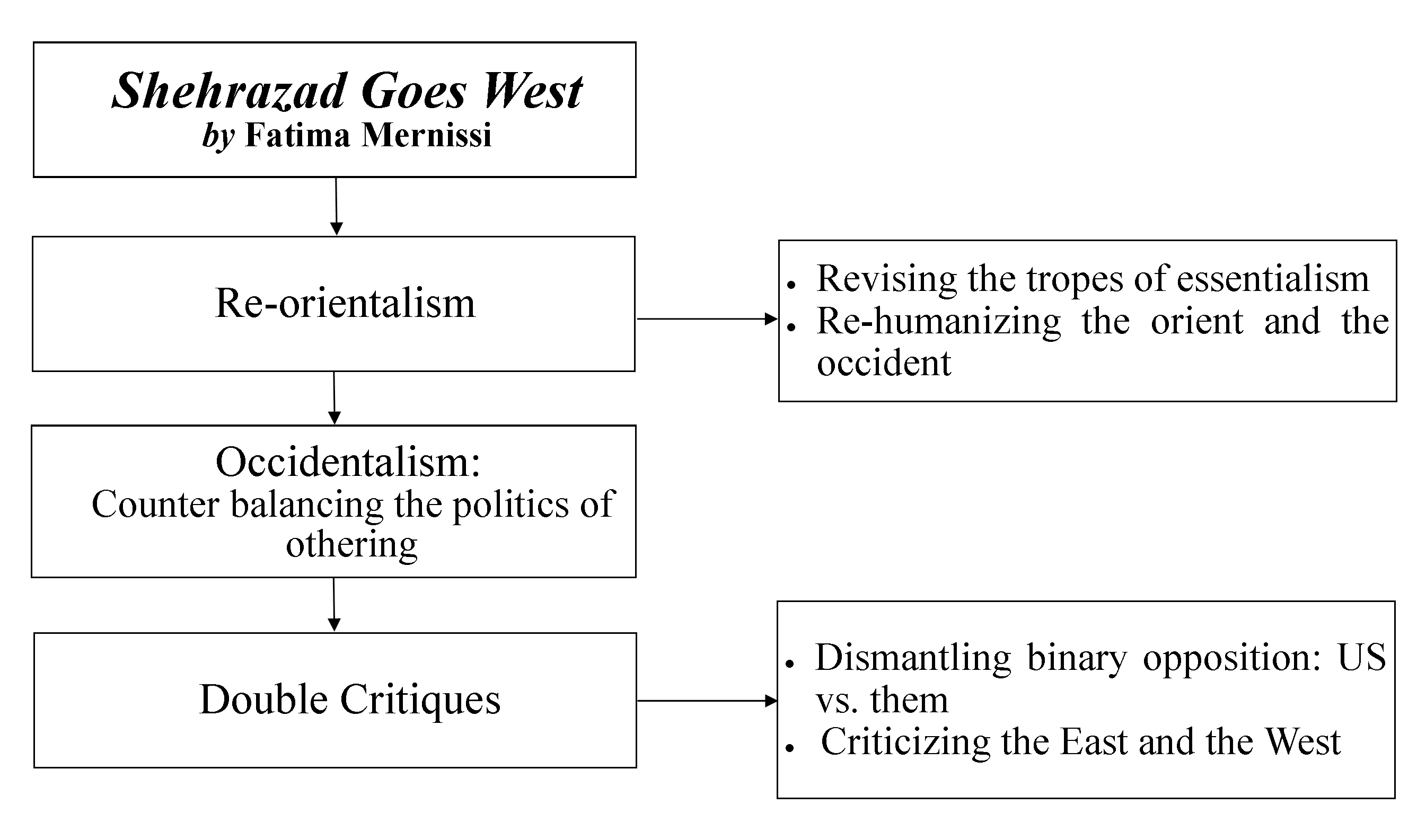
There has been a shift in the works of Fatima Mernissi moving from orientalism to double critiques.
Occidentalist discourse is not based on appropriating Orientalist rhetorical images of the orient but rather on reconsidering the tropes of essentialism, dehumanization and fixity that Orientalist texts usually opt for.
Fatima Mernissi uses ‘Romantic occidentalism’ in Shehrazad Goes West which calls for equality between cultures.
Instead of answering back the West in a dehumanized manner, Fatima Mernissi has opted for deconstructing the western preconceptions about the orient by enhancing her arguments with academic and scientific pieces of evidence.
Auto-orientalism is enhanced in Fatima Mernissi’s Shehrazad Goes West to specify the aspects of double critiques in her work.
Abstract
Occidental discourses tend to revise orientalist images about the orient. Many authors have taken the responsibility of giving a new voice to the occident and among those is Fatima Mernissi. In this regard, this paper aims at discussing the shift that has marked the writings of Fatima Mernissi with a particular focus on her book, ‘Shehrazad Goes West: Different Cultures, Different Harems’. It is undeniable that Fatima Mernissi‘s thoughts have known a radical change in terms of ideology and discourse. ‘Shehrazad Goes West’ seems to promote an Occidentalist discourse that isn’t based on appropriating orientalist rhetorical images of the orient but rather on revising/ reconsidering the tropes of essentialism, dehumanization and fixity that Orientalist texts usually opt for. From an auto-orientalist discourse that Mernissi advocated in her narrative Dreams of Trespass, we move to another discourse that manifests itself in ‘Shehrazad Goes West’, which is Occidentalism. In this article, based on a postcolonial feminist approach, I argue that Fatima Mernissi uses another approach of occidentalism in her construction of Western gender relations and the space of Western Harem. Instead of constructing a counter-hegemonic discourse to orientalism that based on misrepresenting the “other” and denying their voices, Eastern representation of the West in ‘Shehrazad Goes West’ does not keep with the same rhetoric of orientalism; rather it dismantles that logic which victimized people of the East and replaces it with a humane vocabulary. Moreover, the Occidentalist approach appropriated in the book does not only target the occident but also the orient resulting on what Abdelkbir Khatibi calls “double critiques”. The significance of this paper lies in highlighting such a potentially inclusive and democratic discourse that would counterbalance the politics of othering inherent in the discourse of orientalism.
The question of Occidentalism is still not a fully theorized or a defined field. Unlike orientalism that has generated a lot of debate in academia, Occidentalism is still an ambiguous theory that is in need to be approached from different angles. Many scholars have tried to bring their epistemological backgrounds to bear the task of defining Occidentalism. However, the ambiguous nature of the concept itself as being, what James Carrier calls, “a protean concept” (Carrier, 1995: viii) is what alienates scholars from coming up with a fully-fledged definition of the term. Occidentalism is “more dispersed, elusive, disarticulated, and fragmented than orientalism” (Bouroujerdi, 1996: 13). In spite of being an evasive discourse, its ambiguity is what Foucault alludes to discourses as being arbitrary and strange. Given a Foucauldian frame of reference, all kinds of discourses are not permanent but rather they are in a constant change (Mills, 2004: 23).
The reason behind not reducing the discourse of Occidentalism to a certain clear approach is due to the fluidity of the nature of discourse itself. However, many scholars ascribe Occidentalism to a counter-discourse to orientalism. That is to say, Occidentalist discourse incarnates the same rhetorical structure of dehumanization that an orientalist text represents. Among the scholars who have considered Occidentalism as a duplication of orientalism is D. A. Washbrook. In his revision of Edward Said’s Orientalism, he argues that Edward Said has located “the same Enlightenment mal practices” (Yew, 2010: 144) which he tries to debunk in the orientalist approach to the East. According to Washbrook, the same rhetorical tendencies said points in the discourse of Orientalism clearly found in his treatment of the occident; by reducing Western culture to Enlightenment rationalism, Edward Said has enacted the same misrepresentations he criticized. For Washbrook, Said is following the same rhetoric of dehumanization and objectification of the occident in Orientalism (Faical, 2017: 25).
In his reconsideration of Orientalism, Washbrook states that Occidentalism “essentialises ‘the West’ according to orientalist standards and thereby fails to provide a useful counter-discourse” (Wagner, 2006: 145). As claimed by Washbrook, Occidentalism is considered as an echo-discourse to orientalism, thus accusing it of inaccuracy and the perpetuation of orientalist tropes that the occidental writers seek to debunk. In the same vein, Dianna Lary mentions that “Occidentalism in all its forms is, like Orientalism, the enemy of understanding, of the mutual enrichment of cultural exchange” (Lary, 2006: 11).
It goes without saying that on the contrary, Occidentalism in the works of both Saffar and Amraoui do not appeal to reject the difference of other cultures. Throughout their travel writings, they show a willingness to learn from Western technological and political development (Alami, 2013: 42-55). Occidentalism should not be referred to as a discourse of a passive criticism of Western innovations and lifestyles. Controversially, Occidentalist discourse is a heterogeneous one where different ideologies are constructed. To reduce it to a homogenous discourse is considered as denying the difference that marks the writer’s subjecthood. For Fatima Mernissi, as we shall see in Shehrazad Goes West, Eastern representation of the West does not retain the same rhetoric of Orientalism; rather, it untangles the same logic that victimized the people of the East and replaces it with a humane vocabulary.
Among the scholars who have contradicted the essentialization of Occidentalism to an answer back to orientalism by following the same rhetoric is Hassan Hanafi. In his controversial Muqaddima fi al-Istighrab, he explores the inherent possibilities of what he calls ‘the science of Occidentalism’ (Hanafi, 2012). Hassan Hanafi traces the concept of Occidentalism into two dimensions. On the one hand, Occidentalism functions as a new critical science that aims at revisiting the Eurocentricity of Western civilization from a non-Western standpoint; and, on the other hand, Occidentalism functions as an ideological platform in its attempt to liberate and strengthen Muslim identity (Faical, 2017: 30).
In his attempt to define Occidentalism, Hassan Hanafi replaces destructive Orientalism with constructive Occidentalism. In constructive Occidentalism, “the relation between the self and the other, either way, can be an equal relation, not a high-low relation, an even and sane inter-subjective relation instead of superiority-inferiority complex” (Hanafi, 2012). In other words, Occidentalism is neither about domination nor hegemony. Such a latent inclusive and democratic discourse would counterbalance the politics of othering intrinsic in the discourse of Orientalism. As such, Occidentalism “is not motivated by any rancour or the desire to dominate. It does not consciously or unconsciously deform the object by stereotyped images, or make value-judgments on it” (Hanafi, 2012). In this vein, Hanafi rejects what has been stated in Par Ian Buruma, Avishai Margalit’s Occidentalism: The West in the Eyes of its Enemies. In this book, it has been argued that “the view of the west in Occidentalism is like the worst aspect of its counterpart, orientalism, which strips its human targets of their humanity” (Buruma, 2014: 10). Having different agendas and pertaining to distinguished discourse, Occidentalism does not duplicate Orientalist rhetorical structures in Scheherazade goes West. Haut du formulaireBas du formulaire
2 . THE SHIFT FROM RE-ORIENTALISM TO DOUBLE CRITIQUES IN FATIMA MERNISSI’S WORK
In her feminist journey, Fatima Mernissi challenged by both local and normative discourses, which alienated women from the sphere of writing. The shift that marked her writing is very explicit while comparing her autobiography ‘Dreams of trespass’ with the current work under study ‘Shehrazad Goes West’. To elaborate on that, her illuminating work entitled, ‘Dreams of Trespass’ was typically a postcolonial counter-discourse to orientalist prejudices and stereotypes. Reclaiming agency and giving voice to the Arab/Muslim women are the focal point of this autobiography. However, in ‘Shehrazad Goes West’, the author adopted double critiques to produce an Occidentalist discourse that humanizes both the East and the West. In this book, Fatima Mernissi approaches the subject of harem as it appears both in Eastern and Western spaces. Her aim was to rewrite women, power and beauty with a particular focus on how both Eastern and Western men see it. This helps in producing a discourse that critiques both the normative thinking that is prevalent in both East and West. This explains why this book is quite different from her previous books where focus was solely on answering back orientalist prejudices without giving hints to how Western atmosphere needs to be criticized.
3 . OCCIDENTALISM IN SHEHRAZAD GOES WEST
The style Fatima Mernissi has adopted in her book can be labeled as what Jonathan Spencer calls “Romantic Occidentalism” (Spencer, 1995: 238) which is about believing that cultures are very different yet equal. Throughout the narrative, Fatima Mernissi seems to produce a double critical discourse to both the self and the other; thus, she has transcended the binaries some orientalist texts enforce in their narratives. Instead of focusing on answering back and reversing power relations, it can be argued that Fatima Mernissi’s discourse of Occidentalism embodies the method of what Abdelkbir Khatibi’s calls “Double Critiques” (Meriam, 2009: 242). Her book is grounded not only on criticizing the West but also on delivering discourses about the self.
Residing in a Harem where it is forbidden for women to overstep the door gate, Fatima Mernissi’s travel to the West is constructed as being an empowering strategy whereby she debunks the authoritarian traditions imposed by men over women in the Harem. However, crossing the borders of one’s own country necessitates crossing the frontiers of homogeneity that characterizes her culture. In the narrative, she expresses her fear of not getting to understand strangers, she says:
Even now, at my age, I am frightened when crossing borders because I am afraid of failing to understand strangers. […] You must focus on the strangers you meet and try to understand them. The more you understand a stranger and the greater is your knowledge of yourself, the more power you will have. (Mernissi, 2002: 1)
That anxiety that characterizes Fatima Mernissi before her travel is not due to her underestimation of herself but rather it is due to her approval of difference that exists between cultures. With an implicit Occidentalist view, she approves that cultures differ but what is more striking for oneself is not being understandable to bridge the gap between two different worlds. She explicitly links the knowledge of strangers with the knowledge of the self by deconstructing the other/self-binaries. Put differently, Fatima Mernissi emphasizes that knowing the stranger makes you know who you are which signifies power. She does not assume the fact that the self is defined to its contradiction. She emphasizes the idea of understanding, which is in itself an aspect of tolerance. Unlike some orientalist texts, which construct the orient without being indulged in knowing them, Fatima Mernissi foregrounds her apprehension in not being able to know the Westerners as if she is afraid of misreading them in her representation.
4 . DECONSTRUCTING WESTERN STEREOTYPES
After the traveler crosses the boundaries of the East, Fatima Mernissi is confronted with many stereotypes that are normally generated by people of different cultures. Her task is clearing the prejudices the westerners hold vis-a-vis Islam and Eastern culture in general. Instead of answering back the West in a dehumanized manner, she has opted for deconstructing the western preconceptions about the orient by enhancing her arguments with academic and scientific pieces of evidence. When Fatima Mernissi represents the image of Islam in her book, she argues that “there are Muslim who kills women in the streets of Afghanistan and Algeria, but it is because they are extremist, not because they are Muslim” (Mernissi, 2002: 29). To reiterate, Occidentalism concerns itself not only with representing the West but also with revising one’s home country stereotypes. It is worth mentioning what Par Ian Buruma and Avishai Margalit say about the task of the occidental writer. They say that “Occidentalism [is based on] liberating one’s self from the image imposed on him by the other” (Buruma, 2004: 4). Apparently, through foregrounding the discourse of Islam vs. Extremism, Fatima Mernissi is not comparing between Islam and other religions for the sake of privileging one over the other but she is just clearing the stereotypical tropes Westerners hold with regards to Islam as being a religion of terror.
In her book, Fatima Mernissi does not only concern herself with clearing the stereotypes as far as the East is concerned but rather the distance has granted her the ability to reach what Edward Said calls “Double consciousness” (Said, 1994: 53) which helps writers provide an external and an internal critique of both the space of the host country and home. He states that double consciousness “challenges the tragic popularity of ideas about the integrity and purity of cultures” (Said, 1994: 53). In this regards, Fatima Mernissi’s arrival to the West grants her the ability to be engaged in a kind of a comparative study between libraries in both Berlin and Morocco. As Shannon Wooden says, “travel-writing is always biased, finally revealing more about the author’s home country than the land visited” (Alami, 2013: 47). In her representation of the West, Fatima Mernissi divulges some truths about her own culture. Being so excited in a German bookstore, Fatima unavoidably criticizes the manners the booksellers behave in her country. She says that “In Rabat, a bookstore owner may throw you out if you dared to touch any of his displayed publications: you are supposed to buy the books before enjoying its sensuous pleasure of opening it” (Mernissi, 2002: 29). This criticism is not done randomly but rather Fatima Mernissi is trying to instruct booksellers to give value to the readers. Books should not only be a profit-based industry, on the contrary, their values lie in encouraging people to check them though they do not have the intention to buy them. She goes on showing her admiration of the German bookstore by admitting that:
You would not believe how excited I get when strolling through a German Bookstore, where you are free to open the books, and even sit and read comfortably on stools discreetly placed in corners for that purpose. (Mernissi, 2002: 29)
Looking closely beyond the passage, I see that there are so many details in this paragraph in describing the German bookstore, which is not used in vain. Details are mainly used when we get either fascinated by an unfamiliar thing or when we want to instruct others on how to use a certain object. I think that Fatima Mernissi is both fascinated and implicitly criticizing the Moroccan bookstores for not elevating to the status of the reader. By comparing between bookstores in Rabat and in Germany, she favorably prefers the German one. This tradition of favoring Western culture over one’s culture is not apparent in orientalist texts. Thus, we cannot consider Occidentalism as a duplication of orientalism since it adopts other styles of representation where the Occidentalist is quite aware of the inconsistencies engraved in his own culture and is able to quieten her/his ego in admitting the negative side of her/his culture.
5 . SELF-ORIENTALISM
The narrative is also constructed in terms of auto-criticism, which manifests its ground in many lines. When Fatima Mernissi talks about the Muslim’s disinterest in approaching westerners, she divulges the criticism of her own Sufi paradigm saying:
I was stunned to realize that a western man’s smile could destabilize me because I had already decided that he was a potential enemy, I had skinned him of his humanism. All my Sufi heritage, I was shocked to discover, did not protect me against the most obvious form of barbarism: the lack of respect of the foreigner. (Mernissi, 2002: 25)
Fatima Mernissi acknowledges that facing Westerners in the contact zone enables her to revise her adoption of the Sufi paradigm. This rhetoric of auto-criticism is rarely found in orientalist texts. In other words, this paragraph emphasizes what I have previously talked about as far as Occidentalism is concerned. It is clear that Fatima Mernissi is humanizing the Westerners instead of dehumanizing them as some orientalist texts used to do. The rhetoric of othering is not manifested in this paragraph instead, it is replaced by the rhetoric of revising oneself which alienates it from being a counterpart of orientalist text. The method of Abdelkebir Khatibi is exhibited in this paragraph. Meriam Cooke argues that:
[Khatibi] sets two tasks for the Arab intellectuals in order to truly decolonize Arab sociology. In what he calls double criticism, Arab intellectuals must deconstruct the Occident’s logo-centrism and ethnocentrism, which affect the whole world, and they must equally deconstruct and critique the learned discourses that the Arab world has elaborated around and about itself. (Mehrez, 1991: 260)
Shehrazad Goes West performs Fatima Mernissi’s “double critiques” in the sense that she is turning critical lenses both ways, toward the country of origin and that of reception. Such an Occidentalist text does not only concern itself with attacking one’s culture but also with criticizing the Western Harem that according to Fatima Mernissi based on women’s compliance with submissiveness. Through foregrounding stories about Shehrazad, Fatima Mernissi is trying to clear up the stereotypes Westerners hold vis-à-vis Eastern women as being submissive, exotic and lustful humans who are denied agency and intellectual aspects.
For instance, instead of responding to the Western journalists’ questions, she has reversely shifted from being interviewed to being an interrogator. She has used this rhetoric so as to know more about Western conception with regards to the concept of harem. In a humanized subversive strategy, Mernissi answers back the way journalists describe Eastern Harem. She says that:
Muslim men portray harem women as uncontrollable sexual partners. But Westerners, I have come to realize, see the harem as a peaceful pleasure-garden where omnipotent men reign supreme over obedient women. While Muslim men describe themselves as insecure in their harems, real or imagined, westerners describe themselves as self-assured heroes with no fear of women. (Mernissi, 2002: 16)
After interviewing so many Westerners about what consists of their harem, Fatima Mernissi comes up with the conclusion that in an Eastern harem, women are considered as being an uncontrollable force that impacts men’s confidence and strengthens their self-doubt, whereas Western harem is the one which is exotic, lustful and idyllic. There, women are deprived of their intellectual side. With critical lenses, Fatima Mernissi is both answering back Western stereotypes about harem and revealing the nature of Eastern harem based on pieces of evidence from Western people. She is not misrepresenting the Eastern harem but rather she is only giving her view concerning what she has been told by Westerners in this regard in a humanized way. In other words, unlike orientalist texts that tend to define the East so as to dominate it, Fatima Mernissi has no intention to represent the West so as to achieve hegemony or to objectify it. Besides that, she is not denying the Westerner’s voices or representing them based on her own thoughts but rather she constructs the Western Harem based on the remarks she has gathered while being interviewed by Western journalists and painters.
6 . CONCLUSION
Fatima Mernissi has managed to look from a distance at what constitutes Western culture and that of her home country. Double critiques is exhibited in the entire book and directed to both spaces. Shehrazad Goes West promotes an Occidentalist discourse that is not based on appropriating orientalist rhetorical images of the orient but on revising/ reconsidering the tropes of essentialism, dehumanization and fixity that some orientalist texts usually opt for. Through her genuine and active engagement with difference, she has succeeded in combating the politics of othering displayed by the Western characters.
Tables
Figures
Conflict of Interest
This paper has no conflict of interest.
Acknowledgements
This paper would not have seen light without the guidance and instructions of Professor Souad Slaoui.
Mehrez, S., 1991. Subversive Poetics of Radical Bilingualism: Postcolonial Francophone North African Literature. The Bounds of Race: Perspectives on Hegemony and Resistance, Ed. Dominick LaCapra, Ithaca NY: Cornell UP.
9.
Meriam, C., 2009. Multiple Critique: Islamic Feminist Rhetorical Strategies. In Arab Voices in Diaspora. Ed. Layla Al Maleh. Netherland.
10.
Mernissi, F., 2002. Shehrazad Goes West: Different Cultures and Different Harems.Washington Square Press, 2002.
Said, E., 1994. Culture and Imperialism, New York: Vintage.
13.
Spencer, J., 1995. Occidentalism in the East: The Uses of the West in the Politics and Anthropology of South Asia. James G. Carrier (Ed.), Occidentalism: Images of The West. Oxford: Clarendon Press.
14.
Wagner, T. S., 2006. Occidentalism: Edward Said’s Legacy for Occidentalism Imaginary and its Critique. Paradoxical Citizenship: Edward Said, Ed. Silvia Nagy Zekmi.Lanham: Lexington Books.
15.
Yew, L., 2010. Alterities in Asia: Reflections on Identities and Regionalism. New York: Routledge.