1.Academic Affairs, International Institute for Languages and Cultures (INLAC), University of Fez, 28, Rue Haiti, Avenue Oran, Montfleuri 1, Fes 30 000, Morocco.
The violence and discrimination against women’s access to land ownership is criticized in Moroccan Legislator.
All rights to access of land are tangible resource, constitute the concern in issues related to citizenship.
Women call equality to men key positions in society mainly through access to the means of production.
A reform of their tenure status bearing in mind that land property is directly associated with power.
Abstract
Assorted kinds of violence and discrimination against women’s access to land ownership seem to be the most criticized the moment their dismissal is no longer a necessity for the Moroccan Legislator. It is hard to deny that all rights and obligations related to access to land, seen as a tangible resource, constitute the first-rate concerns of citizenship. As such, women not only call for an austere equality to men in the broadest sense of the term, but also for access to key positions in the society mainly through access to the means of production1 (El Yaagoubi, 2012: 33). The idea that women are landowners has become an in-vogue question. It is possible to say that women are heading towards building a social class that is becoming more voluble and visible. A reform of their tenure status is imperative bearing in mind that land property is directly associated with power. It is therefore appropriate that legal regimes of different land statuses take into consideration the benefits of this category given the fact that women constitute more than half of the population.
Keywords
Land , Land Ownership , Economic Discrimination , Economic Violence , Men , Production , property , Trusteeship
1 . INTRODUCTION
It has become axiomatic that every progress of society is contingent on the growth of its human resources. Both men and women, each on their own, should be able to promote their potentials with confidence and dignity to contribute efficiently to the economic and social growth of their country. However, we have witnessed a long heritage of women’s exclusion from the proprietorship of the means of production2 (Belarabi, 1994: 68). In Morocco, this tendency is decreasing progressively since self-governance reveals the influence of traditions of inequality between men and women, bearing in mind that the latter weak state suggests their protection from men. In the name of the law as well as religion, women were largely under the trusteeship of men3.
Indeed, if women today represent more than half of the Moroccan population (50.1%), their production level is hardly 23. 2% on a national level, clearly inferior to men4 implying that men are still associated with production and women to reproduction. They are situated in a position of complete dependency. This discrimination with regard to women inevitably constitutes a source of violence against them5. If research that deals with the prevalence and the effects of violence with regard to women, in all contexts, is stridently widespread in Morocco, rare are the researchers who are concerned with a peculiar form of economic violence, which is the dispossession of women’s land property right through the multiple hold-ups to her access to land. Women are rarely owners of this means of production. In common parlance, they are designated as a “housewife” not as an “owner of the house”.
A simple reading of different property and land law books certainly leads us to conclude that no discrimination towards women is incorporated in the legal provisions. Property rights are attributed to citizens without gender distinction or matrimonial status. For this matter, the property right is a principle with a guaranteed constitutional value6. It is guaranteed by the supreme law of the nation. However, it is clear that practice reveals infraction behaviors against women’s access to properties, which are sometimes replaced by imprecise, ambiguous and ill-formed provisions. It follows then that women are aware of real estate questions and reach them with difficulty given the complexity of property structure in Morocco.
The weight of traditions remains significant as the local customs still weigh heavily in the Moroccan context and usually take the lead in the direct sources of legislation (Nachtaoui and Essardi, 2012: 124). As a result, violence against women’s right to property is closely related to traditions more than to legal considerations. Observation of rights in the light of practice just like the appreciation of these rights in the legal context requires an ongoing intervention of the legislator to overcome all the difficulties that prevent women’s access to land property proceeding to the harmonization of the act and right.
2 . VIOLENCE AGAINST WOMEN’S ACCESS TO PROPERTY LAND: THE WEIGHT OF TRADITIONS
Restrictions of women’s right to land property is probably the most dangerous form of violence and discrimination, in certain situations the origin of other discriminations is based on sex. As a matter of fact, either under the complex weight of land property legacy in Morocco which preserved in different land statuses7 (Ben Haj Soulami, 1978: 31) or because of the ambiguity of certain measures of land law, women especially those of rural areas are often excluded from this vital means of production. They are often placed in an inferior judicial status. However, one cannot gauge this inferiority without referring to the place women hold in certain land statuses in which complexity finds its roots in the long history of the country (Bouderbballa, 1999: 54).
Given the fact that Morocco had undergone invasions and had fallen under the pressure of various ethnic groups, it is not startling that a legal system relative to land property structure is slightly developed. Moreover, law is only a translation of powerful forces that are produced at a certain level. The legal status of Collectively Owned Lands (COLs) and Guich lands foregrounds this power link out of which different situations of the marginalization of women emerged.
2.1 The Status of Women in Collectively Owned Lands: A Long History of Marginalization
Collectively Owned Lands (COLs) are distinguished among the traditional land-tenure status that lodges a significant place in the Moroccan structure of the land property. It refers to lands that belong collectively to a group of inhabitants of the same origin and descendants of the same ethnic group. This land heritage of ethnic collectivities constitutes a significant economic wealth since its total area is estimated at about 15 million acres8. Prior to law number 62-17 of 9 August 20199 which has enacted the new reform, the basic text regulating COLs was the Dahir of April 27th, 1919 that organizes the administrative trusteeship of indigenous lands and regulates the management and disposal of collective property. This text was the charter of collectively owned lands.
The members of the community called collectivists are the legitimate holders. They alone have the right to use the land. Bare ownership belongs to the ethnic community as a legal entity. The division of COLs was continually made according to the appearance of an eligible successor who had reached the age of majority10. Based on ambiguous and imprecise legal provisions, this division is inadequate since it was often done outside the rules of equity and justice.
2.1.1 Inequitable Division of Collectively Owned Lands
The division of Collectively Owned Lands (COLs) is one of the duties of the assembly of delegates (nouabs), which has the feature of being the legal and unique representative of the ethnic community. The Court of Cassation specified that “the provisional partition by usufruct11 of COLs in accordance with the provisions of Article 4 of the Dahir of April 27, 1919 is the responsibility of the Delegates12 Assembly, which carried out the partition according to the traditional methods of farming and local use and in accordance with the trusteeship guidelines13.
After the division, each right holder holds an indeterminate and variable share in the repartitioned shares. Within this framework, one has to be under the limelight that COLs are not hereditary; however, it is the ethnic group affiliation that is inherited and gives the right to the exploitation of tribal land. Indeed, everyone agrees that this division is inequitable since it deprives women of the right to benefit from the usufruct of COLs on the same basis as men. Moreover, women did not have the right to take part in the assembly of delegates which is in charge of the management of collective property and whose decisions in this regard can only be appealed before the Trusteeship Council (reference: UN website).
Emphatically, the Dahir of April 27, 1919, amended and supplemented by the Dahir of February 6, 1963, did not determine the procedures of designation of the delegates nor even the group with the power to designate. However, according to a plentiful literature on the subject, “the assembly of delegates is either all the heads of families composing the group, or the elders”. Traditions of the aforementioned period of time did not allow women to be part of either group. That said, other than questions of gender, the division of COLs indubitably favored the richest over the poorest, especially when they were done on the basis of relationship (Albert, 1960: 23). This extreme diversity of division procedures for COLs originates from the ambiguity around the notion of ‘rights holder’.
2.1.2 An Equivocal Nature of the Notion of ‘Rights Holder’
First of all, it must be noted that the exclusion of women from having access to collective property may be done only by an abusive interpretation of certain equivocal terms in the original legislation regulating the issue, that is the Dahir of April 27, 1919, since this Dahir contains no clear provision that prevents integrating women in the ‘rights holder’ of the right to use COLs. Indeed, in the absence of a specific legal provision that determines the terms and conditions of rights holders designation, this concept has been the subject of many different definitions. Article 4 of the Dahir of April 24, 1919 foresees “allocating every head of family one undivided share” while determining that “the distribution is done, as a common norm among the collectivists”. It is about two concepts of family heads and collectivists which lack precision.
Hence, to shed light on the notion of right holders, the Ministry of the Interior established, on November 13, 1957, a regulation in regards to the sharing of Collectively Owned Lands14. This put an end to confusions between the notions of ‘head of the family’ and the ‘collectivist’. The first article of this regulation specifies that collectivists are the heads of families, meaning men who have been married for a minimum duration of six months or widows of collectivists who have one male child at least. It is thus obvious that the term ‘head of the family’ was strictly reserved for the husband which was used in the old legislation which regulated the personal status in Morocco that defines marriage as the contract which allows a common and lasting conjugal life under the exclusive direction of the husband15.
Indeed, by pushing this reasoning further, one can deduce that this male guardianship imposed on women has, in a way, inspired the government of the protectorate to institute administrative guardianship over COLs. Under Article 4 of the 1919 Dahir, the right of ownership of tribes to lands collectively exploited by them can only be exercised under the supervision of the state
To circumvent any friction with local traditions and to benefit from them at the same time, the 1919 Dahir stipulates that possessing these lands is undertaken according to traditional modes of exploitation and use. Undeniably, this solemn recourse to tradition was only recourse to modes of discrimination against women, which results in a deterioration of their economic situation by depriving them of their land rights. The status of women within the framework of Guich16 lands was not far from this predicament.
2.2 An Insecure Legal Status for Women within the Guich Communities
The origin of the Guich lands is rather inaccurate and seems to date back to the 16th century, a time when the absence of a well-structured and well-supervised regular army led the Moroccan rulers to resort to certain tribes to maintain order, to quell revolts, to ensure territorial integrity, and to protect borders in return for the perpetual right of use of these tribes of subsidiaries owned by the state (Taleb, 1986: 87). This right to use was reserved exclusively for male adults following a power imbalance allowed them to control women’s access to the Guich land.
2.2.1 The Participation in the Military Service: A Condition to Access Guich Property
The Guich tribe had a collective property right called ‘Manfâ’ and within the tribe any member had a right of usufruct insofar as he participated in the military service performed by his group17 (Taoufik, 2012: 12). This once again demonstrates the deprivation of women from any right to use of Guich land. The latter could not claim any share because of its lack of official participation in the military actions. It should be noted in this context that it is difficult to deal with women’s property rights in Guich lands without referring to their right in the COLs. Nevertheless, unlike the collective land that is fully owned by the ethnic community in question, the right of ownership in the context of Guich is found to be dismembered, divided as follows:
• The bare ownership or the right of eminent domain both belong to the State’s private domain
• The right of perpetual use belongs to the concession holders
This schism in property law led the Guich lands to enjoy a hybrid status, which falls within the state land regime and collective land regime at once. Two administrative entities that share responsibilities in this sector and each have a focus area. The consequence of this duality and similarities with the collective land regime is two-fold: First, Guich lands are inalienable, exempt from seizure and imprescriptible; subsequently women are excluded from the right to use her land as a result of an imbalance of power that wrongs more than half of the right holders.
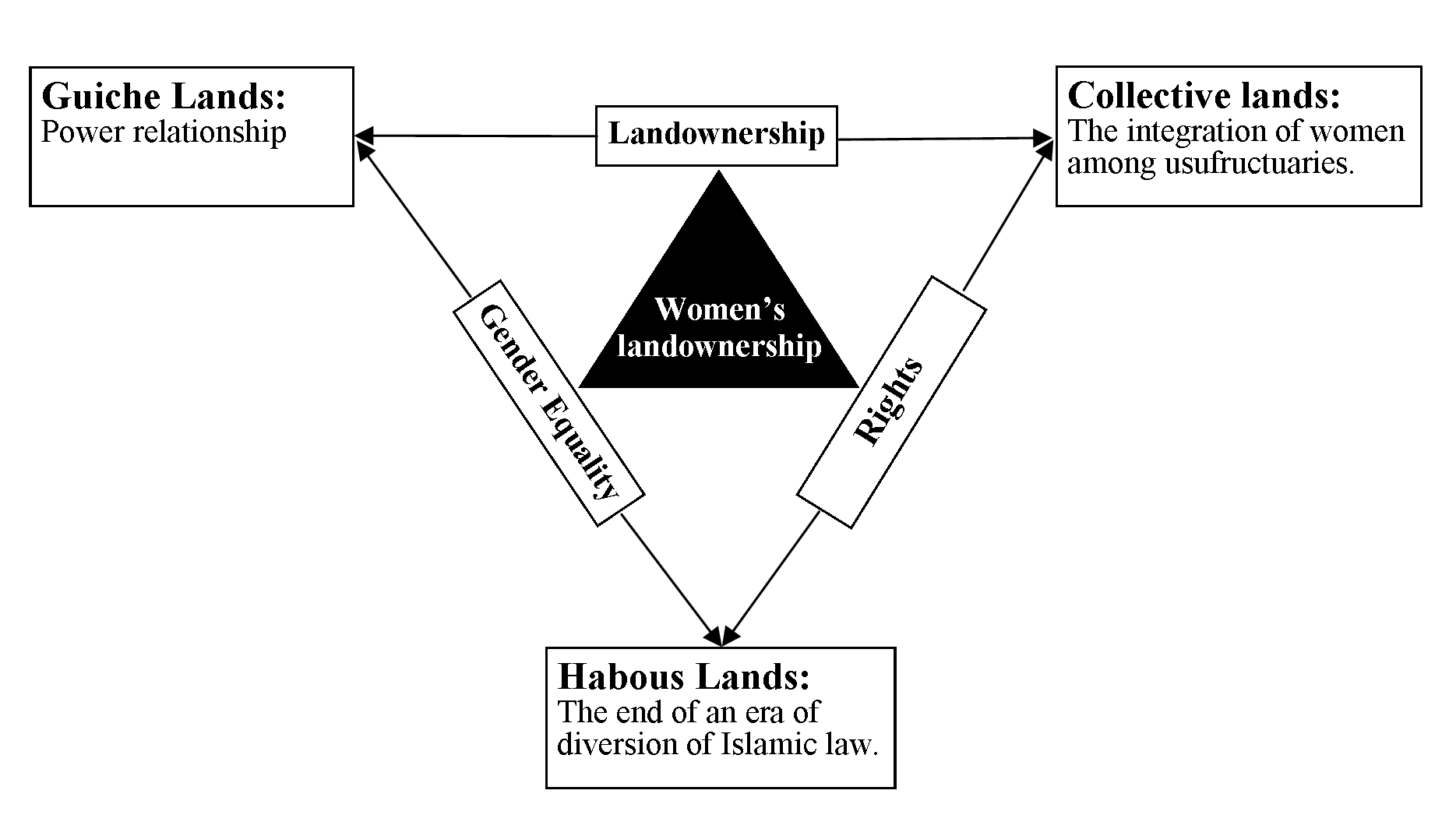
2.2.2 A Power Relationship to the Detriment of Women
The issue of women’s access to the Guich property is a question of power relationship that benefits the collective men and allows them to establish, exert and reinforce the right to control access to assets18. Nonetheless, the indirect participation of women in the military service (medical care for the injured, feeding the soldiers, to name but these) speaks volumes. Hence, it can be concluded that their unawareness of their rights over the Guich land met other requirements of the time, which can be summarized in social peacekeeping. Thus, every effort to know women’s land rights could compromise the stability of a social peace that was built on the unclear, on a difference of interests that remains “manageable” as long as they have not been expressed (Colin et al., 2009: 34).
This has been a common practice starting from 1912 marking the beginning of the protectorate, a year where the Guich tribes were not affiliated to military service, the administration, based on the right of ‘Raquaba’ that the state had on the Guich, exposing these buildings to special legislation without the possibility of women benefiting from right of use. In this framework, the property was an instrument of government by the land and not the objective of a regulation (Yanmich and Rivière, 2018: 22). Since the establishment of a regular army and with the demographic pressure on property, the Guich was stabilized. There is no property share, just like COLs. The users have a tendency to behave as owners. This has given a great autonomy to some counters, who have moved to the status of private property (Melk) or to collective land. Put succinctly, it can be said that land is a very specific asset resulting from a long history and imbued with subjectivity, which cannot be reduced to a simple means of production. This implies that the land organization observed must be considered as the result of the social mode of access to a limited resource (Claude, 2001: 25).
Thus, customary restrictions on women’s access to land ownership are rooted in gendered social structures rather than in individual and isolated acts. The status of collective land and Guich land has accentuated the gap between men and women for generations and caused an imbalanced society. In this respect, it is important to bear in mind that in all societies there is a class system, that is, relations between social groups, one of which is dominant and the other dominated19. These land ownership patterns have left more than half of the Moroccan population behind, which will ponder heavily in the social costs and sanction the whole country.
It must be noted that among the paths to be taken towards gender equality, there is the removal in the various land statutes of any kind of discrimination against women. The advocacy of women’s access to land ownership is supposed to become a concern of the state in order to meet the expectations of feminist movements in terms of equity and justice. This measure has just been applied through the new reforms made to the legal system governing certain land ownership statuses.
2.3 Claim for an Equitable Land Status for Women
History is marked out by forms of resistance by women who refuse to be dismissed as inferior to their male partners. Feminist activists have never stopped fighting against all forms of gender-based violence and discrimination bearing in mind Morocco’s ratification of the CEDAW in 1993 and its uplifting of all reservations in 2008; which highlights that such a ratification is in stark contradiction with the prevalent injustices against women as the land ownership testifies in spite of the remarkable advances in the Constitution and the status of women in reality. In Morocco, equal rights between women and men have progressed considerably over the last decades. However, women have had very limited rights to land. Some legislative rights tend to remain formal and are rarely put in effect. If the fight for the recognition of women’s rights on Habous lands, private in particular, was achieved since 2010 by adopting the code of Habous whose contribution is considerable since it put an end to all kinds of misappropriation of the Muslim property law (section 1); it is imperative to note that a reform of the statutes of COLs and Guich lands has proved to be essential.
Today, the finish line has been reached since law number 62-17, which amends and completes the Dahir of April 27th, 1919 related to the administrative supervision of collective property and the management of their assets, was recently passed20. Its adoption surely marks a break from the traditional model that sanctioned a strict division of the social roles of the two sexes.
2.3.1 Acknowledgment of Women’s Rights on Habous Lands: The End of an Era of Misuse of Muslim Land Ownership
Within the Muslim communities, rare are those who doubt that Islam has liberated women through the establishment of a value system that rests on the principle of equality between men and women. However, the negligence of the exertion of the mind commonly known as “ijtihad” has considerably limited the possibility of interpreting the holy text according to the evolution of society by making its letter reign over its spirit (El Hajjami, 2002: 40), which has gradually led to the misuse of Muslim rules. In the land sector, the status of Habous land is a crystal-clear example of illustration.
Notwithstanding the adoption of the Dahir of February 23rd, 2010 establishing the Habous Code, the question of the pretenses that have often been put forward for the ill use of Muslim rules of law on the land sector remain imperative and deserve to be analyzed. They range from the “continuous” to the “discontinuous” depending on the role attributed to family members, the land and the localized social activity.
2.3.2 “Passion” for Continuity: A Pretext for the Deflection of Muslim Land Ownership
Charity foundations have always played a major role in the lives of societies and individuals, regardless of their race, religion or the era in which they live. Times change and the human beings evolve, but the objectives remain approximately the same, namely to be pleasing to the Supreme Being in order to receive a privileged treatment in the afterlife21. In Morocco, where Islam is the official religion of the state22, the Habous (endowments) can be either public, private or common; of these three forms, it is the private Habous that triggers more questions. It is also called ‘Family Habous’ because it is most often managed by the representatives of families who have granted ‘inalienable Habous’ part or all of their property to their descendants. It is at the level of this land status that the problem of the exclusion of women has long been the center of debates.
Land tenure is an area of expertise where, regardless of the type of the family forms and the degree of their cohesions, it is the family that plays the essential role rather than the individual23 or the social class24. The essential thing is the continuity or the sustainability: continuity of the patronymic (family name), continuity of the lineage, continuity of putting down roots ... A continuity which is anthropologically structured. The “passion” for the land hides a passion for continuity (Guigou, 1982). Consequently, it is evident that the main purpose of the “Family Habous” is to maintain real estate in the male line through disinheriting women, which leads to conclude that the private Habous is an institution that was not really pious given the fact that it could serve the derogation from successional rules.
It should be noted that the provisions of Muslim law prohibit the wills and testaments for the benefit of the heir25 and restrict the bequest to a third party of the property of the testator26. Resorting to “Family Habous”, the succession of land was done exclusively for the benefit of men, which required the interference of the legislator to amend the status of private Habous in order to fight against this form of discrimination against women.
2.3.3 Equality Between Men and Women: A Principle Confirmed by the Habous Code
The precarious situation of Moroccan women does not result only from socio-cultural factors, that is a consequence of a patriarchal and phallocentric mentality and the poor implementation of the Quranic teachings and legal texts that hinder any attempt of reform. Yet, it is the result of its economic situation which represents a major obstacle to the eradication of gender inequalities. Thus, the status of women is anachronistic in relation to their economic situation (Barkallil, 1994: 75). The integration of women in economic development and their socio-educational empowerment call for the implementation of a series of measures, including concerning the improvement of the legal status of women.
With the adoption of law number 70-03 constituting the family law27, Morocco has taken a significant headway towards the protection and the improvement of women’s rights. This law is a major breakthrough from the inferior as well as dependent position apportioned for women in previous legal provisions. The family law of 2004 is the byproduct of a special type of feminism known as state feminism that does not rise from the grassroots but from the royal will to be the protector as well as the main advocator of women’s cause. There was; however, a significant feminist mobilization of the masses through the march of Rabat in March 2000; it is really unfair not to recognize the bottom-up approach paradoxically inspired by Islamist women to the condition of women in Morocco following the socialist government’s presentation of the national plan for the integration of women in development. Ultimately, the family law not only happens to restore justice28 (Chafi, 2015: 13) for women, but above all to curb men’s defective acts mainly property rights and family issues. It must be admitted that this law was the prelude to a process of legal reforms based on the protection of human rights and equality between men and women. It is precisely in this context that the Habous Code was created. The multiplication of complaints that women were excluded from the right of use of property allocated in the private Habous led to the adoption of the Dahir of February 23rd, 201029.
From this time onward, the use of this category of Habous by the owner as a technique used to divert the rules of succession in order to limit the beneficiaries to those he prefers is prohibited. Under article 14 of this code, when the private Habous act includes such a term, the Habous is valid and the term is null. Likewise, article 109 of the same code has limited the private Habous to the third generation of the descendants of the constituent; even sections 123 and 124 allow the sell-off of private Habous. Therefore, it is certain that the principle of gender equality rests on women’s access to land ownership. The new reform of the collective land statute is part of this perspective.
3 . RECOGNITION OF WOMEN’S RIGHTS OVER COLLECTIVELY OWNED LANDS
The turn of the third millennium was marked by a firm decision by Sulaliyat women to fight against all forms of discrimination against them. As a result of this fight, a law recognizing their right to Collectively Owned Lands was passed and adopted on August 9th, 2019.
3.1 The Sulaliyat Women’s Movement: The Beginnings of Emancipation
It is obvious that modern society is all-englobing and anything that does not fit into the system is considered marginal, and is therefore thrown out to the periphery. Thus, given women’s awareness of their rights, particularly those related to COLs, several groups of women belonging to the tribes concerned in several regions of Morocco have inducted providing services since 2007 in order to guarantee their rights to land on the same basis as men in accordance with the new legal provisions of the family code.
In this code, the legislator ensured the adoption of a modern formulation instead of concepts which undermined the dignity and humanism of women while taking into account their role in society. According to article 4 of the family code, the husband is no longer the sole head of the family since it is now under the joint responsibility of the two spouses who together make the decisions required for their life (Art 51 of the family code). Thus, in response to protests organized by the Sulaliyat women’s movement, bulletin number 60 of the Minister of the Interior dated October 15, 2010 finally included them among the beneficiaries of any proceeds from the sell-off of collectively owned lands. One can advance that this situation has led women from a class in itself30 towards a class for itself31, if we may say so.
In this respect, it must be added that the new Moroccan constitution of July 29th, 201132 aims to protect women against any form of injustice or discrimination between men and women. Its article 19 makes it the responsibility of the state to materialize parity between the two genders; a measure which gave birth on March 30, 2012 to a bulletin from the Minister of the Interior allowing women to benefit from an undivided share of COLs on the same basis as men. Jurisprudence has also followed suit33. This interference of the executive power to regulate the ownership of rights holders on collectively owned land through bulletins has been widely criticized. Incessant requests for the legislator to intervene ended with the adoption of Law number 62-17.
3.2 The Reform Brought About by Law Number 62-17: An Update of the Legal Regime of Collectively Owned Lands
It is clear that the legislation governing collectively owned lands has only undergone slight as well as sporadic changes since its adoption at the beginning of the last century, which is the reason why it fell short of meeting the demands of current economic and social developments34 (Bouderballa, 1996: 143). In a context of land privatization, market opening and the rise of liberal ideology, the updating and modernization of the status of collectively owned land has become a project of the Moroccan society and a business of the state. The royal letter to participants in the national fora on state Land Policy insisted on “tackling the reform of collectively owned lands… to make it a means of integrating rights holders into this national dynamic, within the framework of the principles of law and social justice, without any obsolete consideration” (The Royal letter addressed to the National Fora on State Land Policy December 8th, 2015).
Likewise, in his speech on the occasion of the opening of the 80th legislature on October 12, 2018, the King underlines “the importance of [...] opening up ownership35 to beneficiaries of collectively owned land in non-irrigated areas”.
Indeed, the implementation of the royal speeches was reflected in the adoption of law number 62-17 relating to administrative supervision over ethnic communities and the management of their assets36. This law opens up the possibility of sharing collective agricultural lands. Under the terms of its article 17 “collective agricultural lands located outside the irrigated areas, and not covered by urban planning documents, may be shared, by providing for their appropriation in joint ownership or on a private basis for the benefit of members of the community, men and women, who had the status of beneficiaries. Article 16 of this law specifies in an unequivocal manner that the distribution in using collectively owned lands is made by the assembly of deputies for the benefit of the beneficiaries, men and women, in accordance with the conditions and terms determined by a statutory instrument. The same is true for Guich lands whose bare ownership was granted to the concerned ethical communities37 since the provisions of law number 62-17 are extended to them by virtue of its article number 2. This is a major modification since it makes it possible to expressly integrate women among the usufructuaries38 of COLs and Guich lands. However, the reluctance of the legislator to designate the share of women over that of men leaves much to be fought and wished for.
Unquestionably, the possibility of women’s participation in the assembly of delegates39 can be observed as a guarantee to defend an equitable distribution of land between the two genders, especially since this assembly is responsible, under article 9 of law 62-17, to carry out all legal acts related to the ethnic communities. However, the absence of a system of quantitative representation of women via adopting a quota system within these assemblies can hollow the legal provisions of this article of their contents, especially as the legislator still refers, through article 4 of the aforementioned law, to the traditional ways of exploiting collectively owned lands and local uses.
4 . CONCLUSION
In proportion to what has been advanced in terms of economic violence and disparity of right holders, one can only regret this reluctance of the legislator to establish a system of equality between collectivists, women and men, in rights and obligations. In any case, with the adoption of this new legal system, the role of women as citizens and participants in production has been inevitably confirmed. The acknowledgement of women’s land rights will surely enable them to acquire an increasingly autonomous identity. Put succinctly, the question of the recognition and protection of women’s land rights is a question that is part of a global issue relating to the condition of the latter in a patriarchal and phallocentric society. Thus, the answer is not a priori to be found in a strict regulation of the matter which guarantees women’s access to land ownership; it seems rather that it is better to adopt a participatory approach which aims to change mindsets40 (Guigou et al., 1982) and approaches to gender roles and rights. Putting Morocco on the map in terms of rights and obligations of men and women is incumbent upon the pressure forced by the political actors to pass and implement more gender-neutral laws. This article not only aims at raising consciousness to the agency of women in the Moroccan society in particular, but it is itself an audacious pressure on the legislator to be the voice of men and women who advocate equality, equity, justice and above all meritocracy in all access to ownership of the means of production. With the inclusion of seven women ministers in the recent formed government of October 7th, 2021 which represents doubling the proportion of women ministers compared to the former government of 2016, this article can have satisfying implications on its readers as well as it can be the gadfly of socrates that instigates change as it was the case in the apology of Socrates during his trial in Athens. A genuine paradigm shift of women’s and men’s agency in society can only be achieved by exploring them as social capital on equal footing.
5 . NOTES
In this context, one feels completely in agreement with the claim of Mohamed El Yaagoubi which advances that: “there is no actual citizenship without the possibility of ensuring its implementation” (El Yaagoubi, 2012: 33).
2. In the ancient Greece, no right was recognized for women and no role was assigned to them in the actual daily life of the city. There were not deemed as citizens. Please consult “Women and Democracy” A collected publication edited by Aicha Belarbi, Le Fennek Editions, 1994, 68.
3. Among the Solemn consecrations of the domination of the husband in regard to his wife, we can cite article number 6 of the code of commerce (abrogated) which prohibits a married woman to engage in any commercial activity without a marital authorization notwithstanding the legal provisions of her personal status in this respect. Likewise, article 726 of the Code of Obligations and Contracts (abrogated) by virtue of which a married woman cannot undertake to work.
4. The High Commission of Planning (2018), The Moroccan Women in Numbers, Evolution of Demographic and Socio-Professional Characteristics, 9 and 59.
5. The statement on the elimination of violence against women adopted in 1993 by the General Assembly of the United Nations (resolution, 48/104) acknowledges violence against women as a violation of Human Rights and a form of discrimination against women.
6. Article 35(1) of the constitution of 2011 stipulates that “the Right of ownership is safeguarded”.
7. A great deal of researchers deems that this multiplicity of legal statuses of land is a sign of “tenure underdevelopment”. Mohammed Ben Haj Soulami, A Policy of tenure registration between the publicity of landed property and the socio-economic planning, a thesis for the fulfillment of postgraduate studies, ENAP, Rabat, 1977-1978, 31 (Unpublished Thesis ).
8. The Synthesis Report of the National Forum on the land ownership policy of the state held in Skhirat on December 8th and 9th. Given the lack of a data base devoted to collectively owned property, the statistics provided by the institutions in charge of the management of this legacy are often presented for information purposes only. A case in point, the Ministry of the Interior stipulates in its handbook on Collectively Owned Lands that their acreage is estimated at ten million acres, while the Ministry of Agriculture evaluates this area surface at twelve million acres in which 1534654 acres are arable lands, that is 17.6% of Utilized Agricultural Land at the National level (A workshop on Agricultural land policy, Rabat, 2000).
9. Dahir number 1.19.115 August 9th 2019 Containing law number 62-17 published in the Official Gazette number 6807 August 2019, 5887. This law comes to substitute the Dahir of April 29, 1919 after a century of its implementation (see article 37 of the law number 62-17).
10. This property sharing entails the predominance of the exploitation slightly subjected to an intensive enhancing.
11. The right to use is referred to in Latin as usufruct.
12. The Nouabs is the Arabic equivalent of the Delegates.
13. Decision of the Cassation court number 1304 issued in 24/04/2002. See the journal of Jurisprudence of the court of Cassation number 62, p.20. the Administrative Court of Meknes has equally specified that in its verdict number 650/ 7110/ 2014, File number 72/7110/14 issued in 19/11/2014 that “all partition of collectively owned lands among right holders that takes place outside the interference of trusteeship council is null” (an unpublished judgment).
15. See Article 4 of the Dahir number 1-57-343 issued in November 22, 1957 enacting volume I and II of the Code of Personal Status and Successions as it was modified and completed with the Dahir issued in September 10th, 1993. Published in the Official Gazette number 2378 issued in 05/23/1958, 806
16. At the inception of the French protectorate 1912-1956, the term Guich was mainly linked connected to the Guich tribes. “Guich” tribes or “gish” tribes, or sometimes “Makhzen” tribes, were organized by the sultans of Moroccan dynasties to serve as troops and military garrisons. They were usually cantoned in their own lands and maintained a state of perpetual military mobilization. The contingents were formed in order to be loyal to the sultan only instead of to other local interests, but they often maintained a coherent group identity long after the death of the sultan and were sometimes the source of political instability. The historical Guich system took shape primarily under the reign of the Alaouite sultan Moulay Isma’il, although variations of similar military organizations were used by prior rulers and dynasties. The major historical guich tribes were the Chraga, the Udayas (or Oudaias), the Cherarda, and the Bwakher. It was Moulay Isma’il, the brother and successor of al-Rashid who ruled for 55 years between 1672 and 1727, who institutionalized the Guich system to an exceptional level. He was motivated to install this system by a desire to create a strong central government which was not obstructed by dependence on any particular ethnic or regional group, conceiving his own authority as absolute and above all else. (Jouve and Bouderbala, 1999: 56).
17. The State has the right of ‘Surveillance’, in this context a distinguished right on Guich lands, TAOUFIK Abdelaziz, Land Tenure Legislation and Guarantees, first edition, 2012, 12 (Arabic).
18. We have to specify herein that the Guich land cannot be inherited; it is the right of a proportion that is transferrable to a major male belonging to the tribe.
19. It is about one of the principles of the Marxist Theory. According to a great deal of researchers, the ideas of Marx have resisted the challenges experienced through different epochs and turn out to be triumphant. The economic recession of 2008 has demonstrated the predictions of Karl Marx in proportion to the economic cycle which are not totally outdated. Alan Words, The Ideas of Karl Marx; retrieved on February 13th, 2015.
20. This is mainly about the Dahir number 1.19.115 issued on August 9th, 2019 enacting law number 62-17 published in the Official Gazette number 6807 issued on August 26th, 2019, 5887.
21. Islam incites landlords to devote a part of their property to pious works. The prophet has demonstrated the manner to own land which would be pleasing to God: “Immobilize it in a way that can be neither sold, given nor transferred in heritage and distributes its incomes on the poor” (our own translation).
22. Article 3 of the Moroccan Constitution of July 29th, 2011.
25. Article 280 of the family code stipulates that “the will cannot be made in favor of an heir, only with the permission of other heirs”.
26. Article 277 of the Family Code stipulates that “the will is the act by which its author constitutes, on the third of his property, a right that becomes due by his death”.
27. Dahir number 1-04-22 issued on February 3rd, 2004 enacting endorsement of Law number 70-03 carrying the Family Code. Published in the Official Gazette number 5358 issued on October 6th, 2005, 667.
28. CHAFI Mohammed, The Family Law in Morocco, Print, El Watania, Marrakech, First Edition, 2015, 13.
29. Dahir number 1-09-236 issued on February 23rd, 2010 carrying the Habous Code. Published in the Official Gazette number 5847 issued on 14 June 14th, 2010, 3154.
30. A social class in itself is the one that exists in objectively whose members do not have a conscience that they belong to a certain class.
31. A class for itself is a class whose members have a certain conscience to constitute a class and engage in fighting against other classes.
32. Dahir number 1-11-91 issued on July 29th, 2011 carrying the endorsement of the Constitution, Published in the Official Gazette number 5964 bis, July 30th, 2011.
33. While the civil procedure assigns a position that is almost impossible to jurisprudence since article number 3 stipulates that: “the judge must adjudicate pursuant to the laws regulating this matter”, the Judges, by being impregnated by the new constitutional laws, have endeavored to liberate themselves from the absolute straitjacket Dahir of April; 27th, 1919 by confirming the principle of equality between men and women. See: Decision of the Administrative Appeal Court: Particularly number 3327 issued on August 29th, 2012, File number 202/10/5 and the one numbered number 2138 of May 27th, 2013, file number 393/11/5; cited by the administrative Court of Meknes in its verdict number 137/110/16 of April 6th, 2016, file number 168/7110/15 (an Unpublished Verdict). Verdict of the Administrative Tribunal of Meknes, the one carrying number 650/7110/2014 of November 19th, 2014, File number 72/7110/14 and the one numbered 241/7110/2018 of May 2nd, 2018, File number 45/7110/2018 (an Unpublished Verdict).
34. According to Najib BOUDERBALA, “Collectively owned lands are the sick status of the Moroccan land and the majority agree that ownership becomes inevitable”. See Najib BOUDERBALA, collectively owned lands in the early period of the Protectorate (1912-1930). In the Journal of the Muslim and Mediterranean World, number 78-80, 1996, 143. (Provide all the pages of the article; you indicate the first and the last pages of the article. For example, 42-61)
35. “Melkization” is derived from standard Arabic and it has become a recurrent borrowed term from Arabic into French to refer to ownership
36. Other Laws related to the collectively owned lands have equally emerged. This is about the Dahir number 1.19.116 issued on August 9th, 2019, carrying law n°63-17 relative to the administrative demarcation of collectively owned lands as well as the Dahir number 1.19.117 issued on August 9th, 2019 carrying law number 64-17 modifying and completing Dahir number 1.69.30 issued on July 25th, 1969 on collectively owned lands within the outlying irrigation areas. All these laws are published in the Official Gazette number 6807issued on August 26th, 2019.
37. At the inception of the Protectorate, surface areas of Guich lands were taken by the colonial authority for the benefit of the outlying areas of the official colonization. In exchange of the these samplings, the State assigns to the Guich communities already portioned the complete property over the remaining surface areas that the State transforms into collectively owned lands by waiving its right of eminent property: Negib BOUDERBALA, Land Policy and Planning of Farming Structures (Jouve and Bouderbala, 1999: 56).
38. A usufruct is a legal right accorded to a person or party that confers the temporary right to use and derive income or benefit from someone else’s property. It is a limited real right that can be found in many mixed and civil law jurisdictions. A usufructuary is the person holding the property by usufruct.
40. The rule of law is abided by only when it is compatible with a wild way of thinking or the mythical one, which structures tenure conduct of landlords. However, it is violated when it is grounded only on moral or rational bases (Guigou, 1982: 924).
Tables
Figures
Conflict of Interest
The authors confirm that the content in this article has no conflict of interest.
Acknowledgements
Author is very thankful to anonymous reviewers for constructive comments and suggestions on the manuscript.
Abbreviations
COLs: Collectively Owned Lands.
References
1.
Albert, G., 1960. Collective Property in Morocco, La Porte Edition, Rabat, 23.
2.
Barkallil, N., Chiche, J., Lemrini, A. and Naciri, R., 1994. Women and education: Hinderances and impacts, Fennec Editions.
3.
Belarabi, A., 1994. Women and Democracy. A collected publication, Le Fenned Editions.
4.
Ben Haj Soulami, M., 1978. A Policy of tenure registration between the publicity of landed property and the socio-economic planning. Rabat (thesis written in Arabic)
5.
Bouderbballa, N., 1999. Land property, policy and planning of farm structure in Mediterranean countries, CIHEAM, Mediterranean Option, 36.
6.
Chafi, M., 2015. The Family Law in Morocco, (1st Ed.). Marrakech: Print, El Watania, Marrakech.
7.
Claude, N., 2001. From land control to social control of access to resources, CIHEAM-IAMM, Karthala Edition.
8.
Colin, J. P, Le Meur, P.Y and Leonard, E., 2009. The politics of registration tenure rights: From a legal framework to local practices. Karthala Edition.
9.
El Hajjami, A., 2002. Issues of women’s legal status reform in Morocco between a frame of reference and procedure, Journal of Law and Economics, 19.
10.
El Yaagoubi, M., 2012. Reflections on human rights and civil liberties, Morocco (1986- 2012). Rabat, El Maarif AL Jadida Publishing House.
11.
Guigou, J. L., 1982. Land Rent: Theories and evolutions since 1950, Ed. Economy, 1982.
12.
Guillaum, A., 1960. Collective Property in Morocco, Rabat (La porte Edition).
13.
Jouve, A.-M. and Bouderbala, N., 1999. Politiques Foncières et Aménagement des Structures Agricoles dans les Pays Méditerranéenes, 36, Montpelier: CIHEAM.
14.
Korachi Bensouda, T., 1986. Land Administration in Morocco and Tunisia. Symposium proceedings, Barcelona, September, 22-25.
15.
Nachtaoui, M. and Essradi, O., 2012 Moroccan rural women, carrier of economic and human developement, REMALD, 79.
16.
Taleb, K. B., 1986. Land administration in Morocco and Tunisia. Symposium Proceedings, Barcelona, September 22-25, 87.
17.
Taoufik, A., 2012. Land Tenure Legislation and Guarantees (Arabic).


 ,
Kamal El Aissaoui 1
,
Kamal El Aissaoui 1