204-223
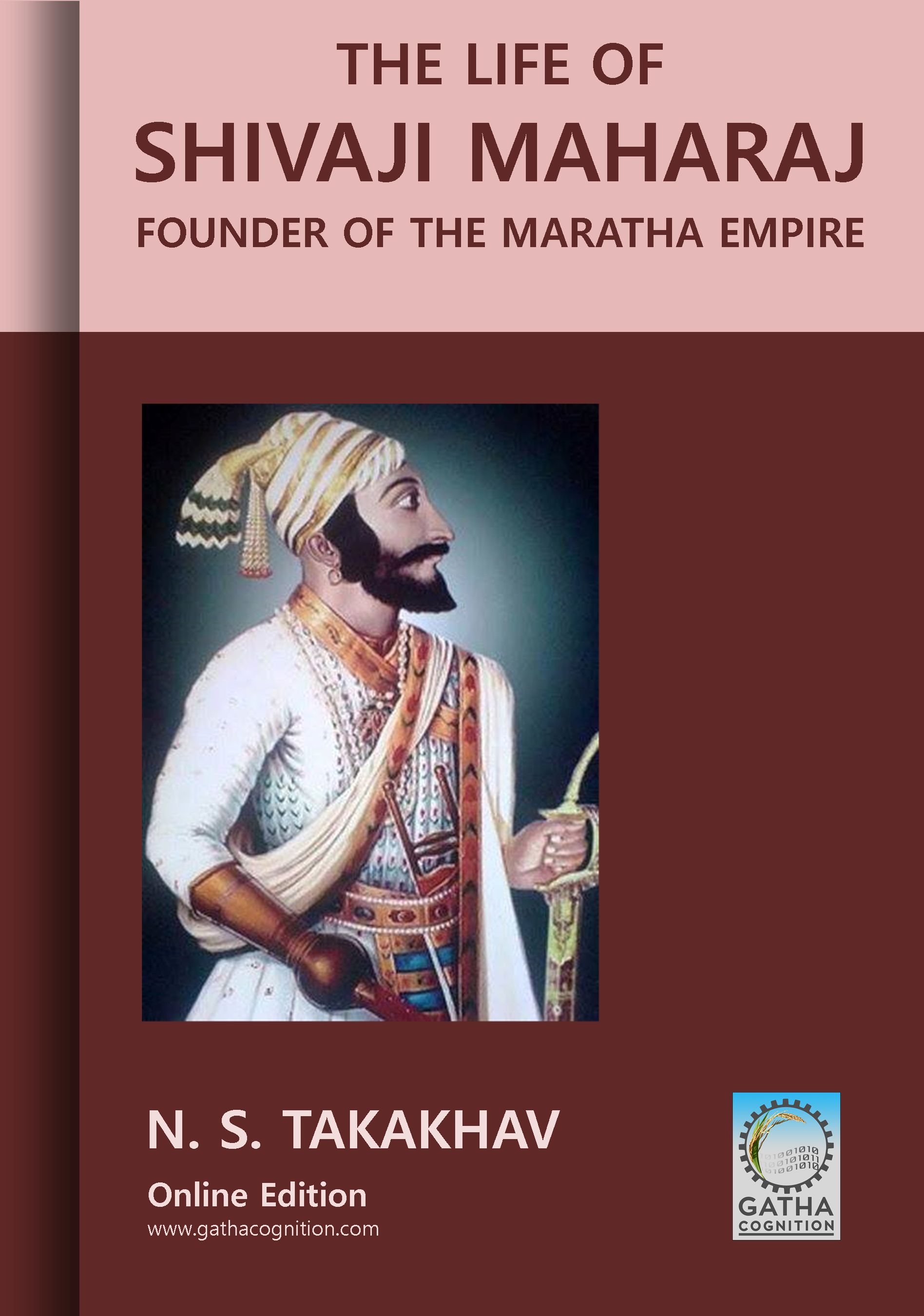
The Life of Shivaji Maharaj: Founder of the Maratha Empire


When the decision to visit the imperial capital was finally made, Shivaji left the Mogul camp and proceeded to Raigad, where he had summoned his principal officers to communicate to them his intention. Not a few of them expressed their disapproval, pointing out that Aurangzeb was a sort of impious Titan, who never forgot his intrigues nor his enmities. To trust him was to take a leap in the dark. Besides Delhi was two months journey off, and who would say what difficulties would have to be encountered? To these criticisms Shivaji replied that to go to Delhi was now a necessity, and he depended on the utterance of his tutelary goddess in this connection. For the prophecy had then been made that Shivaji would have to go to Delhi and his tutelary deity would bring him safe from harm. A journey to the north had besides its educative value. It would enable him to observe the state of the country and the Mogul durbar, to view those countries which at one time had been under the sway of his ancestors, and to visit the great shrines and holy rivers of Aryavarta. Jay Singh’s guarantee had dispelled all fears and the emperor’s friendly disposition had been proved by the Treaty of Purandar. Notwithstanding all the assurances, should any unforeseen calamity overtake him, he hoped he would make shift to emerge from it in triumph. In this manner Shivaji overruled the objections of his counsellors and adhered to his resolution to visit Delhi in company with his eldest son Sambhaji.
Shivaji invested three of his principal officers, Moropant Trimal, the Peshwa, Annaji Datto, the Surnis (the record keeper), and Nilo Sondev, the Muzumdar (the auditor general) with full authority during his absence, bade them conduct all the administration from Raigad under the regency of Jijabai, and enjoined upon all public officers to respect and obey their orders. To Prataprao and others of his intimate nobles he entrusted the care of his mother and second son. He made a tour of inspection throughout his kingdom. He urged all to conduct the administration with the same efficiency as heretofore, to defend the realm and add to it, and to be on the watch for any news about him from Delhi. Whatever evil might betide, he was sure to return, and the word of men like Jay Singh could not be pledged in vain. But should the unexpected happen and trouble come upon his party, it was left to his officers and ministers to cheer up his old mother and guard the kingdom and govern it in the name of Rajaram. In their zeal, their loyalty, and their ability he had complete confidence. For his escort Shivaji chose men of approved loyalty, who would never forsake him in any crisis. Among the principal officers there were Niraji Ravji, Trimbak Sondev Dabir, Dattaji Trimbak, Manako Hari Sabnis,[1] and among his aides-de-camp were Hiroji Farzand, Ragho Mittra, Dawalji Gadge, and Jiva Mahalya.[2] With these Shivaji had a corps of expert swordsmen and a Mavali brigade of three to four thousand warriors.[3] As the hour of parting came near, Shivaji had a last interview with the leading ministers, after which he paid his reverence to the image of his tutelary deity in the palace chapel and came down to the apartments of his mother for her parting benediction. This parting was the most painful of all, but as she clasped him in a close embrace and laid her hand upon his head, her hopes and blessings struggled forth into incoherent words through her tears and emotion. Shivaji listened to her blessings and the old, old precepts which he had listened to from the days of his childhood and always with increasing enthusiasm.
Before proceeding directly to Delhi, Shivaji had another conference with Jay Singh, who gave an entertainment in his honors. He also gave advice to Shivaji from his wider experience as to the ways of Delhi life and the society at court. He gave him a special letter to be handed to his son, Ram Singh[4] who was at the Mogul darbar. In this epistle, Jay Singh enjoined upon his son to pay proper attention to Shivaji and his party and supply their needs with the greatest zeal and diligence at his command. Finally, Jay Singh undertook to remain in the Deccan as long as Shivaji was at Delhi, so as to safeguard Shivaji’s forts and possessions from any molestation at the hands of the Moguls, and he promised that in case of danger, Ram Singh would leave no stone unturned to effect Shivaji’s rescue, even at the cost of an open rupture with Aurangzeb, nor would he himself fail in his turn by his actions to do all he could to humble the haughty emperor.
With these assurances and re-assurances Shivaji started on the fateful march to Delhi, having already sent his envoy in advance. Orders had been issued to all the mahalkaris (taluka-officers) and mokassadars (revenue farmers) to require the local fouzdars (garrison commanders) on Shivaji’s route to provide for all the wants of his force and treat him as a prince of the empire. At every halt the local dignitaries came to pay their respects to one of whose fame and valour they had heard so much. The district and taluka officers took particular care not to cause the least annoyance or disrespect to Shivaji, who was known to be very sensitive on this subject. In connection with this subject a story is told of what had recently occurred at Aurangabad, when Shivaji called there on his way to Agra. The governor Safshikan Khan, did not come to the city gates to receive Shivaji, but sent his nephew instead. Shivaji in anger instead of calling on the governor proceeded immediately to the residence provided for him, whereupon the governor’s kinsman submitted that the governor was waiting in the audience hall to receive Shivaji. Shivaji retorted that if the governor meant to make so much of him he might have come to receive him at the gate.[5] Later when the governor and his officers came on formal visits to Shivaji’s quarters they made a proper apology and banqueted the guests. Their example was followed by the other nobles in the camp.
A story that is told in connection with the preparations for the journey to the north illustrates the strictness of military discipline, characteristic of Shivaji’s fort administration. With a view to test the observance of his rules of discipline, Shivaji presented himself suddenly at night at the gates of a fort and, calling out to the commander of the garrison, sent word that Shivaji in person was come, flying before the enemy and ordered the gate to be thrown open for him. The captain of the fort manned the ramparts and replied that Shivaji’s strict orders were not to open the fort gates under any circumstances, that if the foe did approach he might be kept at bay from the out-posts at the outer barrier of the fort, and he would see to this being done. But as for the fugitive party they must keep without under the ramparts. Upon this Shivaji protested that he was the author both of the disciplinary regulations and of the command to open the gates. If he still persisted in his refusal, he would come in for a severe censure. A loyal soldier’s duty was to obey immediate commands, no matter however inconsistent with general regulations. But the governor made little of these threats and pointing out that the night was almost turning into day assured him that the pursuing foe would be baffled in the chase. Nevertheless he detained Shivaji’s party outside the fort walls for the rest of the night. When morning dawned the governor and the principal offenders appeared at the gate with their hands bound, and unbolting the gate gave admission to Shivaji and prostrated themselves before him, acknowledging their guilt and demanding instant punishment. Shivaji was quite overjoyed with this proof of their adherence to discipline and regulations and far from imposing any kind of censure gave them higher positions in the army. With this moral certainty that the administration at the various fort centres would be conducted in a spirit of harmony and discipline, Shivaji left for the north.
When it was announced that Shivaji’s cavalcade was about to approach Agra,[6] Aurangzeb sent Ram Singh and Makhlis Khan, a nobleman of somewhat inferior rank, to receive him. This marked slight, though it did not pass unobserved, Shivaji forbore to notice. He took up his residence at the mansion appointed for him and urged upon Ram Singh to hasten the day of the audience. He also represented to the Rajput prince that the meeting should be arranged on a footing of equality as between ruler and ruler. But Ram Singh pointed out that this was impossible, and that the haughty sovereign of the empire would never treat the ruler of a small principality on terms of equality, and declared that it would be highly imprudent to communicate to him such a proposal.
Aurangzeb indeed was disposed to play the host on a scale of imperial splendour. Nothing was wanting to the comfort of Shivaji and his party. But to kindle his old enmity and add fuel to his passion certain zenana influences were being exercised.[7] The wife of Shaista Khan was then at Agra. She naturally harboured an unforgiving grudge for one who had slain her son and discomfited her husband. She spread the infection of her revengeful hatred among the ladies of the imperial seraglio, urging upon them to plead with the emperor that now that Shivaji was in his power, he should, instead of treating him as an honoured guest of the empire, lead him to the execution block. This made Aurangzeb’s mind waver. The gossip of these intrigues in the imperial household came to the ears of the leading omrahs of the court. They deprecated such a proposal, affirming that the imperial honour should not be stained in so foul a manner and that their own lives and fortunes rested entirely on the emperor’s reputation for good faith. A treachery so glaring and unforgiveable was bound to throw Jay Singh and the rest of the Rajput supporters of the throne into open rebellion. These protestations had their effect and Aurangzeb revised his judgment.
When Ram Singh arranged the day for the audience which happened to be the fiftieth birth-day of the emperor, special precautions were taken and the most loyal nobles and the pathans of the praetorian-guard stood in their appointed places, round the throne, with naked swords in their hands. The emperor had his own fears; he had heard that Shivaji was no ordinary man. Gossip said that he was a very devil at requiting an injury, and that his stride sometimes measured twenty-five cubits in length! In addition to the precautions that have been mentioned, the emperor had in readiness close to his seat five different weapons of war and was clad in mail, over which was worn a robe of muslin. Owing to a natural curiosity to see so distinguished a warrior of the south the audience hall was crowded with leading nobles and merchant princes of the capital. The zenana ladies burned with the same curiosity, and arrangements were made for them behind the tapestry. As the durbar hour drew near, Shivaji with Ram Singh and a few chosen attendants came to the hall. He made the usual salutation,[8] placed the nazar (loyal present) before the throne and was introduced according to the usual etiquette of the court to the emperor. Aurangzeb made the usual enquiries after his health and Shivaji gave the proper answers. This being done, Aurangzeb motioned him with his hand to take his place among the second-rate amirs. Ram Singh led the way to that part of the hall and Shivaji had no alternative but to follow. He could now no longer suppress his indignation and seating himself instead of standing with the rest of the nobles, he inquired what was the rank of the amirs among whom he was placed. Ram Singh’s answer that they were mansabdars holding command of five thousand men only aggravated his anger and he ejaculated that the emperor had grossly insulted him in ranking him with such inferior officers, and that he could not with self-respect accept such a position. Saying this, he demanded a dagger from Ram Singh.[9] The emperor inquired what was a-foot, and the amirs repeated Shivaji’s words.[10] Thereupon the emperor, fearing that Shivaji’s excitement might lead him to some excess, ordered Ram Singh to present to him the betel-nut leaf in token of parting,[11] and to conduct him to his residence, adding that the audience might be completed on the morrow.
But no more audience was granted. The emperor had no desire to see Shivaji again. The latter was now struck with dismay, being convinced that the emperor meditated evil. To know the worst and be prepared for it, he sent Ram Singh to enquire into Aurangzeb’s intentions. Aurangzeb replied that it was his imperial pleasure to retain Shivaji at the Mogul court and entrust him with military duties of the highest importance. Besides the jahgir in the Deccan which had already been conceded to him agreeably to his own stipulations, the emperor professed to confer on him an additional jahgir in the north with a revenue of lacs of rupees. Shivaji might put the southern jahgir in charge of his son: and in virtue of the northern jahgir he might serve in the imperial armies at the head of his own force of 50 to 100 thousand. For a man of Shivaji’s bravery, generalship and statesmanship, the Mogul durbar was the only arena for the proper exercise of his high gifts.
These prospects of high office under the Mogul were quite distasteful to Shivaji’s ideas, apart from the fact that the sincerity of these proposals was very doubtful. It was obvious to Shivaji that these were the blandishments devised by a naturally crafty and astute mind to entangle him in the north while undermining his power in the south. He, therefore, petitioned the emperor through Raghunathpant, pointing out that he had been invited to the durbar by hopes of promotion,[12] that his services to the Mogul flag were already too well known to require repetition, and that he was quite prepared to fulfill to the letter the terms of the treaty made with Jay Singh. He submitted that he was willing to co-operate heart and soul in the imperial project of the conquest of the Bijapur and Golconda kingdoms. He was capable of rendering much more vital service to the empire by operating in the south which was his own country and where he commanded such a large following and influence rather than in the north, where he was an exile and a stranger to the soil, without any friends or influence to boast of. Thus neither was it to the advantage of the empire that Shivaji should transfer the scene of his imperial service to the north, nor was it of any earthly use or convenience to him. Besides the northern climate did not agree with his health nor with that of his young son, or of the little contingent that accompanied him. He therefore craved the emperor’s gracious permission to return to the Deccan.
To this petition the emperor vouchsafed no answer, so much was he obsessed with the view that by detaining Shivaji in the north, he would further his ambitious designs in the south. By the restraint he sought to practise upon Shivaji, the emperor thought he would curb his haughty temper and reduce him to a state of helpless dependence. Shivaji was indeed entirely at his mercy and the only marvel is that he did not take more violent measures. But the stipulations made with Shivaji by the mediation of Jay Singh always came before his eyes and made him coward when the thought of violence occurred to his mind. Some Mahomedan chroniclers add that among the ladies of the imperial zenana who had seen the introduction of Shivaji in the audience hall, was a daughter of the emperor named zeb-un-nisa Begum. This princess had already before heard the fame of Shivaji’s deeds and what she saw with her own eyes of his handsome person and behavior worthy of a brave man and a soldier answered exactly to what she had expected in such a hero of romance. This princess, say some of these historians, pleaded with her father and successfully won him over from extreme measures. Besides it is easy to believe that Aurangzeb was quite sincere in professing a desire to make use of Shivaji’s gifts and genius in war and might have attempted through the mediation of Ram Singh to induce him to remain permanently at the Mogul court, had not Shivaji persisted in his refusal.
Among the omrahs in the confidence of the emperor was one Jaffar Khan a brother-in-law of Shaista Khan and prime minister to Aurangzeb, This noble is credited with having made a suggestion to Aurangzeb that in case Shivaji should not willingly agree to the proposal that he should reside at the imperial court as a grandee of the empire, he should be threatened and hampered in his movements and on no account allowed to return. This proposal seems to have been approved of by the emperor. On its coming to the knowledge of Shivaji he honored Jaffar Khan with a visit and interviewed him on the subject, addressing himself to his sense of fairness and justice and exhorting him to use his powerful influence with the emperor to make him relent and fulfill his promise to permit his departure for the Deccan, with an escort befitting his rank. Jaffar Khan made a pretence of assenting to this request. But as a matter of fact even while the conversation was at its height the Khan’s wife who happened to be a sister of Shaista Khan sent a secret message from the harem advising the Khan not to prolong his colloquies with Shivaji, as there was no knowing what he might do and when. At this warning on the part of his consort the uxorious Khan cut short the interview and presented the betel-nut leaves, a sign according to Indian usage that the visit was at an end.
Aurangzeb pursued the policy of threatening Shivaji into submission and compliance with his wishes. The city kotwal (commissary of police) was given strict orders to place a guard of five thousand men upon Shivaji’s residence, not to allow anybody to enter or depart without permission, and, in case of Shivaji’s quitting the house, to provide a sufficient force that would be responsible for his custody. Shivaji remonstrated through Ram Singh, submitting that in as much as the emperor seemed to distrust him even when he was undertaking to subdue and make over to Aurangzeb the entire Deccan as a dutiful vassal of the empire, and in as much as he persisted in refusing to grant him permission, though bound under the treaty, to return to the south, he felt the only alternative before him was to reconcile himself to the emperor’s wishes and to continue to remain at Agra as a nobleman of the court. Aurangzeb answered Ram Singh that the Raja Shivaji did not seem to act with sincerity. He had turned a deaf ear to all his solicitations to take service among his feudal nobility in Hindustan. His pertinacity had driven the emperor to the necessity of restraining his movements, and until his mind was clear of doubt and misgiving he would remain in this unhappy predicament. On the other hand the emperor persisted in maintaining that he could have no covert object in ill-treating Shivaji, as he was bound in honour under the terms of the compact effected by Jay Singh and Diler Khan. He concluded by earnestly appealing to Ram Singh that he should use all his influence with Shivaji to convert him into a loyal champion and dignitary of the empire, as he himself was. When that was done, things would resume their natural course.
When Ram Singh intimated to Shivaji the purport of this communication he saw that there was no prospect of success by any methods of persuasion. The police guard around his residence continued to increase in number. To elude them would tax the ingenuity of the ablest intriguer, but this was the question that now lay immediately before him. The first condition for the success of any plan he might form was to betray no sign of fear to friend or foe. The second problem was to reduce the number of those placed innocently in the same predicament as himself. It was clear that if a way could be found to extricate from Agra those loyal followers and dependents who had accompanied him from the Deccan, the problem of his own escape would present less difficulty. Shivaji, therefore, petitioned the emperor again, urging the hardship of detaining in the north his followers from the Deccan, as the northern climate did not agree with them and sickness was rife in their ranks. He, therefore, prayed that he might have permission to send most of them home, retaining only those whose services were needful. This would also mean a great saving to his exchequer. Aurangzeb was but too pleased to grant passports for the return of Shivaji’s followers to the Deccan and his Maratha retinue with the exception of a few officers was ordered to return home. His loyal attendants were extremely reluctant to return, being aware of the serious predicament in which they were leaving their master, and Shivaji had great difficulty in explaining to his faithful adherents that the scheme he had formed for his own escape made it imperative that they should first leave their master. He assured them that he would return in safety and they should be under no anxiety on this ground. The imperative orders thus received compelled them to turn their backs upon their master, who was now left to face calmly what was probably the greatest crisis in his career.
Shivaji now obtained permission to exchange visits and cultivate friendly relations with the leading omrahs at the Mogul court. On these occasions, Ram Singh attended him and introduced to him the leading grandees of the court. Shivaji’s suavity of manners and urbanity of social intercourse won golden opinions wherever he went. In his most intimate conversation he now began to harp on the change in his opinions and his determination to aspire to the highest honours and dignities in the empire by rendering the most loyal and devoted service in field and council. These repeated professions gradually won the confidence of the courtiers and drew them into free and unrestrained social intercourse with Shivaji, nor did it take long for the rumors of his changed behavior to reach the emperor’s ears.
Shivaji now commenced to celebrate special festivities every Thursday in the week under the pretense of a religious vow, and as a part of this function to send presents of sweets and confectionery to the great omrahs whose friendship he had taken such pains to cultivate. For the conveyance of these sweets to and from Shivaji’s residence ten large baskets were ordered to be prepared. When filled with sweets, these monster baskets became as heavy as to require two persons to carry them. They were usually hung by ropes from a bamboo that rested on their shoulders. The sentinels used to order the carriers to lay down their burden and only allowed them to carry it on, after they had duly satisfied themselves about its contents. This went on from Thursday to Thursday and the sentinels got tired of the needless search, and instead of examining all the baskets one after another they began to examine just one or two to clear their conscience. The sentinels were on the best of terms with the august prisoner they guarded, having been won over by his repeated largesses and by the punctilious courtesy that the great Maratha never failed to extend to his keepers. Shivaji mingled in their blunt conversation and unreserved ways of life and they used to speak freely to him of their hopes and fears as though he were one of themselves. With equal tact Shivaji behaved towards the officers of the guard, losing no opportunity to expatiate on his allegiance to the emperor, with the natural result that they unconsciously relaxed the rigour of their surveillance.
Now that there were growing signs of the fulfilment of his design, Shivaji gradually sent away to the Deccan many of the officers who yet kept company with him. Some left on the pretence of sickness and for a change of climate, others as being wearied with his service and desiring a change of master. Thus on one pretext or another the number of his followers dwindled from day to day. They had no difficulty about their passports and were instructed by Shivaji to await his arrival at certain appointed places. Thus most of his Deccani menials and attendants were got out of the way and their places filled by Hindustani servants. At length there were left with Shivaji of his original retinue only his son Sambhaji, Hiroji Farzand and one or two attendants. Shivaji now feigned illness, sent for diverse physicians and got them, to prescribe for him. Affecting to grow worse and worse, he avoided company and instructed any one coming on business to transact it from a distance. After a time he gave it out that he was on the way to recovery and out of gratitude sent large hampers of sweets to his physicians as also complimentary presents to the amirs and omrahs of the court. Alms were liberally distributed among Brahmans and the poor, and the fakirs in the mosques had sweets and confections in abundance, the monster baskets being borne to and from Shivaji’s door. This occurrence had now become so usual that it no longer excited any curiosity. One evening, Shivaji ordered some four or five baskets to be made ready with sweets, in one of which Shivaji concealed himself, while his son, the Prince Sambhaji hid himself in another. After their usual practice the sentinels examined one or two baskets and let the others pass unchallenged. As it is related in one of the chronicles, the pretence made use of on this occasion was that the sweets in question were being despatched for distribution among fakirs and the Brahman priests of the holy shrine of Mathura (Muttra). The ruse succeeded perfectly. Shivaji eluded his guards and joined his party outside of the city gates.[13]
It was arranged that the trusty Hiroji should for the time put on Shivaji’s robe and occupy his master’s place on the sick-bed and seize the earliest occasion to make good his escape. The trusty officer willingly undertook the perilous honour, assuring his master that he might leave the scene without any anxiety on his servant’s account, since by the good fortune which had always attended his loyal service he hoped to make good his own deliverance. He lay all night covered by the bed clothes, except for one of his hands on a finger of which appeared conspicuously Shivaji’s ring. Thus with serene confidence he maintained the deception, a young page contributing to it by gently rubbing the supposed patient’s feet. It was now morning, and as Shivaji did not appear to have left his bed though it was broad day-light, some of the sentinels approaching the door inquired the cause of the Maharaja’s keeping so long to his bed. The page replied, as he had been instructed, that the Maharaja had a severe headache, whereupon the sentinels withdrew. Upon this Hiroji rose from the perilous place he had occupied the night before and putting on his dress left the palace with the trusty page, giving out that Shivaji had had the most acute pain all through the night, and as he had just then fallen into a doze after a whole night’s torture, he enjoined them to observe the strictest silence, until he returned with medicine from the physician. On their making further inquiries about the unusually late hour that the Maharaja was sleeping he put them off by a repetition of the pretence of sickness, and left the place as in urgent haste to see the physician. He had a hasty interview with the Prince Ram Singh, whom he informed of Shivaji’s safe escape, and bidding him a hasty adieu, he hastened away to complete his deliverance from captivity and exile.
Let us now follow the fortunes of our hero when he had turned his back on the capital. At a certain distance from the city, Shivaji found a horse that had been kept in readiness for him, and mounting it, with young Sambhaji seated astride before him[14], he put spurs to it, not drawing reins until he had reached the village[15] where the officers of his private staff were waiting to receive him. With their advice the future line of route was determined, as it was extremely hazardous to return to the Deccan by a straight and direct route from the north, when search parties were scouring the ordinary roads in all directions. With a view to obviate the risk of capture, Shivaji ordered a portion of his party to disguise themselves and proceed as best they might to their southern homes. Shivaji himself and his chosen band of secretaries and menial attendants were now attired as gosavis and followed a leisurely and circuitous route from one pilgrim place to another until they reached the Deccan. Thus they came to Benares and from thence to Mathura where they had the good fortune to fall in with three good friends of their cause, Krishnajipant, Kashipant, and Visajipant, the brothers-in-law of the minister Moro Trimal Pingle. Shivaji unravelled to them the whole story of his escape and wanderings and inquired if they would undertake the charge of young Sambhaji till the Maharaja’s safe arrival in the Deccan. They heartily entered into the plan. One of the three brothers joined Shivaji in his wanderings.[16] The whole party disguised themselves as gosavis, having shaved their topknots, beards and mustaches.
At Mathura Shivaji’s party used to perform their morning ablutions in the Jumna. On one occasion their identity was all but betrayed. Shivaji commenting on the untidy state of the river-ghat expressed his surprise that in such a place of pilgrimage renowned all through India, the river-ghats should be kept in such an unsightly condition and suggested what appeared to him the proper arrangement of such river embankments. Upon this one of the priests of the pilgrim town exclaimed that he could be no gosavi. He had such knowledge of architecture that he must indeed be some other person in disguise. At this Krishnajipant silenced him with a heavy bribe, made him join the pilgrim party on its peregrinations, and on his return to the home country, Shivaji granted him a state pension.
It is now necessary to take notice of what transpired at Agra after Shivaji’s deliverance. The sentinels observed soon afterwards that there was no movement at Shivaji’s residence and that the attendant who had left the place so hurriedly on the plea of calling the physician had not yet returned. To investigate the cause of this strange silence, the officers of the guard came to the door of the illustrious patient’s bed-chamber and to their unspeakable consternation found out that there was no Shivaji on the couch nor any of the usual attendants there. The bird had flown! A great alarm was now raised, and search-parties were sent after the fugitives in all directions. But there was no trace of Shivaji nor of his confidential servants. The local servants in Shivaji’s temporary service were quite in the dark about the mode of their master’s flight. On cross-examination they declared that Shivaji was as usual sleeping in the morning and his young page attended upon him. They did not know when he had left his chamber or how he had gone. The sentinels made their report to Polad (Fulad) Khan, the kotwal, who ran in great trepidation to the emperor with the incredible news that Shivaji had disappeared. He protested that the sentinels he had appointed to watch over the illustrious prisoner were as trustworthy and alert as they could be, but for all their vigilance Shivaji’s arts had triumphed. He attributed it to the black art, of which, he claimed, Shivaji must be a master, for how else could he become invisible, when the sentinel parties were stationed all round, and watched the gates with unremitting zeal, day and night. The news came to Aurangzeb like a bolt from the blue. There was no questioning the loyalty or sincerity of Polad Khan’s protestations. None knew better than Aurangzeb himself that Polad Khan had enlisted the pick of his police force for the great charge laid upon him. Yet could he not spare the helpless kotwal the fulminations of his fury. The most stringent search was ordered. Clouds of cavalry hung about every great road leading from the capital. Cavalry parties scoured the plains and the hills and the valleys. Each subhedar or talukdar was immediately informed that the Maratha eagle had flown from his cage and ordered to arrest the fugitives if found within their jurisdiction. Jay Singh received orders to put under arrest Netaji Palkar whom Shivaji had deputed to co-operate with the Mogul army, to keep an eye upon the fugitive’s flight, and prevent him from making good his position at the head of the Maratha armies in the Maratha hill-forts.
Ram Singh did not quite escape a certain measure of suspicion.[17] Immediately on the escape of Shivaji, when Hiroji Farzand communicated the great secret to him, the Rajput prince immediately asked for and was granted an interview with the emperor. At this interview, the prince protested that Shivaji had come to the imperial durbar relying on the assurances both of himself and of his noble father and that the emperor instead of fulfilling the conditions made with the Maratha warrior had kept him under a strict surveillance. Henceforth neither himself nor his father was to be held responsible for anything relating to Shivaji. Upon this Aurangzeh replied that Shivaji was his dependent and he might deal with him in any way he thought proper. Should Shivaji relent and submit to the imperial terms, he would be glad to raise him in dignity and position, and neither Ram Singh nor his father need have any anxiety on this subject. This was just before the intelligence of Shivaji’s flight was received, the Rajput prince thinking it right to free himself from all responsibility for the event. When the news of the flight came shortly after, a certain amount of suspicion was awakened in the emperor’s mind. Ram Singh came under a cloud. He no longer obtained admission to the durbar.
As to the omrahs of the court the news of Shivaji’s adroitness in eluding the vigilant guard set on his movements and the daring escape from the hands of his imperial captor evoked feelings of undisguised admiration. The opinion was freely expressed that it was scarcely in accord with the traditions of imperial greatness and statesmanship that one, whose loyal co-operation with the empire had been secured by such a pillar of the Mogul monarchy as the trusty and valorous Jay Singh, should have been entrapped into an unworthy and treacherous servitude instead of having been welcomed and treated with hospitality. The emperor thus lost forever the active participation of a brave and resolute leader in the military councils of the empire, whose services in the Deccan conquests were bound to be invaluable. A willing ally had been turned into a relentless antagonist. Fortune had all along seemed to smile upon all his enterprises. With such a foe in the Deccan, what would the fortunes of the empire avail against the southern principalities? And Shivaji’s ability was as notable as his good fortune. Such a talented leader had once espoused the Mogul cause, but who could now expect him to do the like again? Such and other criticisms rumour brought to the ears of the disconsolate emperor. The forlorn reports of talukdars and subhedars deepened his chagrin. A vague fear succeeded this despair, lest Shivaji might be skulking somewhere in some obscure corner of the capital itself, maturing some plan of revenge or treachery. The emperor had to look warily to himself, lest Shivaji might spring upon him from some unexpected quarter. He became a stranger to sleep and rest. Nemesis seemed to threaten him on every side.
From Mathura Shivaji continued his journey in the garb and the company of gosavis. At every halt at a pilgrim town Shivaji performed the proper religious rites, doling out alms and giving religious offerings on a modest scale. He travelled to Allahabad, Benares, and Gaya, the celebrated shrines in the north, and thus he traversed the country from shrine to shrine up to the regions of the Deccan. In these extended tours of pilgrimage he had to put up with many vexations and inconveniences. The autumnal monsoons had already burst when he left Agra. The streams were so deeply flooded as to make it impossible to ford them. At many points the travellers had to swim from one bank to the other. Forests and mountains had to be crossed and it was most trying to have to surmount these obstructions on foot. But obstacle or no obstacle ‒ steady zeal and patience overcame them all. At a certain village the local fouzdar or police officer, on some cause of suspicion, put him under arrest, when nothing but a prompt confession of his identity could save him from the predicament in which he found himself. The fouzdar was quite taken aback at the revelation of the arrested person’s identity and made his apology for the discourtesy of which he had unwittingly been guilty towards so illustrious a person. Shivaji made him a sufficient recompense in money and requested him not to disclose to any Mogul officer the fact of his having travelled by that way. In another place when Shivaji, intending to perform his ablutions with due ceremonial, had entered the river and ordered the attending priest to recite the sacred chants, another priest conversing with the first happened to remark quite casually that Shivaji, the Eaja of the south, who was for some time under arrest at Agra, had escaped and was wandering over the country. These words fell like molten lead upon his ears. He somehow completed his ablutions and hurriedly left the place[18]. At Cuttack Shivaji was quite prostrated with the fatigue of his wanderings and decided to purchase a horse so as to prosecute the rest of his journey on horse-back. A horse was selected for the purpose and Shivaji had to pay down the purchase price. Not finding any silver coins about him, he inadvertently opened his purse in presence of the horse-dealer, who was astonished to see that it was crammed full of pagodas. Upon this the horse-dealer exclaimed: “When you offer gold for this common sort of horse, you must be none else than the Raja Shivaji.” At this, says the chronicler of the Bundela Memoirs, Shivaji flung the money at him and beat a hasty retreat.
On his arrival in the Deccan, Shivaji did not proceed directly to his own principality, but diverted his route to Puri, Gondwan, Bhaganagar (Deccan Hyderabad), Bijapur and so on to Panhala and thence to Raigad. He continued to wear the garb of a gosavi, having previously sent word of his arrival incognito in his own dominions. When Shivaji first presented himself at the Raigad gate in the coarse habiliments of a gosavi and demanded an interview with Jijabai, the sentinel conveyed the intelligence within the fort that a stranger gosavi desired to see her. When introduced within the fort, Nirajipant played the part of a gosavi in earnest, invoking blessings on her in true gosavi style. But Shivaji could not longer sustain his part in the comedy, and advancing prostrated himself at her feet. She did not recognize him: to such an extent had the constant anxieties and privations of his long journey altered his features. She was astonished at the amazing conduct, as she took it, of the gosavi in falling at her feet. Shivaji doffed the pilgrim’s garb and laid his head on her knees. Then indeed did she recognize him by the old marks upon his person dating from the earliest days of his childhood. Mother and son embraced each other joyfully. Tears streamed from her eyes. It was not merely that her son had returned ‒ he was re-born to her!
The happy interview with his mother over, Shivaji gave audience to the leading chiefs, ministers and distinguished gentry in his kingdom. Shivaji’s return was celebrated on a lavish scale by all classes from the greatest to the humblest. Men vied with one another in their eagerness to have a glimpse again of his well-beloved and familiar features. Shivaji celebrated the occasion with proper observances. He was open-handed in his hospitality and largesses to the Brahmans. He scattered alms, food and raiment among the helpless and the poor. Special thanks-giving ceremonials were celebrated in honour of the tutelary Bhavani and pearls were plentifully showered upon her image. Sugar was distributed in oriental fashion to the joyful multitude from panniered elephants. Each nobleman and garrison officer received his honorary present of sweets. Sweets and alms were distributed to men of learning and piety, to hermits and sages. Each fort fired its feu de joie. The whole land celebrated the restoration in a spirit of jubilation such as they had never experienced before. Their hopes were aroused to the highest. Here was a chief that knew no defeat His was a cause that was bound to triumph. The air was filled with admiration for Shivaji’s exploits, his tameless spirit and the inexhaustible resources of his inventive mind.
Nor did Shivaji forget to reward the gallant services of that devoted band of followers who had shared with him the perils of captivity in the Mogul capital. The rewards took various shapes according to the merit of each zealous vassal. In the case of some personal honours and dignities were granted, in other cases annual allowances or assignments of revenue over villages and mahals. Presents of horses, elephants, trappings and personal ornaments were bestowed upon the most devoted of his personal attendants. None merited these more eminently than the self-effacing chief Hiroji Farzand. He was made a commander of a corps of cavalry and the honour of a palanquin was conferred upon him.
An interesting anecdote is related of Shivaji’s adventurous flight. Shivaji was compelled one night to seek a lodging at the house of a peasant and to procure provisions from him for his immediate use, and when he demanded them the peasant’s aged mother is reported to have said that they would gladly have offered provisions to gosavis, (as Shivaji and his party appeared to be) but that Shivaji’s army had quite recently sacked the place, and among the booty much of their moveable property had been carried away. ‘Shivaji’, continued the old woman in her garrulity, ‒ ‘has, we hear, gone to Delhi, and we don’t know why the emperor Aurangzeb does not chastise him, for, to say the truth, he was a great nuisance to us peasant folks.’ From this Shivaji knew that in his absence his followers had not been idle, but had carried forward the old programme of making forays into the enemy’s country. He gave his assurance to the old woman that things would after all turn out happily for her family, took down the peasant’s name and other particulars, and on his safe arrival in Maharashtra, sent an escort to bring down the peasant’s family and, having made them full compensation for their losses, admitted the head of the family to his service.[19]
According to previous arrangements the guardian of young Sambhaji at Mathura was invited to the Maharashtra court with all his family. On receipt of this invitation, Kashipant left Mathura escorting Sambhaji to his father’s kingdom. On the way this party fell in with a Mogul commander, whose suspicions were aroused at the princely bearing and handsome features of young Sambhaji, with the result that the latter was on the point of being arrested.[20] Kashipant and his brother submitted that they were Brahmans of Mathura and that he was a son of the family. The commander desiring to put this to the test bade him dine out of the same plate with Sambhaji, which a Brahman would under no circumstances do with a non-Brahman. Kashipant had to obey the command.[21] A dish of curds and pounded rice (poha) was hastily improvised and was served out on a plantain leaf to Kashipant and Sambhaji, and the Brahman and the Maratha prince partook of the common meal. Upon this the commander let them off[22]. The company reached Raigad without any further adventures. Sambhaji’s arrival was greeted with great jubilation. Kashipant’s enthusiastic services to the cause were duly acknowledged and the title of Vishwasrao or lord of good faith was conferred upon him. His two brothers received similar marks of recognition and appreciation of their noble services.[23]
A more romantic incident is interwoven by certain writers in their version of the Agra episode. It is related that on the occasion when Shivaji was invited to the durbar the ladies of the imperial harem, out of a natural curiosity to see with their own eyes one of whose romantic escapades they had heard so much, were seated behind a curtain. Among these ladies was an unmarried daughter of Aurangzeb, known as Zeb-un-nisa Begum. The princess was twenty-seven years of age. It is said that the Begum fell in love with Shivaji though it was not perhaps merely a case of love at first sight.[24] Already had she heard, so runs this romantic account, of his valour and efforts for the advancement of his country’s liberties. Already had the fame of his romantic and soul-stirring adventures ravished her heart. His generosity towards the fallen foe, his filial devotion, his exemplary piety towards the gods of his country had touched in her breast a chord of sympathy. And now had he come after achieving so many labours in the furtherance of his country’s cause, after so many shocks of battle with her father’s invincible forces, ― now had he come as a conciliated friend and ally, to honour the hospitality of the Mogul court. These feelings had prepared her heart for the first advances of a passion, which Shivaji’s conduct in the durbar only served to make even deeper than before. It is said she vowed a firm resolve that she would either wed Shivaji or remain a virgin for life.
It is even said that Shivaji came to know of the sentiments of the princess towards himself and that the matter was duly represented to him on her behalf that should he be prepared to embrace the faith of Islam, the princess would be glad to be united with him in wedlock. Shivaji was naturally opposed to any thing like this proposal. To him the social and religious traditions which were his birth-right were dearer than any connexion with the imperial family. Had he been merely a creature of ambition, had he been swayed by no higher feelings than self-aggrandizement, he might eagerly have grasped at this offer of love and obtained a de facto sovereignty of the south, as the son in-law of the reigning emperor. However, the whole story appears too much like romance to have been true, and appears to have arisen from a traditional belief, current at any rate in some of the chronicles, that a daughter of Aurangzeb remained a lifelong virgin on account of her love, not indeed for Shivaji, but for his son Sambhaji.[25]
The princess Zeb-un-nisa at any rate vowed to remain unmarried till her death, which took place in 1702. She was involved in Prince Akbar’s rebellion and her last days were spent in the prison-fort of Salimgarh near Delhi. This princess is said to have been a lady of considerable intellectual attainments.[26] The Marathi chronicles have apparently not distinguished between this princess and the second daughter of Aurangzeb named Zinat-un-nisa, as they speak of the latter only as Nisa Begum, a term that could be applied to all the daughters of Aurangzeb. It was Zinat-un-nisa who accompanied Aurangzeb in camp during his interminable wars in the Deccan and who after the barbarous execution of Sambhaji and the fall of the fort of Raigad interested herself in the guardianship of the stripling son of that ill-starred Maratha sovereign. The young prince, the last hope of the Maratha race, was brought up by this princess with a tender care as if he were her own son. The Marathi chronicles, like the Shedgavkar’s bakhar, represent this princess to have remained unmarried on account of her regard for Sambhaji, who, it is known, had made an insolent demand for her hand after his capture.[27] The Begum’s ward became afterwards distinguished in history as the Maharaja Shahu.
*****
1. Chitnis substitutes for this name Jivanram Manko. He also adds to this list the names of Balaji Avji Chitnis and Narhar Balla Sabnis.
2. Sabhasad omits the names of Gadge and Mahalya. The Shivdigvijaya gives the names of Raghunathrao Korde, Yesaji Kunk, Tanaji Malusare and Balaji Avji. It is clear from Jedhe Chronology (p.188) that Trimbakpant Dabir and Raghunathpant Korde accompanied Shivaji and were arrested after his escape from Agra.
3. Some bakhars state that Prataprao Guzar accompanied Shivaji.
4. Some bakhars state that Ram Singh was in the Deccan with his father and was sent thence to Agra to accompany Shivaji.
5. This anecdote is given on the authority of Scott Waring and the Bundela Memoirs (Nushka-i-Dilkasha).
6. According to Grant Duff and the bakhars, Shivaji’s meeting with Aurangzeb at the imperial durbar took place at Delhi. Shivaji might have left Raigad with a view to visit Aurangzeb at Delhi. But soon after the death of Shaha Jahan in January 1666, Aurangzeb removed his court to Agra which was practically his capital for the rest of his reign. Khafi Khan is, therefore, right when he says that Shivaji visited the emperor at Agra. The Jedhe Chronology also mentions Agra as the Mogul capital visited by Shivaji. Vide Rajwade VIII, 23.
7. The authority for this is Bernier.
8. According to the chronicle of Chitnis, Shivaji did not make the salutation required by the durbar etiquette and Ram Singh scraped through it somehow. Sabhasad says that Shivaji made a triple Salaam, reconciling himself to the act by mentally devoting the first bow to the god Shambhu Mahadev, the second to the goddess Jagadamba, and the third to his father Shahaji.
9. It may be inferred from this that Shivaji had to enter the durbar hall without his arms. It is difficult to conjecture why he now demanded a dagger. According to the Bundela Memoirs Shivaji fainted with grief at the insult and had to be removed to the bath-room where by sprinkling rose-water etc. he was brought back to his senses. The author of these memoirs believes that Shivaji was frightened at the sight of the splendour of the Mogul court and lost his senses with astonishment! He also adds that on recovering his senses he got himself to be conveyed to his residence, where he became delirious, exclaiming in his fit that he was a fool to be caught in the talons of an eagle and asking why he did not kill him outright. The bakhars and the Bundela Memoirs further state that Shivaji asked of Ram Singh the name of the Rajput commander who was standing in front of him, and hearing that it was the Raja Rai Singh exclaimed, “Rai Singh! What? Am I considered only equal to him?” Sabhasad and Chitnis substitute the name of Jaswant Singh for Rai Singh. But Jaswant Singh was a haft-hazari and a friend of Shivaji, who was not likely to make an ungenerous comparison with him. Rai Singh was a subordinate officer.
10. Orme says that Shivaji rebuked the emperor about his motives and said that the Shaista Khan affair and the sack of Surat must have taught him who he was. With that he drew his dagger intending to plunge it into his own breast, but was prevented by the by-standers, and the emperor reassured him that he had nothing to fear and exhorted him to live in his service and take part in the Mogul campaign against Kandahar.
11. Khafi Khan states that the jeweled-crest, ornaments and an elephant which had been kept ready for presentation to Shivaji remained unpresented on account of the sensational termination of the audience.
12. According to Manucci the agreement was that Shivaji was to be given the first place when he appeared in the durbar, and the agreement was broken by the emperor, though made in writing and on the oaths of Jay Singh and Aurangzeb himself. Prof. Sarkar believes that there is a great probability in the assertion of the Maratha chronicles that Jay Singh had promised that on his return from the Mogul court, Shivaji would be given the viceroyalty of the Mogul Deccan. Khafi Khan asserts that Shivaji had a claim to nothing less than a haft-hazari (command of 7000), as his son Sambhaji and his general Netaji Palkar were already holding a mansab of 5000 each in the Mogul army. He asserts Jay Singh had made promises to Shivaji but had artfully refrained from making them known to the emperor. Sabhasad says that Shivaji had made the offer of conquering Bijapur and Golconda for the emperor if he were appointed the Mogul commander-in-chief in the Daccan, and Jay Singh had agreed to the proposal.
13. The Bundela Memoirs say that on account of Shivaji’s practice to give sweets in charity to mendicants of all sorts every Thursday, there was a crowd of beggars at his door. A quantity of sweets had to be brought in monster hampers, which when exhausted had to be retaken empty to the confectioners’ shops to be reloaded. Shivaji and Sambhaji escaped in two of these empty hampers.
Khafi Khan tells the story that Shivaji had purchased three excellent horses ostensibly to give in charity to Brahmans, for which purpose they were taken out of the city and kept ready with all their trappings and equipments at a village about 14 km (i. e. 35 miles) from the capital. Another authority, the Alamgir Namah (i. e. the life of Alamgir or Aurangzeb) states that when Jay Singh heard of the captivity of Shivaji, he remonstrated with the emperor describing the impropriety of the action, upon which the kotwal’s watchmen were removed from Shivaji’s residence.
14. According to Bundela, Sambhaji sat on a horse which was led by the reins by Shivaji upto Mathura.
15. The Rairi bakhar says that a Deccani potter lived outside the capital with whom an arrangement was made by Hiroji Farzand. On arriving outside the city, Shivaji made his way to the potter’s and there disguising himself lived in hiding at his cottage for a month. When the scouts sent after Shivaji by Aurangzeb returned without hope of finding any trace of the fugitives, Shivaji assumed the disguise of a gosavi and travelled as if proceeding on a pilgrimage. According to Orme, at the extremity of the city a boat was waiting in readiness to take over Shivaji across the river on crossing which Shivaji paid the boatman handsomely for the service rendered and bade him go to Aurangzeb and report that he had conveyed the Raja across the river. Having crossed, Shivaji rode at full speed for a considerable distance down the river and crossing again to the other side made his way over hills and dales baffling all pursuit.
16. According to the Rairi bakhar, Prince Sambhaji was kept at the house of a certain Nanaji Vishwasrao at Benares. The reason for keeping Sambhaji behind was that he could not stand the fatigue of the hasty march and his health gave way. Vishwasrao was, however, the title which Shivaji gave to these Brahmans after his and Sambhaji’s safe return home.
17. Chitnis asserts that Ram Singh connived at Shivaji’s escape. Some Maratha Brahmans who were caught admitted under torture that Shivaji had escaped with the connivance of Ram Singh. But when Jay Singh heard of this charge, he protested his son was innocent of such faithlessness to the emperor. The Jedhe Chronology (p.188) corroborates the story of the arrest of the Brahmans. In a subsequent, letter to the prime minister Jay Singh proposed to give a proof of his loyalty to the emperor by trying to entrap and murder Shivaji by pretending to enter a matrimonial alliance and enticing Shivaji to give his daughter in marriage to his son. Nothing came of this fine proposal. (Jay Singh’s letter in the Haft Anjuman quoted by Prof Sarkar).
18. Khafi Khan is the authority for these two anecdotes.
19. Vide Chitnis 118; Shivdigvijay, 254.
20. The author of the Bundela Memoirs says that the young Sambhaji having long hair was disguised as a girl and Kashipant made the journey in company with his wife and the prince thus disguised.
21. Chitnis 10; Shivdigvijay, 255, 256.
22. Other bakhars give the version that Aurangzeb came to be informed that Prince Sambhaji was in hiding at the house of Kashipant and had his house watched, upon which the Brahman dispelled the Mogul officer’s suspicion by dining in the manner described.
23. Shivdigvijay says that the title Vishwasrao was conferred upon all the three brothers. The sanad conferred upon them is published in Rajwade VIII, 3. This sanad refers to Shivaji’s flight from Agra, not Delhi, showing that Shivaji attended the Mogul durbar at the former town.
24. Vide Douglas: Bombay and Western India, I, 349-51. The socalled love-intrigues of the princess Zeb-un-nisa are discussed by Prof. Sarkar in his “Studies in Mughal India” pp. 79-90. He has proved these stories of love-intrigues to be entirely baseless. None of the Marathi bakhars contains the least hint as regards the supposed passion of the princess for Shivaji, nor do any of the Persian authorities or European contemporaries like Bernier, Manucci or Dr. Fryer mention it.
25. Vide Sarkar’s Studies in Mughal India, pp. 89-90.
26. It is said that like her father Aurangzeb she knew the Koran by heart and that she wrote poetry under the pseudonym of Makhfi or the Concealed One. Vide Masir-i-Alamgiri, (Elliot, Vol. VII, p. 196) and Prof. Sarkar’s Aurangzeb. Vol. I, Ch. IV, and Vol. III, p. 61 and Studies in Mughal India, pp. 79-90).
27. See Shedgavkar, pp. 110-112.