Article Title :
Techniques and Indices for Groundwater Quality Assessment: A Comprehensive Review 
9 (2025)
20-42
Water Quality Index , Groundwater quality , Irrigation Suitability , Hydro Chemical Assessment , Principal Components Analysis




Groundwater quality assessment is crucial for providing safe drinking water and supportive sustainable irrigation, especially in areas facing water scarcity and contamination risks. This review analyses 45 studies that used different techniques to evaluate groundwater quality in varied hydrogeological settings. The main objectives are to: 1) identify common assessment methods 2) examine their applications for drinking and irrigation purposes, and 3) highlight gaps and future directions.
The findings show that most studies focus on physiochemical parameters such as pH, Electrical Conductivity (EC), Total Dissolved Solids (TDS), Total Hardness (TH), and major ions like Ca²⁺, Mg²⁺, Na⁺, K⁺, Cl⁻, HCO₃⁻, SO₄²⁻, NO₃⁻, and F⁻, as they strongly influence the water usability. The water quality index (WQI) is the most widely applied method, used in about 93% of studies, because it combines multiple parameters into a single value for drinking suitability. Hydrochemical classification methods like Piper Diagram (84%) and Gibbs Diagram (62%) are also common for identifying water types and geochemical process. For irrigation, indices such as Sodium Adsorption Ratio (SAR) (60 %), Residual Sodium Carbonate (RSC), Magnesium Hazard (MH) (27%), Permeability Index (PI) (31%), Kelly’s Ratio (KR) (24%), and graphical tools like the Wilcox Diagram (40%) are frequently used. Advance statistical methods, including Principal Components Analysis (PCA) and cluster analysis, along with GIS and Remote Sensing are increasingly applied for spatial mapping and source identification.
The synthesis indicates that while traditional hydrochemical and index-based methods dominate groundwater quality evaluation, significant research gaps persist in the integration of emerging contaminants, real-time monitoring, and machine learning-based prediction models. Future studies should adopt hybrid frameworks combining chemical, biological, and spatial datasets to improve groundwater quality forecasting and resource management. The findings of this review provide a consolidated reference for developing standardized, data-driven approaches for groundwater quality assessment and sustainable utilization.
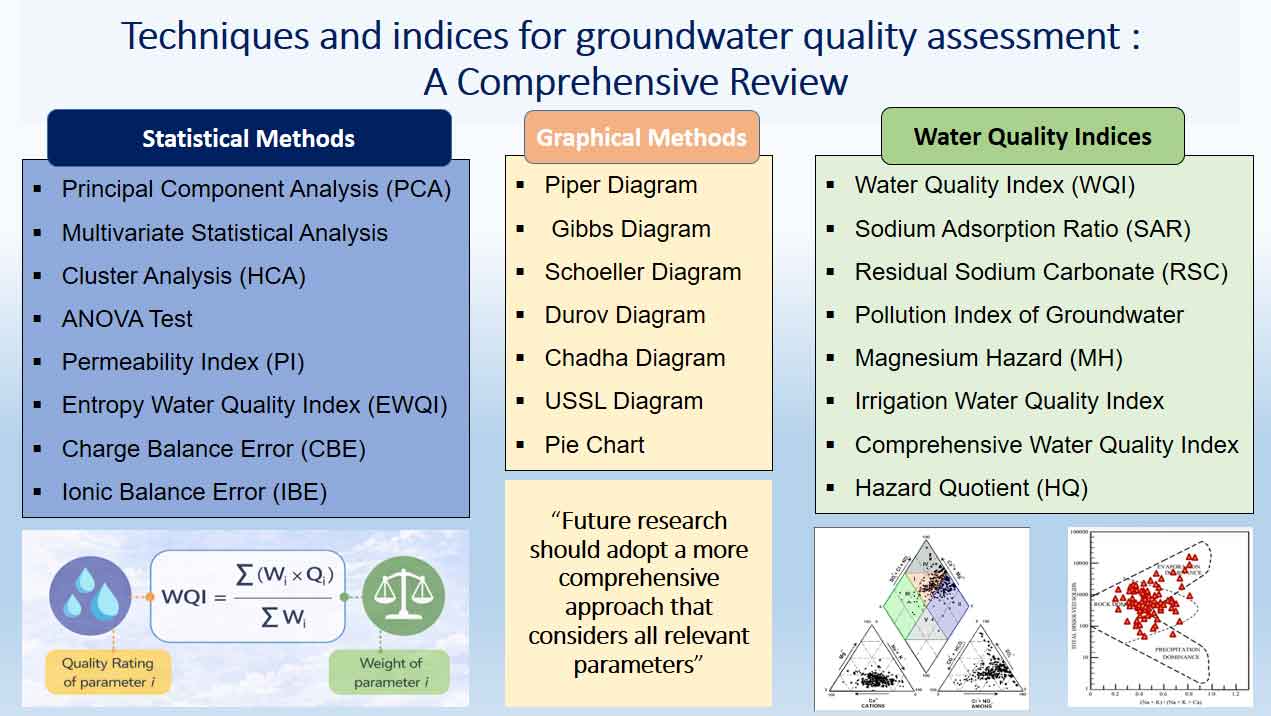
The review covers 45 studies on groundwater quality for drinking and irrigation.
The WQI is the main technique for water quality assessment.
Diagrams and irrigation indices help classify water and assess irrigation suitability.
The tools like GIS, PCA, and remote sensing support mapping and source detection.
More work is needed on emerging contaminants and machine-learning methods.
Andezhath, S. K., Susheela, A. K. and Ghosh, G., 1999. Fluorosis management in India: The impact due to networking between health and rural drinking water supply agencies. IAHS-AISH Publication, 260, 159-165.
APHA [American Public Health Association] 1995. Standard methods for the examination of water and wastewater. 19th edition. American Public Health Association Inc., New York, 1193.
BIS [Bureau of Indian Standards], 2003. Indian standard drinking water specifications (IS 10500:1991). Bureau of Indian Standards.
Doneen, L. D., 1964. Notes on water quality in agriculture. Department of Water Science and Engineering, University of California.
Kelly, W. P., 1951. Alkali soils-Their formation, properties and reclamation. Reinhold Publishing Corporation.
Paliwal, K. V., 1972. Irrigation with saline water (IARI Monograph No. 2). Indian Agricultural Research Institute, New Delhi.
Ramesh, K. and Elango, L., 2012. Groundwater quality assessment in and around a landfill site in Alappakkam, Tamil Nadu, India. Journal of Earth System Science, 121(3), 671-683.
Richards, L. A., 1954. Diagnosis and improvement of saline and alkali soils (USDA Handbook No. 78). U.S. Department of Agriculture.
Schoeller, H., 1956. Geochimie des eaux souterraines: application aux eaux des gisements de petrole. Inst. Français duPétrole,Paris
Singh, S. K., Srivastava, P. K., Singh, D., Han, D., Gautam, S. K. and Pandey, A. C., 2015. Modeling groundwater quality over a humid subtropical region using numerical indices, earth observation datasets, and X-ray diffraction technique: a case study of Allahabad district, India. Environmental geochemistry and health, 37(1), 157-180.
Subba Rao, N., Sunitha, B., Adimalla, N. and Chaudhary, M., 2020. Quality criteria for groundwater use from a rural part of Wanaparthy District, Telangana State, India, through ionic spatial distribution (ISD), entropy water quality index (EWQI) and principal component analysis (PCA). Environmental Geochemistry and Health, 42(2), 579-599.
Tiwari, A. K., Singh, A. K., Singh, A. K. and Singh, M. P., 2017. Hydrogeochemical analysis and evaluation of surface water quality of Pratapgarh district, Uttar Pradesh, India. Applied Water Science, 7(4), 1609-1623.
Todd, D. K. and Mays, L. W., 2005. Groundwater Hydrology (Ed. 3). Wiley.
Vasanthavigar, M., Srinivasamoorthy, K., Vijayaragavan, K., Ganthi, R., Chidambaram, S., Anandhan, P., Manivannan, R. and Vasudevan, S., 2010. Application of water quality index for groundwater quality assessment: Thirumanimuttar sub-basin, Tamil Nadu, India. Environmental Monitoring and Assessment, 171(1-4), 595-609.
Wagh, V. M., Panaskar, D. B., Varade, A. M., Mukate, S. V., Gaikwad, S. K., Pawar, R. S., Muley, A. A. and Aamalawar, M. L., 2016. Major ion chemistry and quality assessment of the groundwater resources of Nanded tehsil, a part of southeast Deccan Volcanic Province, Maharashtra, India. Environmental Earth Sciences, 75(21), 1418.
WHO [World Health Organization], 1997. Guidelines for drinking-water quality, 1, 1-4. World Health Organization.
Wilcox, L. V., 1955. Classification and use of irrigation waters (USDA Circular 969). U.S. Department of Agriculture.
Wu, J., Li, P., Qian, H., Duan, Z. and Zhang, X., 2013. Using correlation and multivariate statistical analysis to identify hydrogeochemical processes affecting the major ion chemistry of waters: A case study in Laoheba phosphorite mine in Sichuan, China. Arabian Journal of Geosciences, 7, 3973-3982.