
Feminist Research Volume 10 (2026), Issue 1 · pp. 10-17
Original Research Paper Open Access

From Advocacy to Reform: Women’s Organizations and the Struggle Against Gender-Based Violence in Morocco

- Université Moulay Ismail de Meknes, Meknes, Fès-Meknès, Morocco.
- Sidi Mohamed Ben Abdellah University, Fes, Fes-Meknes, Morocco.
* Corresponding author: Mohammed Yachoulti, yachoulti.mohammed@yahoo.com
Contents
- Highlights
- Abstract
- 1. Introduction
- 2. Notes On The Rise Of Women’s Organizations Fighting Against Violence In Morocco
- 3. Methodology
-
4. Women’s Organizations Struggle To Criminalize Gender-Based Violence
- 4.1 Tabet affaire: On the way for ratification of CEDAW
- 4.2 The experience of ‘Centres d’Écoute’ (Hearing Centers)
- 4.3 Women’s mobilizations and the transformation of CEDAW commitments in Morocco
- 4.4 From advocacy to reform: The amendment of the penal code
- 4.5 Renewed outrage and digital mobilization: The Road to Law 103–13
- 5. Concluding Remarks
- 6. Notes
- Conflict of interest
- Acknowledgements
- Abbreviations
- Article information
- References
Highlights
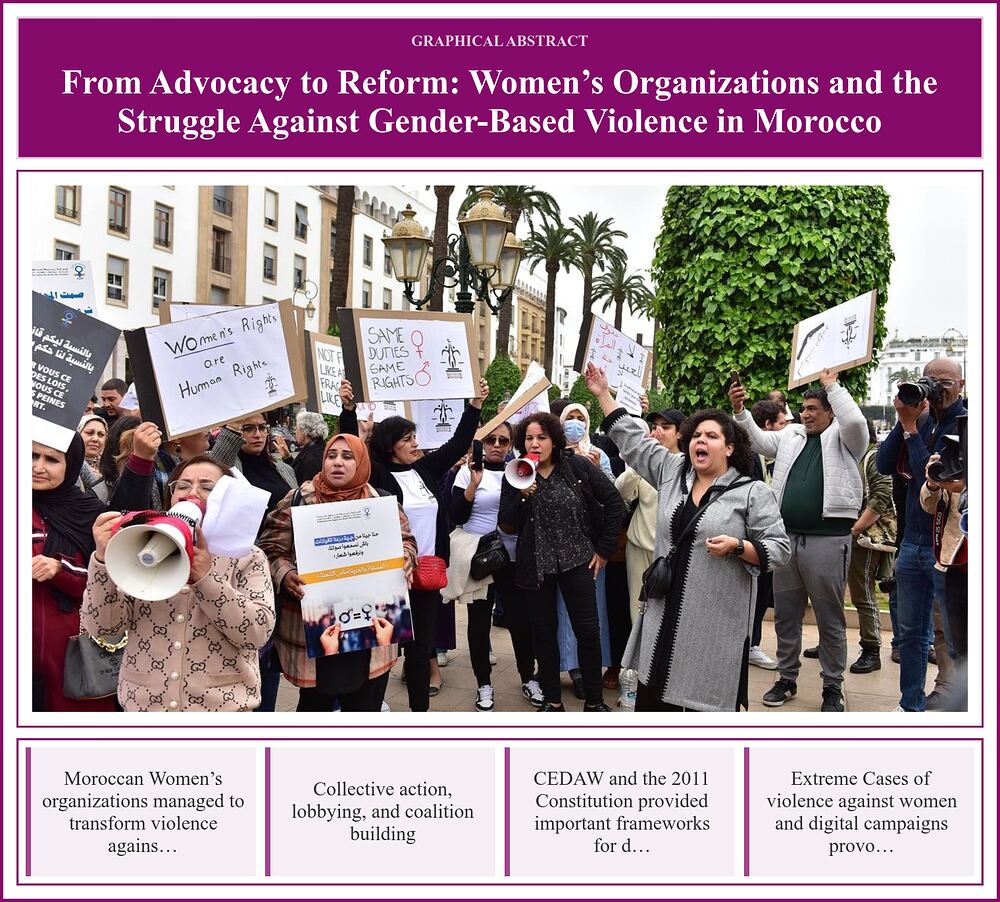
- Moroccan Women’s organizations managed to transform violence against women from a taboo issue into a public and political issue.
- Collective action, lobbying, and coalition building are central to achieving legal reforms.
- CEDAW and the 2011 Constitution provided important frameworks for demanding equality and state accountability.
- Extreme Cases of violence against women and digital campaigns provoked and strengthened public awareness and mobilization.
- The major challenge for women’s organization in Morocco today is ensuring that legal reforms translate into effective protection, justice, and equality for women.
Abstract
This paper traces the role of Moroccan women’s organizations in combating violence against women. To achieve this, the paper makes use of the different cases and milestones that have been used by women’s organizations to pressure, lobby and network to criminalize all forms of violence against women in Morocco. The paper is part of a larger research project on the women’s movement in Morocco. The project started in 2006 and is still ongoing. The fieldwork consists of frequent visits to the organizations that make up the movement, interviews with their leadership and analysis of the different documents and reports produced by these bodies. Tracking the mobilizations of women’s organizations helps in understanding the broader discussion on the activism led by women’s organizations and the different changes and types of reforms they achieve.
Keywords MoroccoWomen’s OrganizationsViolenceGenderWomen's Movement
1. Introduction
UNGA (1993) defines violence against women as any act of gender-based violence that results in physical, sexual, or psychological harm. Such violence takes many forms including physical, sexual, or emotional, and may be perpetrated by a husband, a partner, a family member, or another male individual (UNGA, 1993). It also encompasses sexual harassment and abuse by authority figures such as employers, the police, teachers, etc. (UNGA, 1993). Additionally, traditional practices like child marriages and “honor killings” are considered as violence against women (UNGA, 1993).
In Morocco, the issue of violence against women has always been a taboo issue. That is to say, though women have been victims of all types of violence, they have always made it a family affair, a fact which made the task of fighting or criminalizing the phenomenon a difficult task. However, the constant and growing changes in the economic structures and the rapid urbanization triggered by globalization have all created deep and massive changes in the social structures and lifestyle of the Moroccan family in general and in relations between men and women in particular. Indeed, women’s massive access to education, improvement in health care, growing participation in the labor force, growing interaction with the regional and international partners through their own created organizations are all factors that have contributed to the rise and development of women’s organizations in general and those fighting violence against women in particular.
Accordingly, the bulk concern of this paper is to track the role of Moroccan women’s organizations in fighting violence against women. The focus is on the different cases and milestones that have been used by women’s organizations to pressure, lobby and network to criminalize all forms of violence against women in Morocco. By doing so, the paper will help in understanding the broader discussion on the activism led by women’s organizations and the different changes and reforms they achieve.
In addition to the introduction and concluding remarks, the article is made up of two main sections. The first briefly tracks the rise of women’s organizations fighting against violence in Morocco. The objective is to highlight the different contexts that shaped their development and mobilizations. The second section is divided into subsections that report on the different milestones of women’s organizations’ mobilizations to criminalize gender-based violence. These milestones are chronologically organized following the results of the fieldwork that tracks the mobilizations of women’s organizations across different occasions.
2. Notes On The Rise Of Women’s Organizations Fighting Against Violence In Morocco
The first Moroccan women’s organization to be established was Axawatu al- Safae (Sisters of purity) in 1944 within the Parti Democratique et d’Independence (Democratic Independence Party). At its first congress held on May 23rd, 1947 in Fez, the key challenges were to fight ignorance and illiteracy among Moroccan women, give material and moral support to indigent women who wanted education and exchange useful and valuable information in order to benefit from one another’s experience. The issue of violence was not mentioned or referred to in Axawatu al- Safae congress, which may be attributed to three facts: 1) Taboo nature of the issue, 2) The simplicity of the Moroccan society, 3) The existence of other priorities like the education of girls and the fight against French colonialism.
However, despite the simplicity of the Moroccan society at the time, not to mention the fact that the gender division of space was asymmetrical1, Moroccan women took the opportunity of the national struggle for independence to join the armed resistance in significant numbers, taking on active and militant roles in the fight against colonization; they carried out important tasks that supported the operations of male fighters. Accordingly, Baker (1998) writes that the “mission for resistance not only brought them [Moroccan women] out of seclusion, but sent them into dangerous situations, traveling long distances by themselves carrying weapons and even setting bombs all the way using their wits to escape” (p.8). Indeed, the struggle of Moroccan women did not only target the colonial occupation and oppression but also the restrictive attitude of traditional Moroccan society (Yachoulti, 2015).
Interestingly, despite the active role of women in decolonizing the country, Moroccan women discovered after independence that little had changed – either in society at large or in relation to their status in particular. They found themselves abandoned with no influential actor willing to speak for them and defend their issues. Indeed, several factors converged during that period to restrict women from engaging and contributing to public life, especially at the political level. These included a high rate of illiteracy, lack of interest, and the heavy burden of domestic chores. Additionally, this marginalization was exacerbated by the total absence of women leadership in the political parties and official government institutions – spaces which could have advanced women’s status (Yachoulti, 2015).
By the 1960s and 1970s, during what is commonly referred to in Morocco as the ‘Years of Lead’2, the political atmosphere severely undermined the vibrancy and effectiveness of active civil society groups including those led by women. It was not until the mid-1980s that women were able to take advantage of the shifting political landscape to establish a set of women’s organizations as part of the emerging civil society. These organizations have proliferated in different domains and targeted different women’s issues such as education, empowerment and political participation. In this paper, however, the focus is only on women’s organizations whose main focus is gender-based violence. The objective is to track their active role in criminalizing all forms of violence against Moroccan women.
In 1985, L’Association Démocratique des Femmes du Maroc (ADFM) (Democratic Association of Moroccan Women) was created with the purpose of supporting and advocating reforms that promote women’s social, economic, political, cultural and civic rights in compliance with local laws and international human rights agreements. The vision of ADFM is to achieve gender equality and contribute to strengthening democracy and sustainable development in a climate of justice. Given its strategic visions, ADFM, as will be seen later, makes fighting gender-based violence one of its priorities.
In the same year, Association Solidarité Feminine (Feminine Solidarity Association) was created by Aicha Chenna in Casablanca. The organization aims to help single mothers stay with their children and be able to be part of society by helping them benefit from recruitment programs, taking care of and reintegrating them in society, providing them with both psychological and juridical support and providing them with internships that would enable them to have access to the job market. Despite its critics, this association has massively contributed to resisting the societal violence against the category of single mothers, especially when marginalizing and stigmatizing them.
In 1987, Union de L’Action Feminine - (UAF) (The Union of Feminine Action) was founded with the purpose of promoting the situation of women at the social and legal level, and eliminating all forms of discrimination against them. Also, UAF was created with the objective of providing assistance to women victims of violence, campaigning for reform and offering training workshops and conferences for women’s literacy.
In 1995, a center of battered women emerged in Casablanca under the name of “Association Marocaine de Lutte Contre la Violence a L’Egard des Femmes” (Moroccan Association for Resisting Violence against Women). It was set up to support women victims of violence by providing them with competencies to resist all forms of violence and discrimination against women and sensitize people to the danger of violence against women as a handicap for development.
In short, sketching the rise and development of Moroccan women’s organizations shows a shift toward a more organized and rights-based activism geared towards fighting all forms of gender-based violence. It also shows that combating gender-based violence in Morocco is rooted in decades of grassroots activism and gradual change of society’s attitudes toward women’s rights. Accordingly, the questions that the paper is addressing are as follows: How have women’s organizations in Morocco contributed to criminalizing violence against women? And what strategies have they made use of to pressure the state into legal reforms?
3. Methodology
This paper is part of a larger research project on the women’s movement in Morocco. The fieldwork started in 2006 as part of the doctoral research of the first author. The methodology consisted of qualitative fieldwork based on visits to women’s organizations, semi-structured interviews, participant observation, and document analysis. The fieldwork was conducted at different phases. The purpose is to capture the dynamics of women’s organizations and their reactions to different changes occurring in Morocco.
3.1 Fieldwork and Selection of Organizations
The initial fieldwork began with frequent visits to Moroccan women’s organizations, based on a preliminary list compiled by Espace Associatif, an NGO working for the promotion of the Moroccan associative movement, in Rabat. Women’s organizations were chosen based on their diversity and their commitment to advocacy and gender-related issues. Data were collected through visits to more than 30 women’s associations in Rabat, Temara, Casablanca, Fez, and Meknes, where most organizations are located. These visits provided valuable opportunities to gain direct insight into the structures, operations, activities, and organizational environments of these associations. Most importantly, the visits enabled close interaction with organizational leaders and founding members and provided an opportunity to observe their everyday practices and strategies.
Data collection techniques also included semi-structured interviews, participant observation, and document analysis. The interviews, conducted mostly in Arabic, revolved around the reasons for establishing the organizations, their organizational structures and operations, sources of funding, work and networking strategies, and the challenges they encountered. Document analysis involved reviewing reports, statistical data, brochures, campaign materials, and other documents provided by the organizations.
3.2 The 2011 Fieldwork and the Arab Spring
In 2011, the collection of data coincided with the first sparks of the Arab Spring in Morocco. This period is considered as a second phase of the fieldwork because it gave us the chance to see how women activists reacted to and seized the changing political landscape to push for more gender reforms. As Moroccan women activists did not miss the momentum to voice their concerns and advocate for changes in their status, the research followed their activities both on the ground and through the media.
At this phase, 28 semi-structured interviews were conducted with women activists from established women’s organizations and with members of the new generation of women activists involved in the February 20 Movement. These interviews were conducted in Rabat, Casablanca, and Fez and aimed to explore the role of Moroccan women activists in the Arab Spring, their perceived gains and challenges, and their experiences of political participation during this period. The interviews also captured the reflections of these activists on gender-related reforms introduced in the aftermath of the Arab Spring in Morocco. Campaign materials, press releases, and communiqués from local and national women’s organizations were also consulted.
3.3 Data Analysis and Ongoing Fieldwork
The interview and documentary materials were analysed thematically, with the findings traced and discussed chronologically to reflect the different stages of the fieldwork and the changes in the socio-political environment in Morocco.
The interviews captured the reflections of these activists on the various gender-related reforms in the aftermath of the Arab Spring in Morocco. Campaign materials, press releases, and communiqués from local and national women’s organizations have also been consulted.
The fieldwork is still ongoing. Conferences and meetings organized by women’s organizations to endorse gender issues and women’s rights are regularly attended. These encounters usually provide opportunities to engage with key figures in the field of women’s rights activism in Morocco and abroad. The discussions and observations generated through these encounters continue to inform and contribute significantly to the development of this research project.
4. Women’s Organizations Struggle To Criminalize Gender-Based Violence
Tracing the role of Moroccan women’s organizations in fighting violence against women has revealed the existence of different cases and milestones that have been used by women’s organizations to pressure, lobby and network to criminalize all forms of violence against women in Morocco. These cases are discussed here following the chronology of their occurrence.
4.1 Tabet affaire: On the way for ratification of CEDAW
The first case in which women’s organizations got officially involved in the issue of gender-based violence was in March 1993 when the UAF formed ‘le Comité de lutte contre la violence à l’égard des femmes’ (the Committee to Fight Violence against Women). This happened in connection with the trial of Tabet, a security officer who was involved in 500 rape cases in 1992–1993 over the course of thirteen years. This story raised the questions of power abuse in society and stimulated women’s organizations to pressure the government to ratify the Convention on the Elimination of all Forms of Discrimination against Women (CEDAW) in 1993. However, given the political sensitivity of the incident, women’s movement organizations were denied an official permit for a protest rally and thus were precluded from a form of mobilization similar to that of Moudawana (Family Code) campaign. Despite these obstacles, UAF started organizing symbolic trials that represented different forms of violence against women. The first trial addressed divorce as a social violence and was held in Rabat in 1996. Four subsequent trials followed, all conducted in public venues and consistently held in March. The second trial focused on marital violence, while the third addressed material home and family property after divorce. The fourth trial dealt with alimony, custody and the welfare of children (Ghazali, 2001).
Like any official court trial, the four UAF trials involved testimony from witnesses, defense team and a jury. Also, soon after being denied an official protest rally, the majority of women’s sections of the major political parties and other women’s organizations started to publish ‘a joint communiqué’. This ‘communiqué’ “argued that the Thabit affair was simply one manifestations of administrative corruption” (Brand,1998, p.79). It also “insisted that the attempt to portray this as an isolated individual matter obscured the fact that this is an abuse of power and influence” (Brand,1998, p.79). Finally, it “called sexual violence one of the ugliest forms of violence against women and their dignity” (Brand,1998, p.79).
Indeed, this incident of Thabit opened the door to all women’s organizations to demand investigations into all cases of economic and political corruption as well as cases of human rights violations and torture. In this context, a number of women’s organizations seized the momentum created by the international campaign against violence toward women to submit a memorandum to the government. The document invoked human rights declarations, the Moroccan constitution, as well as the United Nations Convention on the Elimination of All forms of Discrimination against Women. Also, in this memorandum, women’s rights groups asked for greater attention to violence, namely domestic one and sexual harassment, by taking them as crimes and serious issues instead of looking at them as just private or family concerns. To give their campaign a multi-layered dimension, ADFM, an active organization and one of the signatories of the memorandum, published a study on the Moroccan Penal Code in which it concluded that “fifteen provisions in the Penal Code and the Code of Criminal Procedures discriminated against women” (Buskens, 2003, p.109). Thus, it strongly “asked for the abolition of article 814 of the Penal Code, which allows the possibility of mitigating the punishment of the husband who has assaults, batters, or even murders his wife after catching her in an act of adultery” (Buskens, 2003, p.109).
However, it took a long time for the Moroccan government to announce its intention to criminalise violence against women. In 2008, a new initiative was launched aiming to deal with this phenomenon. This initiative includes setting up shelters for battered women and revising the penal code. A bill is now being prepared to outlaw violence against women. However, it still faces many obstacles, among which the difficulty to provide a precise definition of domestic violence or violence against women and the lack if not the absence of specialist judges and staff experienced in the field (field of social action). In a word, this incident of Tabet opened the door to all women’s organizations to start asking for greater attention to violence, namely domestic one and sexual harassment, by taking them as crimes and serious issues instead of looking at them as just private or family concerns.
4.2 The experience of ‘Centres d’Écoute’ (Hearing Centers)
Women’s organizations host and operate ‘Centers d’Ecoutes’ that offer psychological, medical and legal support. To enhance the effectiveness of these bodies more, “Le Resou National des Centers d’Ecoutes des Femmes Victims de violence ’‘Anarouz’” (The National Network of Hearing Centers for Women Victims of Violence ‘Anarouz’) was created on April 24th, 2004. This network, which is made up of nineteen feminine ‘Center d’Ecoutes’ scattered all over the main cities of Morocco with the aim of creating and developing judicial centers to fight violence against women all over Morocco, reinforcing the capacities of judicial centers in areas of fighting violence against women, unifying the efforts of the existing centers to collect, register and analyze the data of violence cases based on sex discrimination, reinforcing cooperation and exchange information between all ‘Centers d’Ecoutes’, facilitating action of associations to fight all forms of violence against women, sensitizing the decision-makers and public opinion to the question of violence against women and allowing more access to the data that concerns violence against women.
Without these hearing centers, many disadvantaged women victims of different forms of violence would not have known how to start the procedures of suing perpetrators. These centers – since their creation – have been providing the psychological support to all categories of women victims of violence.
4.3 Women’s mobilizations and the transformation of CEDAW commitments in Morocco
Morocco ratified the Convention on the Elimination of All forms of Discrimination Against Women in 1993; however, it has never published it in the official bulletin (aljarida arrasmiya). This fact prompted women’s organizations to ask for its publication and lift all the reservations the government claimed to undermine Islamic teachings or shariaa3. As a result, the Moroccan government represented by Ahmed Snoussi, found itself under investigation by experts on the CEDAW monitoring committee. These latter considered the reservations to be against the essence of the convention. To justify and defend the reservations of his government, Ahmed Snoussi “referred to Islam, morality and culture, and to fear of Islamist reactions” (Buskens, 2003, p. 110). Consequently, “the committee called on the government of Morocco to set a standard in developing a more liberal interpretation of Islamic law, mentioning the prestige that the king of Morocco enjoys in the Muslim world” (Buskens, 2003, p. 110). Accordingly, women’s organizations continued their struggle to push the government to lift all the reservations basing their demands on the universal declarations of human rights and the Moroccan constitution. By the end of 2000, Mohammed VI promulgated the convention by a royal decree. However, women’s organizations continued their activism because of the reservations that persisted.
Following the landmark reforms that have taken place in 2003 (Family code reform), Morocco has taken the long-awaited move towards withdrawing its reservations regarding CEDAW. On December 10, 2008, on the occasion of the 60th anniversary of the Universal Declaration of Human Rights, the King of Morocco sent a letter to the Moroccan Consultative Council of Human Rights (CCDH) announcing Morocco’s decision to lift all reservations to CEDAW. These reservations concerned the articles 2, 9, (2), 15 (4), 16 and 29. They deal with legal and constitutional equality between men and women, equality within the family, the right to pass on their nationality to their foreign-born husband and children and women’s rights to freedom of movement. Despite the fact that Moroccan women’s movement organizations hailed this step, they later launched a media campaign criticizing what it called the ambiguous position towards the CEDAW. This critique was made public because no official step has been taken by the government concerning the operational measures to implement this declaration and the Secretary General of the United Nations, in his capacity as the depository of CEDAW, has not received an official document to this effect. Today, women’s advocacy groups have authority, under the national constitution, to invoke all CEDAW’s provisions as a legal basis to hold the government accountable for advancing women’s full equality.
With the first sparks of the Arab Spring, twenty-eight women’s organizations came together to form ‘Le Printemps féministe pour l’égalité et la démocratie’ (the Feminist Spring for Equality and Democracy) on March 16th, 2011 in Rabat. The coalition mobilized at national and regional levels. Nationally, it focused on the constitutionalisation of equality between men and women across civil, political, economic, social and cultural rights. Regionally, the coalition worked to unite women of the MENA (Middle East and North Africa) region in their struggle against dictatorship, inequality, and marginalization. This mobilization was crowned with the creation of the coalition of women’s movement organizations in the MENA region named “Equality Without Reservation”. Bringing together around 600 Arab women’s rights and human rights organizations from several Arab states, the coalition called for the removal of all reservations to CEDAW and for the ratification of its Optional Protocol (ADFM, 2011).
In parallel, the coalition invited representatives from civil society, women’s rights organizations, the public sector, international organizations including UN Women, and the diplomatic corps from Egypt, Lebanon, Morocco, Syria, and Tunisia, to meet in Rabat in May 2011 for two days (ADFM, 2011). The meeting aimed at assessing regional transformations and strategizing for the future in the wake of the Arab Spring transitions, particularly to ensure that the constitutional reforms clearly protect equality between women and men in both the private and the public spheres. It also sought to ensure women’s legitimacy in politics and public affairs, and promote mechanisms to effectively implement gender-equality provisions (WLPLC, 2011). Surprisingly enough, during the conference, Nouzha Skalli, the then minister of Social Development, Family and Solidarity, made a landmark announcement that the Moroccan government was preparing to officially ratify CEDAW and its Optional Protocol. This milestone was officially implemented on April 18th, 2011 (Yachoulti, 2015). This fact opened the doors widely for women’s rights advocates to use CEDAW’s provisions as a legal authority to hold the government accountable to its commitment to move toward gender equality (IWDN, 2011)
Further, the 2011 constitution contains a set of provisions that are radical in their content. For instance, Article 19 makes both men and women enjoy equal rights before the law and creates ‘L’ Autorité pour l’égalité et la lutte contre toutes les formes de discrimination’ (the Authority for Equality and the Fight Against all Forms of Discrimination). This institution is tasked with the duty of achieving equality between men and women. Article 21 explicitly bans sexism as a form of violence against women and Article 175 stipulates that these rights and freedoms cannot be withdrawn in future constitutional revisions.
4.4 From advocacy to reform: The amendment of the penal code
In the absence of comprehensive laws addressing gender violence – including domestic violence and sexual assault in Morocco – women’s organizations launched ‘Printemps de la dignité’ (Spring of dignity) campaign. This initiative was a reaction to the tragic case of Amina Filali, a 16-year-old rape victim, who took her own life in 2012 after being forced to marry her rapist. Her death galvanised women’s rights activists across the country not only to expose the lack of laws that protect victims of all forms of violence, but also to remind policy makers of the total failure of the law to effectively implement the Moudawana (Family Code).
Leading women’s organizations such as UAF and ADFM played a pivotal role in this national mobilization. They collectively called for legislation that would support women who had been sexually assaulted and ensured the prosecution of the perpetrators. The mobilizations, which took the form of demonstrations, sit-ins, press conferences and media campaigns, served both to raise citizens’ social awareness of gender violence and lobby for legislative reforms.
The international network ‘Equality Now’ joined the coalition of Spring of Dignity in calling on the Moroccan government to change the Penal Code to better safeguard women’s rights. On December 8, 2012, the coalition organized a symbolic human chain stretching from the headquarters of the Ministry of Justice in Rabat to the House of Representatives to draw the attention to the urgency of legal reforms. In March, 2014, growing frustration with the Islamist-led government’s reluctance to enforce constitutional guarantees of equality led to the creation of ‘Coalition civile pour l’application de l’Article 19’ (Civil Coalition for the Application of Article 19), which gathered approximately 500 organizations. Article 19 of the constitution affirms that “men and women have equal civil, political, economic, social, cultural and environmental rights and freedoms”, and obliges the state to work towards the establishment of gender parity. However, women activists maintain that these obligations remain symbolically unimplemented, existing more on paper than as a concrete policy.
Following the same strategy of mobilization and lobbying, approximately 800 women marched from the center of Rabat to the parliament on April 13, 2014, calling for a “comprehensive review of all discriminatory laws,” “women’s safety in public places,” and “equality as a right, not a privilege” (Badri et al., 2014). In addition to these street mobilizations, the coalition amplified its advocacy through media, publishing articles in newspapers, blogs, forums, and pages such as Webzine, which detailed feminists. These publications expressed feminists’ deep frustration with the government’s silence. The case also gained international visibility and on March 17th, a Twitter account dedicated to Amina’s memory was opened (@RipAmina)” (Sadiqi, 2015). Even more, a petition on the international activism site Avaaz gathered more than 50,000 signatures. As a result, the government finally acknowledged the rape of Amina and Article 475 was amended to the effect that a rapist can no longer escape punishment by marrying his victim and faces a 30-year term of imprisonment (Sadiqi, 2015). However, despite the fact that Law 103–13 was considered as an important step in the legal protection of women, many Moroccan feminist organizations have highlighted significant gaps in the legislation. They have criticised namely the failure of the new law to clearly criminalize marital rape, the dependence of protection measures on a victim-initiated complaint, insufficient duties imposed on police and prosecutors, the possibility of cancelling protection measures following reconciliation, and flaws in institutional support and implementation.
4.5 Renewed outrage and digital mobilization: The Road to Law 103–13
In August 2017, a video showing the sexual assault on a woman on a bus in Casablanca went viral on social media in Morocco. The video documents a group of six teenage boys, laughing and at the same time molesting and tearing the clothes off a 24-year-old woman with learning disabilities. Sadly enough, though the victim was seen in tears, and hysterically crying, neither passengers nor the bus driver intervened. In fact, this incident shows the general attitude of indifference of Moroccans to sexual harassment and violence in public places. Similarly, in 2018, 17-year-old Khadija was kidnapped from a village in ‘Beni Mellah Region’ (Central Morocco) and held captive for more than two months by a group of a dozen men who took turns in raping and torturing her. The pictures on Moroccan official channels showed her body tattooed and burnt with cigarettes. Khadija’s case could be looked at as an example of the tremendous forms of gender violence experienced occasionally by females in Morocco, and how nowadays social media helps in exposing such cases and bringing them into public discussion.
Following Khadija’s video and pictures, the #masaktach movement (I will not keep silent) appeared. It started with #MeToo hashtag as a way to break the silence surrounding the issue of rape in Morocco. Indeed, Khadija’s case could be put in the context of how worldwide movements such as #MeToo were adopted and adapted in the Moroccan context to enable women to speak out on the issue of sexual violence in Morocco. The case served as a flame that outraged several women activists to join the movement as a way to show solidarity with other Moroccan women who were subject to male sexual violence and encourage them to be vocal about their experiences of abuse. This shows how solidarity and collective action helped transform individual experiences of violence into a broader feminist movement. Because the trial of the perpetrators was postponed several times, a petition with more than 100,000 signatures was sent to the King Mohammed VI, asking for justice for Khadija and assurance of women’s rights and safety in Morocco. Indeed, Khadija’s case may be grouped with other issues like accountability, access to justice, and the connection between collective activism and decision-making in Morocco.
Accordingly, after years of women’s organizations lobbying and networking, the Law 103–13 criminalizing all forms of gender-based discrimination was released on September 12, 2018. This law could be considered not only as a direct response to the #masaktach movement but also as a result of women’s organizations’ long history of advocacy. The law includes many progressive procedures such as defining violence against women, increasing penalties for some forms of violence in the penal code when committed within the family, establishing new crimes including forced marriage. It also criminalizes both sexual harassment in public spaces and cyber harassment and obliges public authorities to take preventive measures, including awareness raising programs on gender-based violence.
5. Concluding Remarks
Gender-based violence is a global phenomenon, driven by a multitude of factors that most of the time include women’s disempowerment, economic disparities and patriarchal cultural systems. In Morocco, the development of Moroccan women’s activism to combat this phenomenon has revealed how continuous advocacy, mobilization, and synergy can transform the picture through instigating and triggering real social and legal changes and reforms. From the symbolic trials of Tabet to the cases of Amina Filali and Khadija, women’s organizations managed to enrich their advocacy repertoire, influence the legislative reforms and process, provide institutional support for victims and hold the government accountable.
In simple terms, women’s organizations have pressured the government to ratify CEDAW, reform the Family Code, amend the Penal Code, and enact Law 103–13 against gender-based violence. Also, the women’s effective use of social media and digital platforms (#Masaktach) has proven that digital activism has become in its turn a decisive strategy for raising awareness, lobbying the government and complementing and reinforcing traditional advocacy methods. All these changes and achievements are very significant in terms of future action, especially when asking for more reforms and advocacy for women victims of violence. The articles of the new constitution and the amended penal code will open Moroccan women the doors widely for further legitimate action. They would be used as an unprecedented official framework for women’s organizations to hold the government accountable to the new constitution and its mechanisms in their future mobilizations.
Finally, with these achievements, Moroccan women’s organizations have not only gained experience but have also shown maturity in dealing with emerging cases and have thus managed to impose themselves as undeniable political actors and partners in the Moroccan political sphere. Now, the endeavours of these organizations are to cause more fissures in the existing social taboos and gender norms, ensure the equal implementation of the amended laws, convince the state to strengthen the capacities of the judicial system for a better, equal and flexible enactment of the gender-based reforms.
6. Notes
- Women’s interaction with the other sex was usually within the home and was restricted only to family relatives; any contact with men outside was considered inappropriate gender behavior. Furthermore, men have more space at their disposal than women do. Besides, it is easier for men to cross the boundaries of male and female domains than vice versa. Women’s space is separated and marked by distinctive gender practices.
- The term is used by opponents of the former King Hassan II to describe a period of his rule, namely from the 1960s to the beginning of the 1980s. This era was marked by state violence against dissidents and democracy activists.
- The Moroccan government declared that article 15 section 4 of CEDAW does not fit in the Moroccan context as it undermines women’s duty or obligation to obey her husband as mentioned in articles 34 & 36 of the family code.
Conflict of interest
The authors declare no conflict of interest.
Acknowledgements
The authors thank the reviewers for their valuable comments and constructive suggestions, which helped improve the quality of this manuscript.
Abbreviations
ADFM: L’Association Démocratique des Femmes du Maroc; CCDH: Consultative Council of Human Rights; CEDAW: Convention on the Elimination of all Forms of Discrimination against Women; MENA: Middle East and North Africa; UAF: Union de l’Action Féminine.
Article information
- Received
- 21 Apr 2026
- Revised
- 9 Oct 2026
- Accepted
- 11 Oct 2026
- Published
- 19 Oct 2026
- Handling editor
- Professor. Fatima Sadiqi
- Licence
- CC BY-NC-ND 4.0
- Journal
- Feminist Research, ISSN 2582-3809
References
-
ADFM [Association Democratiques des Femmes du Maroc], 2011. For a Constitution That Guarantees Effective Equality of Women and Men as an Indicator of Democracy. Memorandum Presented to the Advisory Committee for the Revision of the Constitution. Retrieved Aril, 2012.
-
Badri, M., 2014. Moroccan Women Cling to Article 19 of the Constitution on Gender Equality. Morocco World news. Retrieved from.
-
Baker, A., 1998. Voices of Resistance: Oral Histories of Moroccan Women. New York: State University of New York Press.
-
Brand, L. A., 1998. Women, The State and Political Liberalization: Middle Eastern and North African Experiences. Columbia University Press.
-
Buskens, L., 2003. Recent debates on family law reform in Morocco: Islamic law as politics in an emerging public sphere. Islamic Law and Society, 10(1), 70-131.
Crossref -
Ghazali, I., 2001. “Sculpting the rock of women’s rights: the role of women’s organizations in promoting the national plan of action to integrate women in development in Morocco”. Center on Women and Public Policy Case Study Program. Humphrey Institute of Public Affairs, University of Minnesota. Retrieved may 4, 2005.
-
IWDN [International Women’s Democracy Network] 2011. Women’s Rights and the Arab Spring: Middle East/North Africa Overview and Fact.
-
Sadiqi, F., 2015. “Women’s Organizing in Morocco in Light of a Post-Arab Spring Moment and an Islamist Government”. In Zeina Zaatari & Suad Joseph (Eds), Encyclopedia of Women and Islamic Cultures, Supplement XI: Political-Social Movements: Community-Based. Brill.
-
UNGA [United Nations General Assembly], 1993. “Declaration on the elimination of violence against women” (A/RES/48/104). Retrieved from://www.ohchr.org/en/instruments-mechanisms/instruments/declaration-elimination-violence-against-women.
-
WLPLC [Women’s Learning Partnership and the Leadership Conference], 2011. “Women’s Rights and the Arab Spring Overview on the Middle East and North Africa”. Retrieved April 2012 ( men_&_the_Arab_Spring_Factsheet.pdf).
-
Yachoulti, M., 2015. The feminist movement in the Moroccan spring: Roles, specificity and gains. Sociology Study, 5(12), 895–910.