

Journal of Geographical Studies Volume 2 (2018), Issue 2 · pp. 79-86
2. Technical Paper Open Access

Role of Education in Inter-Caste Marriages of Women from Scheduled Castes in India
- Department of Geography, School of Earth Sciences, Central University of Karnataka, Kalaburgi, India.
* Corresponding author: Ravindra Medhe, ravindramedhe1@gmail.com
Contents
- Highlights
- Abstract
- 1. Introduction
- 2. Data And Methodology
- 3. Results
- 4. Conclusion
- Conflict of interest
- Article information
- References
-
- Table 1. The relationship between education of brides and relatives w…
- Table 2. Inter-caste marriages in SCs (%)
- Table 3. The relationship between education of persons and choice of …
- Table 4. Education and inter-caste marriages
- Table 5. Education and choice of groom
- Table 6. Bride know husband before the marriage (%)
- Table 7. Decision of choice (%)
Highlights
- The study analyses the role of education in decision of inter-caste marriages in Scheduled Castes (SCs) for social cohesion.
- The relationship between education of bride, parents and parents-in-law with number of inter-caste marriages was analysed using India Human Development Survey (2011).
- The study shows no direct and robust relationship between education and inter-caste marriages in SCs.
- Educated brides lead for inter-caste marriages and educated parents support her in this decision.
- Negative relationship was observed for education of parents-in-law with number of inter-caste marriages.
- Educated parents-in-law show no acceptance for inter-caste marriages of their shoots.
Abstract
Scheduled Castes (SC) is a group of deprived castes in India. Traditionally, people belongs to these castes are socio-economically exploited and untouchables. The present study analyses the role of education in decision of inter-caste marriages for social cohesion. The relationship between education of bride, parents and parents-in-law with number of inter-caste marriages was calculated using data compiled by India Human Development Survey (2011). The study shows no direct and robust relationship between education and inter-caste marriages. Educated brides lead for inter-caste marriages and educated parents support in this decision, but negative relationship was observed for education of parents-in-law with number of inter-caste marriages. Educated parents-in-law show no acceptance for inter-caste marriages of their shoots. The freedom of choice to bride show key role in formation of inter-case marriages which shows wide state-to-state variations. Education improves the capabilities of a person to deicide their own. Therefore, we have large scope to create bases for inter-caste marriages and social change through enlightenment and education.
Keywords Scheduled CasteEducationInter-caste MarriageWomen
1. Introduction
The marriage is an essential institution to maintain caste and clan structure of the society in India. This system is fully based on social system and stratification. Generally, marriages in Hindu system perform different families within a socially restricted boundary of castes (Jauregui et al., 2003). Only few marriages cross these strict boundaries of caste, clan, religion, region and tradition. Inter-caste marriages are always denied (Gopalkrishnan et al., 2007; Chauhan, 2008; Bidner et al., 2015) and these families are out-casted in this situations (Köhler-Rollefson, 2017). Small clan and sub-castes are ensuring the traditional maraige rules and denning mobility for maraiges from one social group to another (Hajeeh et al., 2009; Singh, 2017).
North Indians prohibite maraiges within close blood relatives however, South Indian marriages are within close blood relatives with commom practice. The attributes like ‘kin marriage’, ‘village endogamy’, and age of spouses vary by region and gender systems (Agha, 2016).
In 19th century, enormous significance was focussed on civil marriage legislation with contradictory and conflicting ‘personal laws’ (Goli et al., 2013). This vice of awarness is slowly gaining the individual freedom to grils for marriage. However, older generations are still insistsing the old traditional way of marriage for status symbol with bound of emotions.
Indian Governmets, various Non-Govermental Organizations (NGO), some personalities, etc. are promoting inter-caste marriages through incentives and advertizements for youths (Dalmia, 2004). Growing urbanization, education, number of middle- and elite-class society supporting inter-caste marriages. Globalization and Western impact on education and culture in India show visible changes in the traditional marriage practices. Some of the personalities have started to rebel and choose mates outside the caste-, clan-, religion- and tradition- based marriage system. However, reported inter-caste marriages were only 5.82% in 2011 (Ray, 2017).
Boys and girls who preferred inter-caste marriages are threatened with violence, mainly by their own families and leaders even after seventy years of legaliztion of new marriage laws. Thousands of honor killings of young women and men are reported in last few decades from various states of India (Goli et al., 2013). Many families are also victimized for this cause.
Indian marriages are arraigned based on caste with notion of purity and hierarchy of caste. Upper castes believe that the lower castes are impure. The status of scheduled castes is considered comparatively inferior for occupation, education, social hierarchy, cultural, religious and political practices (Chouhan, 2013). Typically, woman from a higher caste marrying a man from a lower caste isn’t supported by own family and society however, the families from lower castes encourage woman to marry with man from upper caste (Self and Grabowski, 2008). Even mythology shows ‘death punishment’ to the lower caste male for marring with upper caste female (Tarikere, 2017).
Inter-caste marriage is an indicator of social cohesion and education play crucial role in formation of inter-caste marriages. Education is powerful tool for upward social mobility, which can help to improve social status of person and family with inclusive society to reduce socio-economic disparities (Chauhan, 2008). Traditionally, people from SCs didn’t have rights of education, prestigious jobs, and dignity. However, after 19th century they have came into mainstrean of education, social, economic and political process. Therefore, present study focuses on the analysis the role of education in the decision process of inter-caste marriages in SC women of India. The present work will be helpful to decide structure and approaches of education for Indian society.
2. Data And Methodology
The study analyses the description performance of education in the decision of marriages in deprived castes of SC category women in India. The information about the education was procured from India Human Development Survey (IHDS) (2011). This is a multi-topic panel survey of 42,152 households in 384 districts, 1420 villages and 1042 urban neighbourhoods across India. Most of these families had interviewed for IHDS-I. Both studies cover all states and union territories of India except Andaman/Nicobar and Lakshadweep. Two one-hour interviews in each household included health, education, employment, economic status, marriage, fertility, gender relations, and social capital. IHDS jointly organised by researchers from the University of Maryland and the National Council of Applied Economic Research (NCAER), New Delhi. IHDS II data has been used eight variables for the analysis, these are women’s education, state-wise distribution of inter-caste marriages, father’s education, mother’s education, mother-in-laws education, and father-in-laws education, how long women knew husband before marriage and who choose groom to respondents. Data collected from 42,152 households, and the un-weighted frequency of received data of eligible women was 39523 included all category women. Data regarding women from SCs has dragged for 8415 sample families.
The analysis uses data from IHDS-II survey of eligible women: a questionnaire addressed at a nationally representative sample of individuals aged 16 to 70 years living in India, of all marital status. The main group of women from SCs was also analysed. Correlation analysis was performed to understand the relationship between the variables.
3. Results
3.1 Distribution of Inter-Caste Marriages in SCs
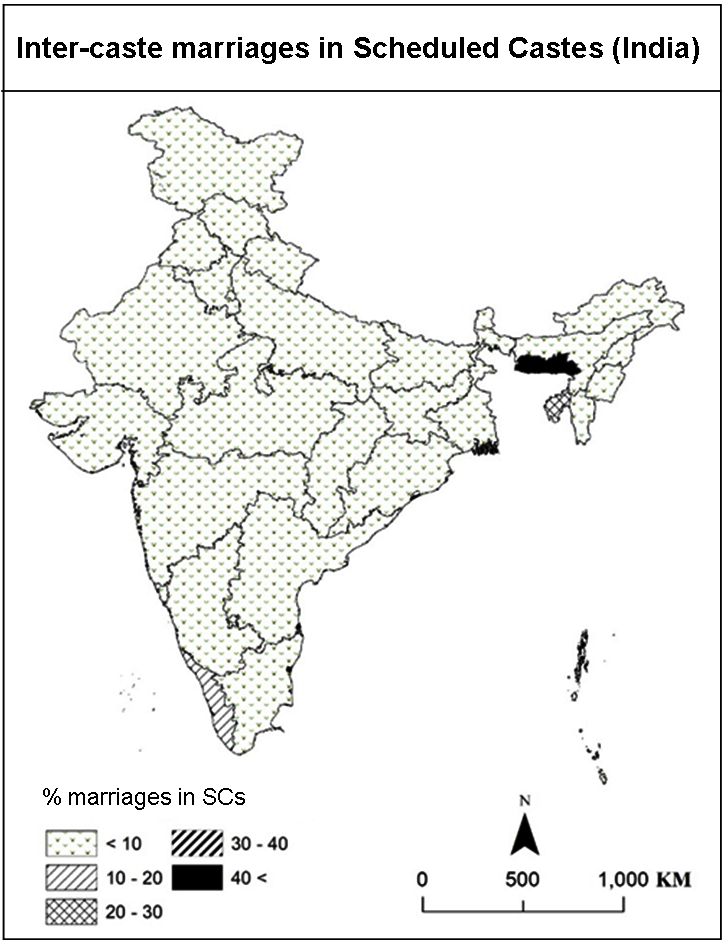
About 4.54% of marriages (state wise average) in SCs were reported inter-caste with wide state wise variations (Table 2). Meghalaya, Dadra Nagar Haveli, Tripura and Kerala are the major union territories and states show the inter-caste marriages as 100, 33.33, 23.47 and 17.29%, respectively. Inter-caste marriages weren’t reported in Chandigarh, Madhya Pradesh, Goa and Pondicherry. Assam is showing 9.61 percent inter-caste marriages though SC population of the state was 7.15%.
Table 1. The relationship between education of brides and relatives with inter-caste marriages
|
Variables |
Correlation |
|
Bride |
0.3177 |
|
Father |
0.0628 |
|
Mother |
0.378 |
|
Father-in-laws |
-0.618 |
|
Mother-in-laws |
-0.3154 |
Table 2. Inter-caste marriages in SCs (%)
|
State |
Marriages |
Population |
|
Jammu and Kashmir |
3.28 |
7.38 |
|
Himachal Pradesh |
0.62 |
25.19 |
|
Punjab |
3.05 |
31.94 |
|
Chandigarh |
0 |
18.86 |
|
Uttarakhand |
4.04 |
18.76 |
|
Haryana |
4.5 |
20.17 |
|
Delhi |
3.41 |
16.75 |
|
Rajasthan |
9.11 |
17.83 |
|
Uttar Pradesh |
2.19 |
20.7 |
|
Bihar |
9.42 |
15.91 |
|
Sikkim |
7.12 |
4.63 |
|
Tripura |
23.47 |
17.83 |
|
Meghalaya |
100 |
0.58 |
|
Assam |
9.61 |
7.15 |
|
West Bengal |
3.63 |
23.51 |
|
Jharkhand |
5.71 |
12.08 |
|
Orissa |
5.02 |
17.13 |
|
Chhattisgarh |
0.38 |
12.82 |
|
Madhya Pradesh |
0 |
15.62 |
|
Gujarat |
6.48 |
6.74 |
|
Dadra Nagar Haveli |
33.33 |
1.8 |
|
Maharashtra |
2.75 |
11.81 |
|
Andhra Pradesh |
4.73 |
16.41 |
|
Karnataka |
4.14 |
17.15 |
|
Goa |
0 |
1.74 |
|
Kerala |
17.29 |
9.1 |
|
Tamil Nadu |
4 |
20.01 |
|
Pondicherry |
0 |
15.73 |
|
Total |
4.54 |
16.63 |
3.2 Education and Inter-Caste Marriage
The relationship of inter-caste marriages with education of married women, bride’s father, her mother, her mother-in-law and her father-in-law was analyzed for find the role of education of intimate relatives in decision of inter-caste marriages. Couples in 0-7% inter-caste marriages have studies up to secondary (12th) level and 13.52% couples learned up to second-year post-secondary (12+2) (Table 3). No inter-case marriage reported for education of boys and girls up to first-year post-secondary (12+1).
Education of bride, her father and mother shows positive significant correlation with number of inter-caste marriages as 31, 6 and 3%, respectively (Table 1). Nevertheless, education of father-in-law and mother-in-law shows negative significant correlation with number of inter-caste marriages.
Table 3. The relationship between education of persons and choice of groom
|
Variables |
Correlation |
|
Bride |
0.538 |
|
Bride and parents / other relatives |
0.615 |
|
Parents / other relatives alone |
-0.8318 |
|
Others |
0.3167 |
Table 4. Education and inter-caste marriages
|
Education |
Married Women (%) |
Father (%) |
Mother (%) |
Fathers-in-law (%) |
Mother-in-law (%) |
|
Illiterate |
4.09 |
4.52 |
4.48 |
4.54 |
4.44 |
|
1st class |
1.01 |
0 |
0 |
4.28 |
0 |
|
2nd class |
5.48 |
5.45 |
6.93 |
1.77 |
9.05 |
|
3rd class |
2.9 |
5.32 |
3.53 |
3.01 |
3.14 |
|
4th class |
4.22 |
1.08 |
2.51 |
5.81 |
3.07 |
|
5th class |
7.33 |
6.32 |
5.02 |
4.79 |
2.04 |
|
6th class |
4.68 |
5.63 |
4.45 |
5.61 |
11.58 |
|
7th class |
3.39 |
4.41 |
6.41 |
5.47 |
10.47 |
|
8th class |
5.22 |
4.37 |
4.47 |
3.75 |
7.65 |
|
9th class |
3.67 |
7.26 |
2.22 |
2.52 |
6.79 |
|
Secondary |
5.08 |
3.69 |
9.98 |
5.91 |
10.64 |
|
11th Class |
4.89 |
0 |
0 |
0 |
0 |
|
Higher Secondary |
4.12 |
2.97 |
8.32 |
2.2 |
5.2 |
|
1 year post-secondary |
0 |
0 |
0 |
0 |
0 |
|
2 years post-secondary |
13.52 |
13.53 |
0 |
0 |
0 |
|
Bachelors |
2.54 |
6.33 |
0 |
2 |
0 |
|
Above Bachelors |
9.33 |
0 |
100 |
0 |
0 |
|
Total |
4.54 |
4.55 |
4.55 |
4.47 |
4.55 |
3.3 Education and Choice of Groom
The decision on choice of groom is crucial in the process of marriage. Parents and other relatives selected 74.65% grooms without concern of the bride. Only 4.75 % grooms had chosen by girls. In the selection of groom by the girl herself, the highest rate (26.92%) is in first-year post-secondary (12+1) (Table 5). The most inter-caste marriages held in second-year post-secondary (12+2) class. The majority of inter-caste marriages happening when girls choose their partner by own. Positive correlation (53%) observed between education and decision on choice of groom. Parents’ education of bride’s parent and choice of the groom is also showing a positive correlation (61%). Very high negative correlation was estimated for inter-caste marriage with education in traditional way of marriage. It is notable that only higher education does not positively correlate with inter-caste marriages. Traditional marriages aren’t allowing daughters for independent decision and give more importance to the caste. However, new generations of educated brides are prefers independent decision of marriage with no essential criteria of caste in the process of selection of life partner.
Table 5. Education and choice of groom
|
Education |
1 |
2 |
3 |
4 |
Total |
|
Illiterate |
2.39 |
16.39 |
81.04 |
0.17 |
100 |
|
1st class |
6.02 |
10.91 |
83.06 |
0 |
100 |
|
2nd class |
4.4 |
15.49 |
80.12 |
0 |
100 |
|
3rd class |
3.02 |
28.54 |
68.44 |
0 |
100 |
|
4th class |
3.35 |
21.26 |
75.03 |
0.36 |
100 |
|
5th class |
6.54 |
17.99 |
75.38 |
0.09 |
100 |
|
6th class |
11.89 |
22.99 |
64.12 |
1 |
100 |
|
7th class |
4.8 |
28.8 |
66.41 |
0 |
100 |
|
8th class |
4.68 |
23.67 |
71.65 |
0 |
100 |
|
9th class |
11.45 |
30.57 |
57.79 |
0.19 |
100 |
|
Secondary |
8.97 |
23.92 |
66.9 |
0.21 |
100 |
|
11th Class |
2.79 |
35.63 |
61.57 |
0 |
100 |
|
Higher Secondary |
4.89 |
30.78 |
63.93 |
0.41 |
100 |
|
1 year post-secondary |
25.92 |
22.95 |
51.13 |
0 |
100 |
|
2 years post-secondary |
15.33 |
21.87 |
62.8 |
0 |
100 |
|
Bachelors |
11.79 |
23.82 |
64.39 |
0 |
100 |
|
Above Bachelors |
7.86 |
33.19 |
56.93 |
2.01 |
100 |
|
Total |
4.75 |
20.42 |
74.65 |
0.19 |
100 |
- Bride
- Bride and parents / other relative
- Parents / other relatives alone
- Others
3.4 Bride Know Husband before the Marriage
It is a very important to know each other before the marriage. Meghalaya shows 100% inter-caste marriages (Table 6) and the bride knows her groom more than one time. Dadara Nagar Haveli shows 100% bride in inter-caste know groom from more than one year and shows highest inter-caste marriages (33.33%). Therefore, relationship of bride with groom before marriage is important for more inter-caste marriages in the society. Arunachal Pradesh and Goa show bride seen her groom on the wedding day. About 70.11% couples were seen partner on the wedding day. 11.62% brides and grooms knew each other before one month from the marriage and 7.47% in more than one month but less than one year. About 4.39 % couples were know each other from more than a year and 6.42% since their childhood.
Table 6. Bride know husband before the marriage (%)
Table 6. Bride know husband before the marriage (%)
|
State |
1 |
2 |
3 |
4 |
5 |
Total |
|
Jammu & Kashmir |
72.89 |
7.57 |
7.9 |
4.85 |
6.79 |
100 |
|
Himachal Pradesh |
30.3 |
7.56 |
30.36 |
27.11 |
4.67 |
100 |
|
Punjab |
84.98 |
5.74 |
4.43 |
3.26 |
1.58 |
100 |
|
Chandigarh |
65.15 |
0 |
21.17 |
13.68 |
0 |
100 |
|
Uttarakhand |
63.61 |
4.49 |
24.54 |
6.64 |
0.72 |
100 |
|
Haryana |
90.53 |
2.71 |
2.94 |
3.17 |
0.65 |
100 |
|
Delhi |
75.7 |
12.13 |
10.27 |
1.9 |
0 |
100 |
|
Rajasthan |
92.03 |
2.33 |
2.79 |
1.22 |
1.63 |
100 |
|
Uttar Pradesh |
90.47 |
1.95 |
2.38 |
1.85 |
3.35 |
100 |
|
Bihar |
97.16 |
2.26 |
0.58 |
0 |
0 |
100 |
|
Sikkim |
72.69 |
5.94 |
0 |
7.12 |
14.25 |
100 |
|
Arunachal Pradesh |
100 |
0 |
0 |
0 |
0 |
100 |
|
Tripura |
86.85 |
2.01 |
7.12 |
4.02 |
0 |
100 |
|
Meghalaya |
0 |
0 |
100 |
0 |
0 |
100 |
|
Assam |
18.65 |
49.7 |
7.83 |
21.04 |
2.78 |
100 |
|
West Bengal |
68.48 |
11.03 |
12.09 |
5.43 |
2.98 |
100 |
|
Jharkhand |
82.69 |
13.1 |
0.93 |
1.96 |
1.31 |
100 |
|
Orissa |
61.39 |
24.07 |
8.74 |
4.02 |
1.78 |
100 |
|
Chhattisgarh |
35.07 |
16.67 |
38.68 |
3.54 |
6.05 |
100 |
|
Madhya Pradesh |
82.79 |
2.72 |
6.84 |
6.4 |
1.25 |
100 |
|
Gujarat |
51.08 |
13.82 |
23.27 |
6.85 |
4.98 |
100 |
|
Dadra Nagar Haveli |
0 |
0 |
0 |
100 |
0 |
100 |
|
Maharashtra |
84.33 |
4.38 |
1.92 |
5.33 |
4.04 |
100 |
|
Andhra Pradesh |
56.84 |
22.42 |
1.52 |
2 |
17.21 |
100 |
|
Karnataka |
26.45 |
38.35 |
9.24 |
4.54 |
21.41 |
100 |
|
Goa |
100 |
0 |
0 |
0 |
0 |
100 |
|
Kerala |
25.35 |
32 |
24 |
13.42 |
5.99 |
100 |
|
Tamil Nadu |
43.77 |
16.76 |
10.51 |
6.45 |
22.51 |
100 |
|
Pondicherry |
0 |
44.44 |
22.22 |
11.11 |
22.22 |
100 |
|
Total |
70.11 |
11.62 |
7.47 |
4.39 |
6.42 |
100 |
- On wedding day
- Less than one month
- More than one month but less than one year
- More than one year
- Since childhood
3.5 Decision of Choice
Decision of marriage in India mostly (74.65 %) made by parents (Table 7). Only 4.75% girls chose their groom with large disparity. Dadara Nagar Haveli is showing 100% marriages made based on brides’ choice whereas Goa showing 100% decision made by parents.
Dadara Nagar Haveli shows the highest (33.33%) inter-caste marriages. Assam (30.47%), Sikkim (27.31%), Pondicherry (22.22%), Tripura (15.92%), Kerala (11.09%) are the important state show freedom to brides for choice for the groom. Majority of North states aren’t considers opinion of girls in the decision choice. Southern states are at least considering views of girls in selection of grooms.
Table 7. Decision of choice (%)
|
State |
1 |
2 |
3 |
4 |
Total |
|
Jammu & Kashmir |
1.5 |
20.66 |
77.84 |
0 |
100 |
|
Himachal Pradesh |
11.8 |
26.77 |
61.44 |
0 |
100 |
|
Punjab |
1.56 |
6.56 |
91.87 |
0 |
100 |
|
Chandigarh |
13.68 |
0 |
86.32 |
0 |
100 |
|
Uttarakhand |
1.27 |
18.54 |
80.19 |
0 |
100 |
|
Haryana |
3.07 |
14.37 |
82.19 |
0.36 |
100 |
|
Delhi |
3.47 |
20.01 |
76.13 |
0.39 |
100 |
|
Rajasthan |
0.95 |
9.01 |
90.04 |
0 |
100 |
|
Uttar Pradesh |
1.44 |
11.2 |
87.36 |
0 |
100 |
|
Bihar |
1.48 |
22.5 |
76.02 |
0 |
100 |
|
Sikkim |
27.31 |
0 |
72.69 |
0 |
100 |
|
Arunachal Pradesh |
0 |
100 |
0 |
0 |
100 |
|
Tripura |
15.92 |
10.65 |
73.43 |
0 |
100 |
|
Meghalaya |
50 |
50 |
0 |
0 |
100 |
|
Assam |
30.47 |
50.63 |
14.69 |
4.21 |
100 |
|
West Bengal |
8.2 |
14.35 |
76.92 |
0.52 |
100 |
|
Jharkhand |
6.7 |
15.7 |
77.61 |
0 |
100 |
|
Orissa |
5.33 |
15.46 |
79.21 |
0 |
100 |
|
Chhattisgarh |
2.95 |
12.3 |
84.75 |
0 |
100 |
|
Madhya Pradesh |
1.5 |
8.96 |
89.54 |
0 |
100 |
|
Gujarat |
4.46 |
37.91 |
57.63 |
0 |
100 |
|
Dadra Nagar Haveli |
100 |
0 |
0 |
0 |
100 |
|
Maharashtra |
2.82 |
42.05 |
55.14 |
0 |
100 |
|
Andhra Pradesh |
2.91 |
14.7 |
82.21 |
0.18 |
100 |
|
Karnataka |
5.88 |
22.77 |
71.35 |
0 |
100 |
|
Goa |
0 |
0 |
100 |
0 |
100 |
|
Kerala |
11.09 |
46.62 |
42.28 |
0 |
100 |
|
Tamil Nadu |
8.42 |
40 |
51 |
0 |
100 |
|
Pondicherry |
22.22 |
55.56 |
22.22 |
0 |
100 |
|
Total |
4.75 |
20.42 |
74.65 |
0.19 |
100 |
- Respondent herself
- Respondent and parents / other relative
- Parents / other relatives alone
- Others
4. Conclusion
The marriage is an essential institution to maintain caste and clan structure of the society in India. Marriages in India are fully based on stratified social system. Only very few girls and boys are crossing these boundaries for marriage. Education is key parameter of positive changes for social welfare. However, the study shows no direct and robust relationship between education and inter-caste marriages. Educated brides lead for inter-caste marriages and educated parents are supportive in this decision, but negative relationship observed for education of parents-in-law and inter-caste marriages. Educated parents-in-law show no acceptance for inter-caste marriages of their shoots.
Indian parents are very traditional and rigid for selection of grooms for their daughters because of stratified caste stucture. Northern states are more traditional and rigid for the selection provides no choice for girls to select their life partner. Comparatively, Southern states consider views of girls in choice of groom. It is remarkable that freedom to girls for selection of groom promote them for inter-caste marriages. Nevertheless, traditional parents choose groom from their caste without consideration of views of daughters. It means that educated new generations are ready to cross the boundaries of caste structure for marriages, but older generations are resisting for social improvements for human welfare.
Conflict of interest
The author confirms no conflicts of interest.
Article information
- Received
- 2 Dec 2017
- Revised
- 19 Dec 2018
- Accepted
- 15 Feb 2018
- Published
- 15 Apr 2019
- Handling editor
- Professor. Marilyn Porter
- Licence
- CC BY-NC-ND 4.0
- Journal
- Journal of Geographical Studies, ISSN 2582-1083
References
-
Agha, N., 2016. Kinship in rural Pakistan: Consanguineous marriages and their implications for women. Women’s Studies International Forum, 54, 1-10.
Crossref -
Berthoud, J., 1978. Joseph Conrad: the Major Phase. Cambridge University Press.
-
Bidner, C. and and Eswaran, M., 2015. A gender-based theory of the origin of the caste system of India. Journal of Development Economics, 114, 142-158.
Crossref -
Chauhan, C. P. S., 2008. Education and caste in India. Asia Pacific Journal of Education, 28(3), 217-234.
Crossref -
Chouhan, P., 2013. A study on literacy and educational attainment of scheduled castes population in Maldah District of West Bengal, India. Journal of Geography and Regional Planning, 6(1), 19-30.
-
Dalmia, S., 2004. A hedonic analysis of marriage transactions in India : estimating determinants of dowries and demand for groom characteristics in marriage. Research in Economics, 58, 235-255.
Crossref -
Divyaranjani, R. and Rajasekar, D., 2017. Case study on inter caste marriage in urban and rural areas of Andhra Pradesh : patterns and causes faced by women. International Journal of Research, 04(08), 706-715.
-
Fontaine, X. and Yamada, K., 2014. Caste Comparisons in India: Evidence From Subjective Well-Being Data. World Development, 64, 407-419.
Crossref -
Goli, S., Singh, D. and Sekher, T. V., 2013. Exploring the myth of mixed marriages in India: Evidence from a nation-wide survey. Journal of Comparative Family Studies, 44(2), 193-206.
-
Gopalkrishnan, N. and Babacan H., 2007. Ties that bind: Marriage and partner choice in the Indian community in Australia in a transnational context. Identities, 14(4), 507-526.
Crossref -
Hajeeh, M. and Lairi, S., 2009. Marriage Partner Selection in Kuwait: An Analytical Hierarchy Process Approach. The Journal of Mathematical Sociology, 33(3), 222-240.
Crossref -
Jauregui, B. and McGuinness, T., 2003. Inter-community marriage and social change in contemporary India: Hybridity, selectivity and transnational flows. Journal of South Asian Studies, 26(1), 71-85.
Crossref -
Köhler-Rollefson, I., 2017. Purdah, purse and patriarchy: The position of women in the Raika shepherd community in Rajasthan (India). Journal of Arid Environments, 149, 30-39.
Crossref -
Ray, T., Roy-Chaudhuri, A. and Sahai K., 2017. Whose Education Matters ? An Analysis of Inter Caste Marriages In India. Indian Statistical Institute, Delhi, India.
-
Tarikere, R., 2017. Inter-caste Marriage and Shakta Myths of Karnataka. Economic & Political Weekly, 52(42-43), LII.
-
Self, S. and Grabowski, R., 2008. Modernization, inter-caste marriage, and dowry: An analytical perspective. Journal of Asian Economics, 20(1), 69-76.
Crossref -
Singh, D. K., 2017. Inter-Caste or Inter-Religious Marriges and Honour Related Violence in India, International Journal of Humanities and Social Science Invention, 6(6), 69-73.