Manuscript Portal® · user guide for reviewers
How to submit a review report
Accept an invitation, read the manuscript and submit your report, all on the Manuscript Portal. You can save your report and finish it later. The screenshots on this page use a sample manuscript and fictional names.
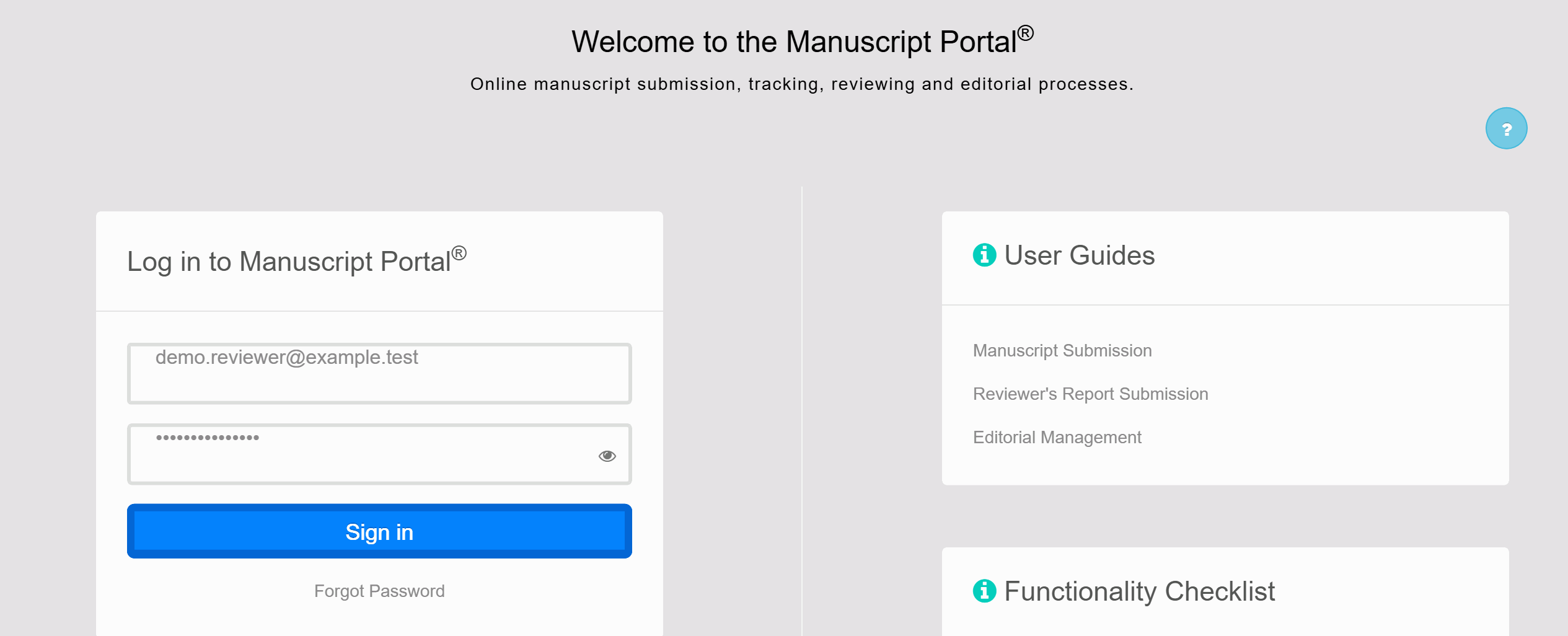
Sign in
- Reviewers are invited by field. Your sign-in details come by email with your first invitation; to offer to review, send the editorial office your CV and areas of expertise.
- Open the Manuscript Portal and sign in with your User ID or email and your password. Forgot it? Click Forgot Password.
- One account works for all your roles; switch between reviewer, author and editor from the menu with your name.
Accept the invitation
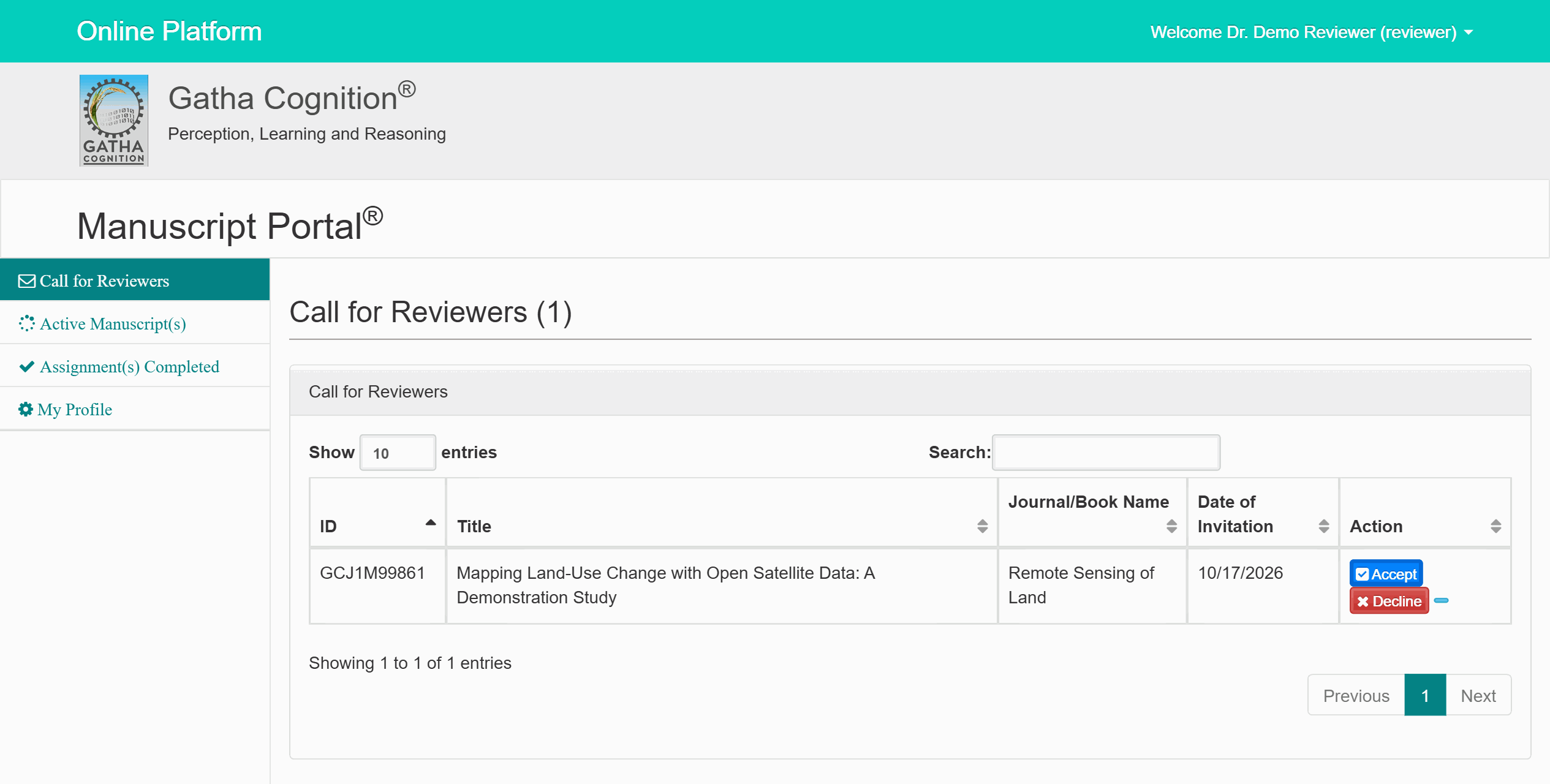
- The editor invites you by email, with the title and abstract. Click Accept or Decline in the email, or sign in and open Call for Reviewers.
- Please decline, or tell the editor, if you have a conflict of interest or cannot finish in time.
- The due date is 30 days from the invitation.
Read the manuscript
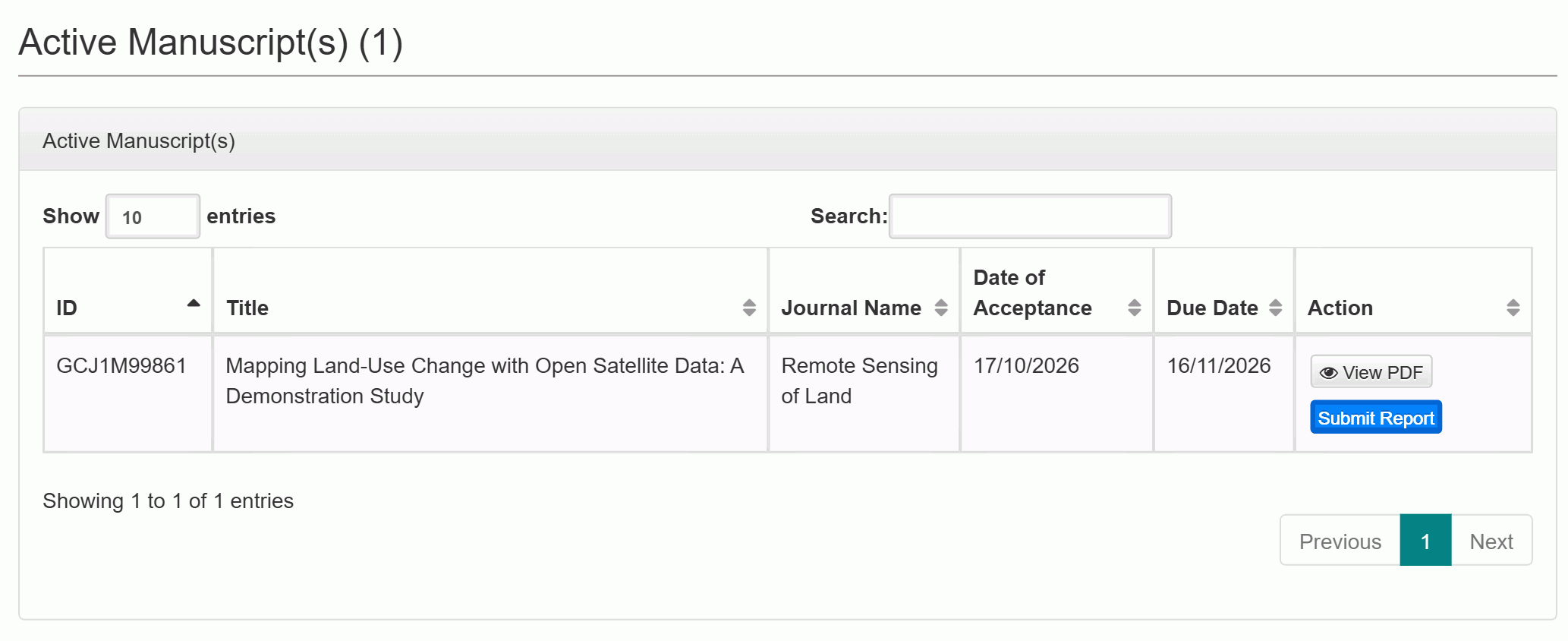
- Accepted manuscripts move to Active Manuscript(s), with the date of acceptance and the due date.
- View PDF opens the manuscript without the authors’ names. You can also open the similarity (Turnitin) report and, for a revision, Compare versions.
Write the report
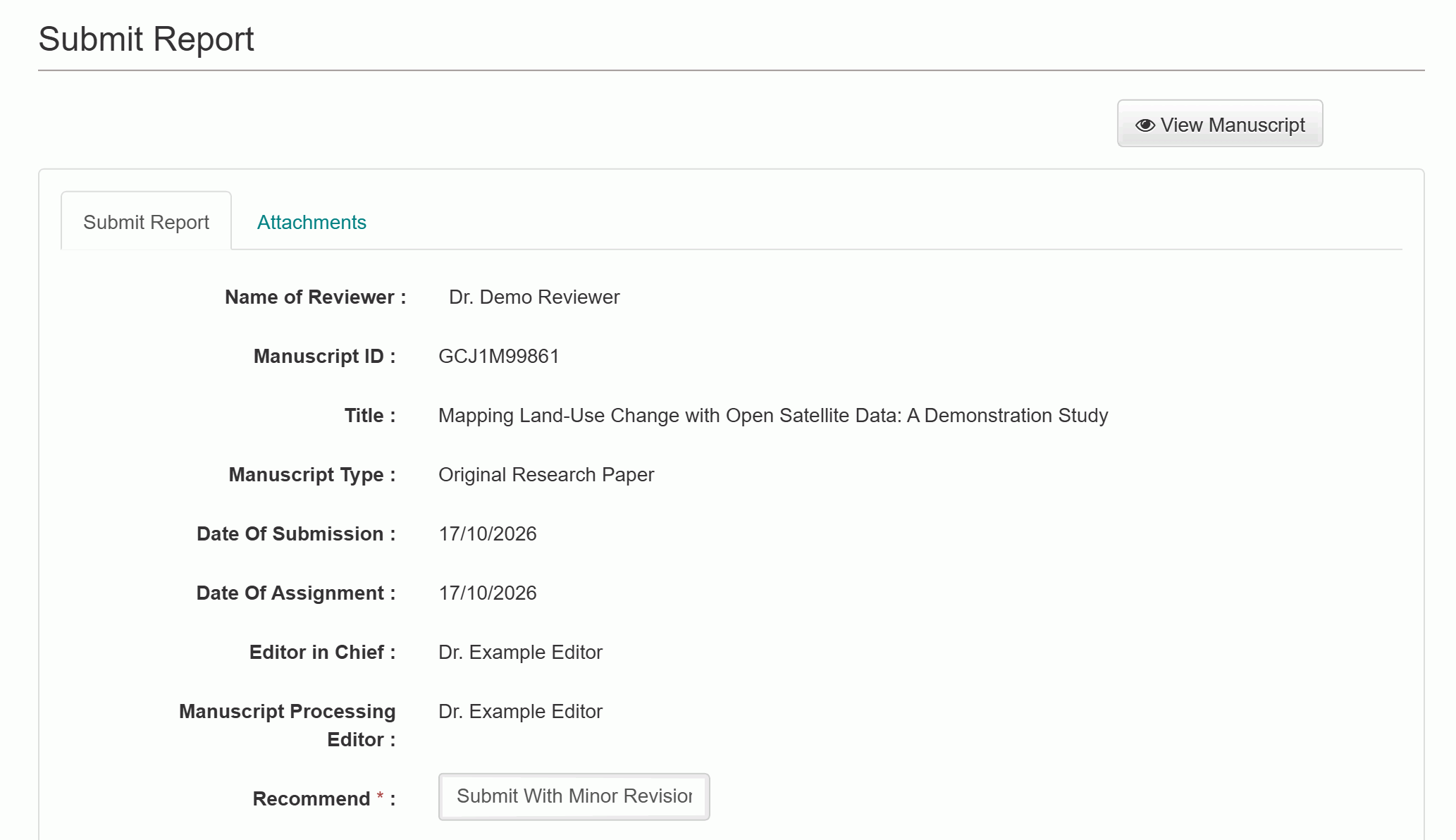
- Click Submit Report. The form shows the manuscript details; View Manuscript opens the PDF again.
- Choose your recommendation: Accept, Submit With Minor Revision, Submit With Major Revision, or Reject.
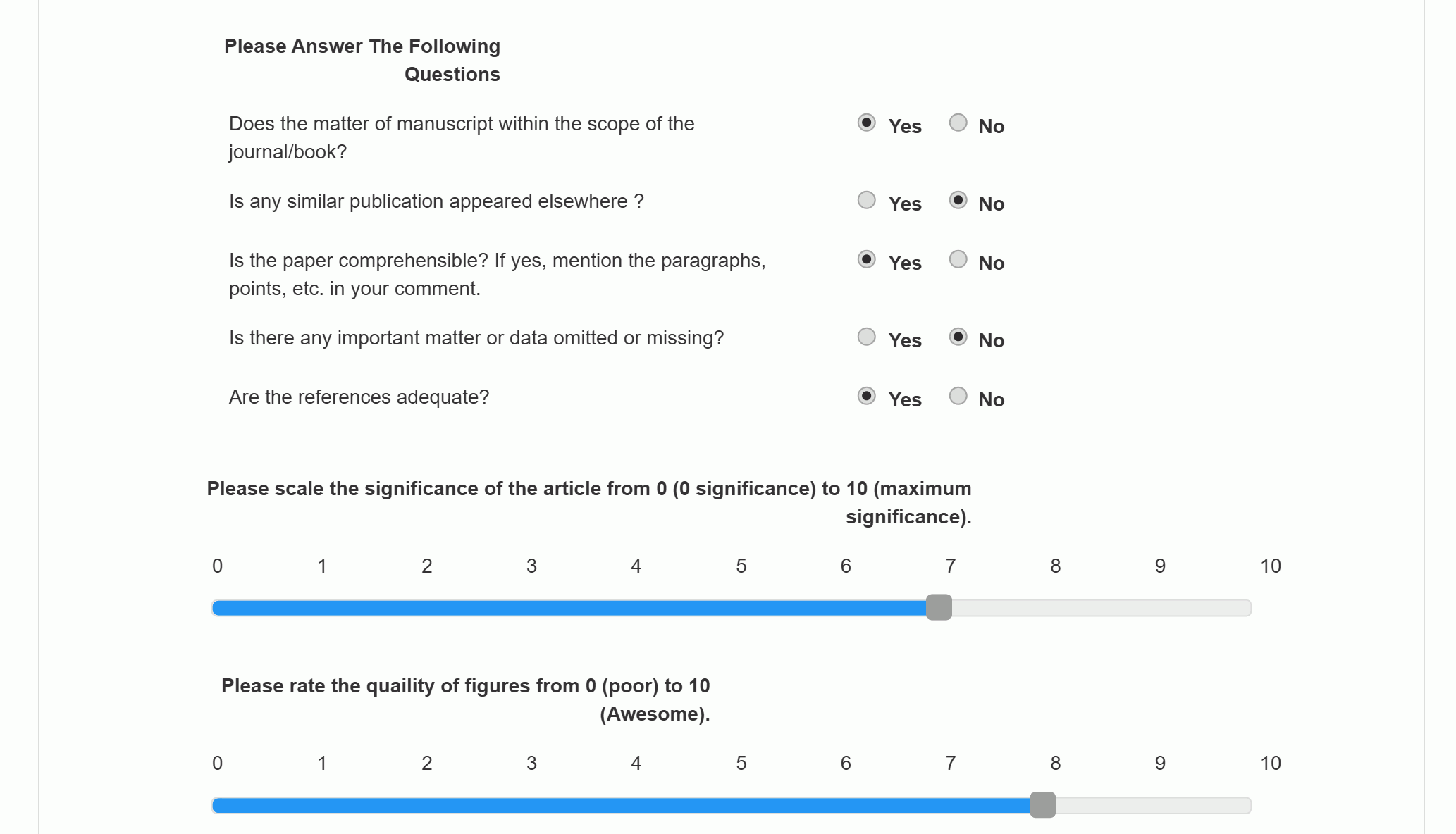
- Answer the five yes/no questions: scope, similar publication elsewhere, clarity, missing matter or data, and adequate references.
- Drag the sliders to rate the significance of the article and the quality of the figures, from 0 to 10.
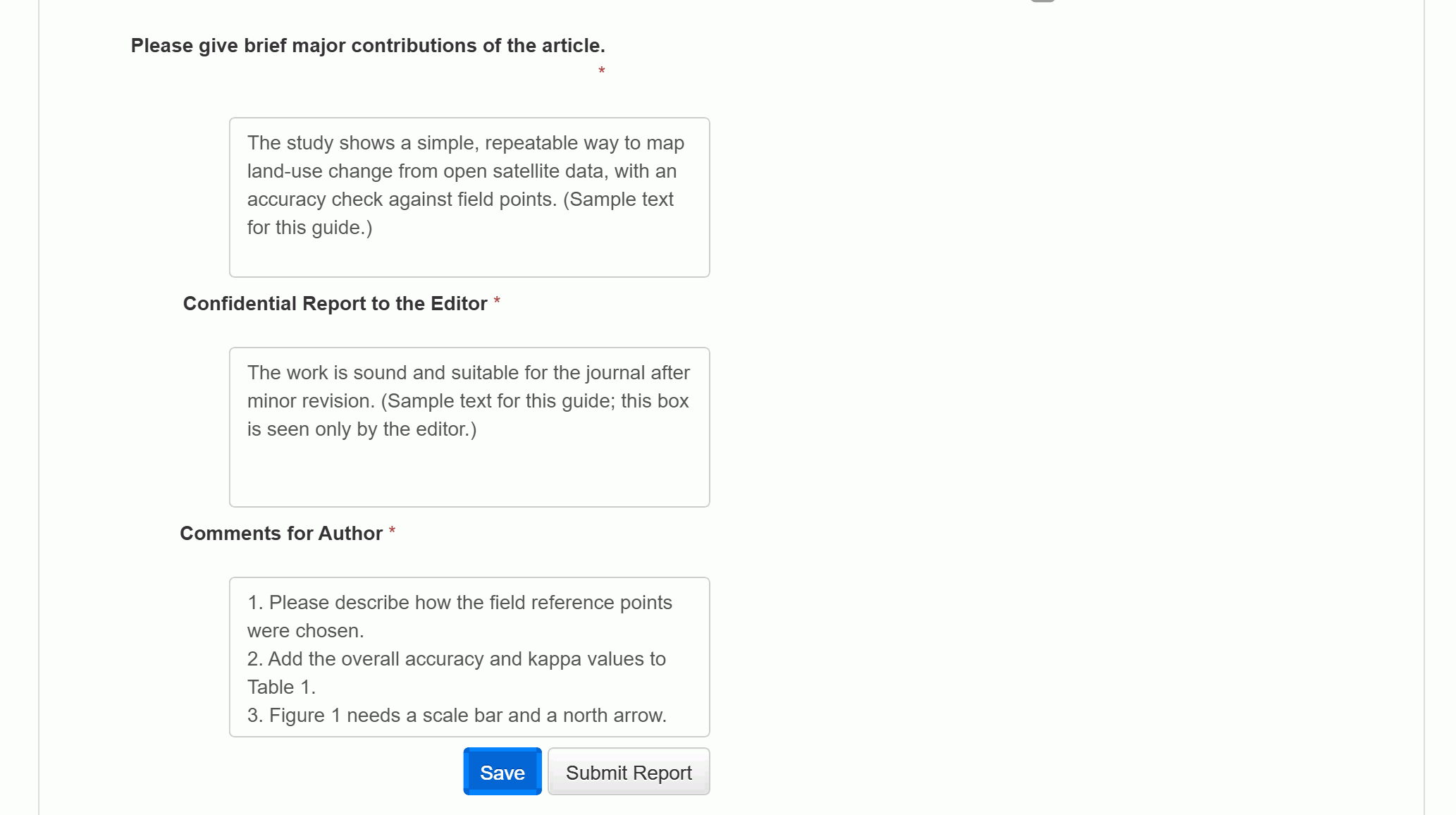
- Write the major contributions of the article, a confidential report to the editor (never shown to the authors), and your comments for the author(s). Number your points so the authors can answer each one.
- The three boxes have a small toolbar for bold, italics, headings, numbered and bulleted lists. You can also paste from Word: the headings, lists and paragraphs are kept, and the editor and authors see the report as you formatted it.
- Click Save at any time, even with the report incomplete, and come back later.
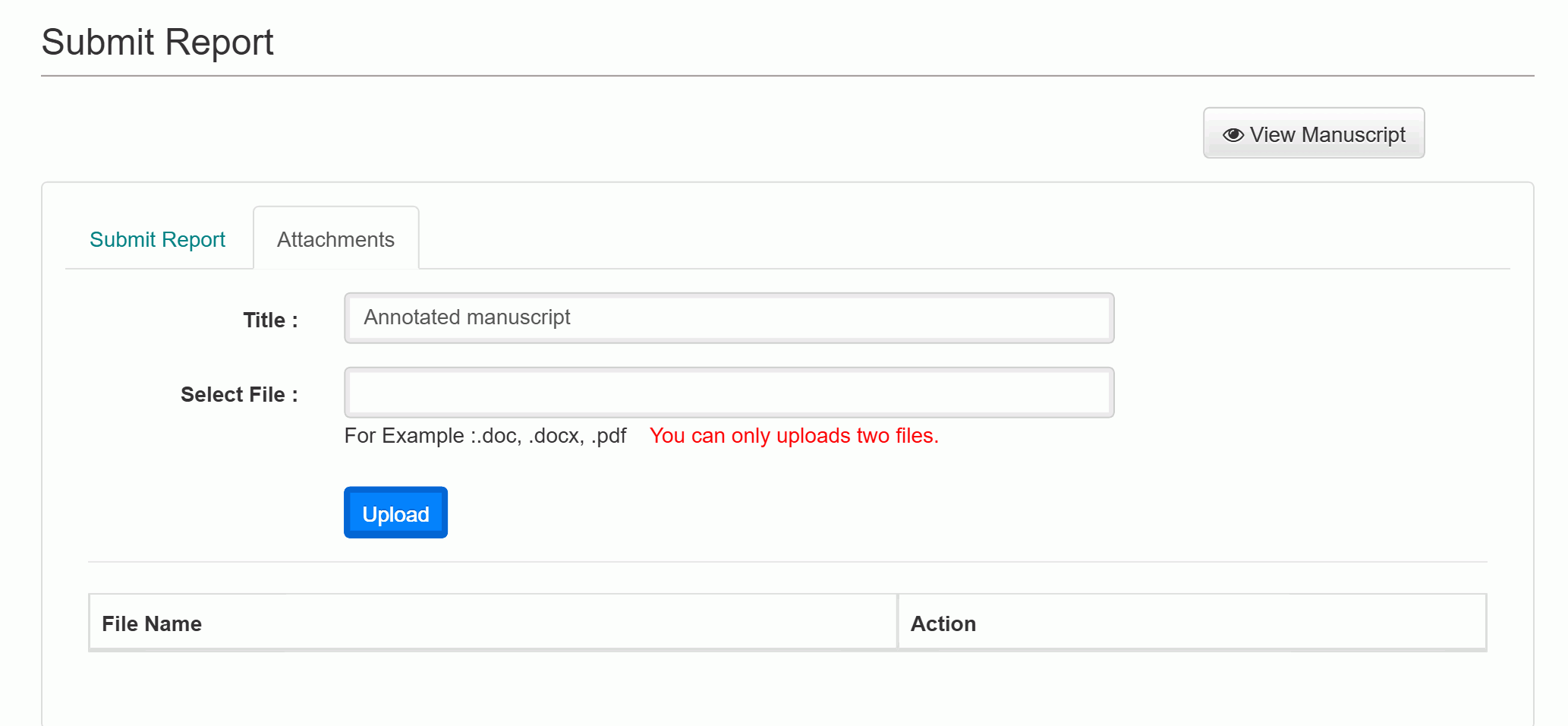
To send a file with your report, open the Attachments tab, give it a title, choose the file (.doc, .docx or .pdf) and click Upload. You can attach up to two files.
Submit the report
- Submit Report works after you have saved. The recommendation, major contributions, confidential report and comments for the authors are required; if one is missing, the form tells you.
- Once submitted, the report is sent to the editor and you get a confirmation email. It can no longer be changed.
After you submit
The manuscript moves to Assignment(s) Completed, where it stays archived with its status.
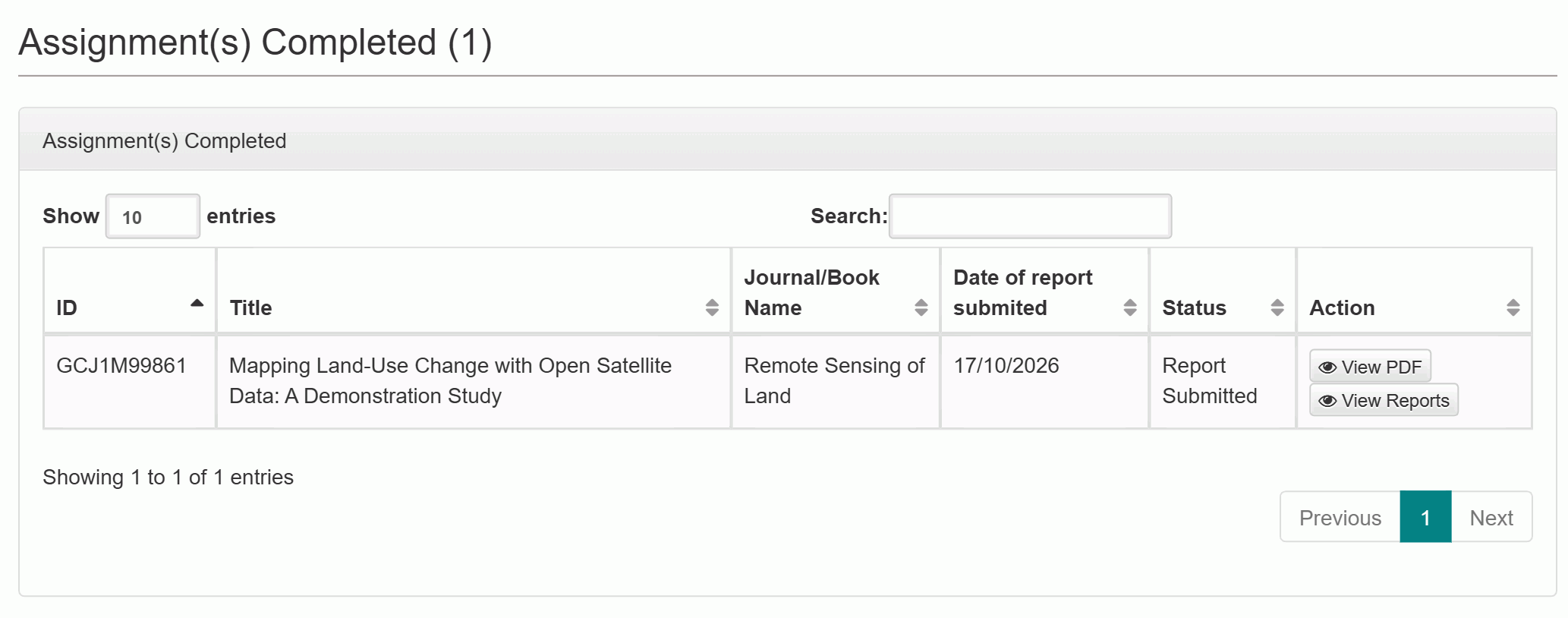
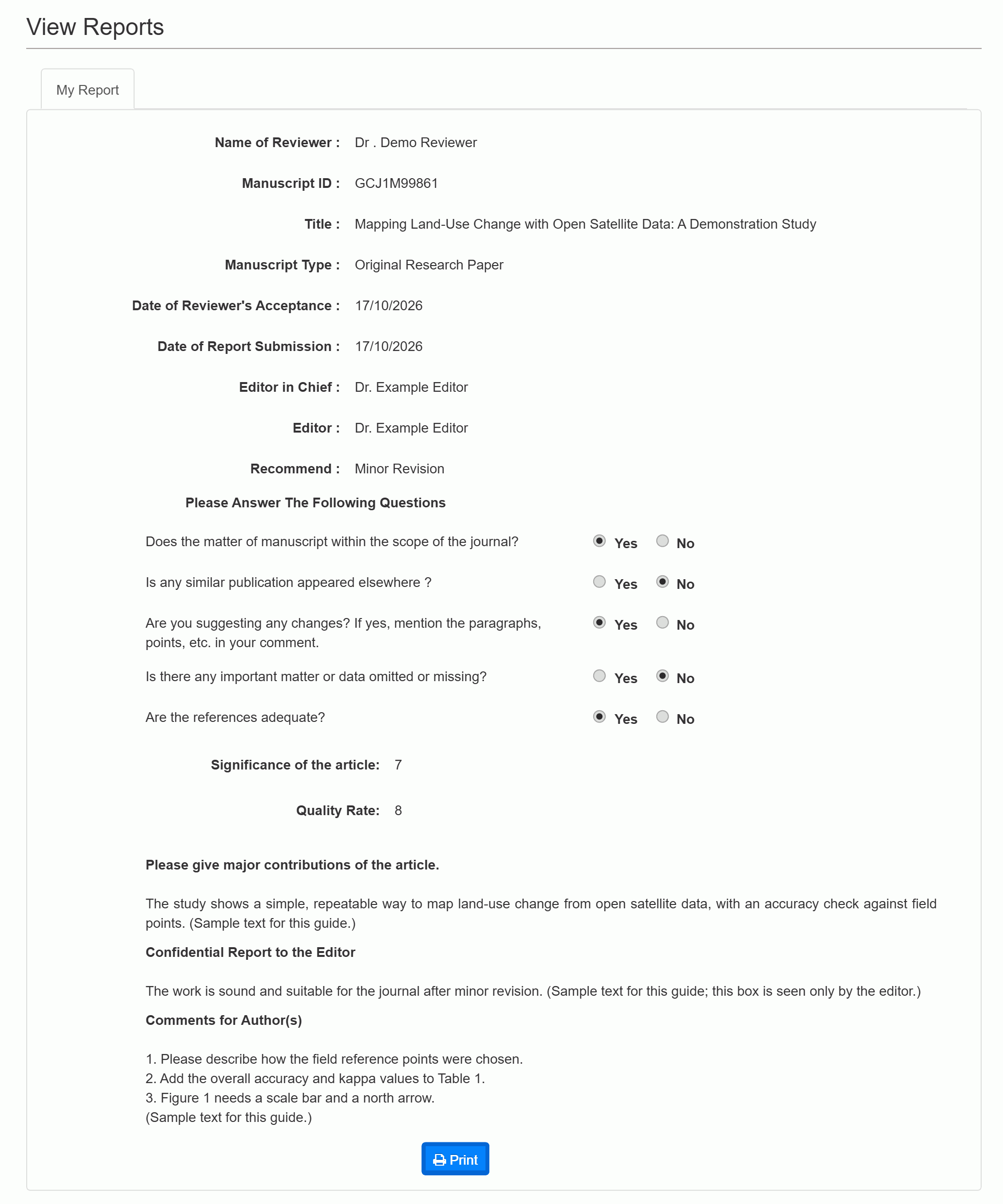
View Reports shows your own report, which you can print. You see only your own report, never another reviewer’s.
Similarity report (Turnitin)
Every manuscript is checked with Turnitin iThenticate, which compares it with published articles, books and web pages. The editorial office runs the check; the report can then be opened only by the people working on that manuscript.
| Who | What they can do |
|---|---|
| Editorial office | Runs the check on submitted manuscripts, and again if a check fails. Only the editorial office can start a check. |
| The manuscript’s authors | Open the report from their author account — a view-only copy. |
| Its reviewers | Reviewers assigned to the manuscript open it from Active Manuscript(s) or the report form. |
| Its editors | The editor handling the manuscript and the journal’s editorial board editors open it from the manuscript’s editorial page. |
| Anyone else | Cannot open it: the button shows “no access”. Reports are never public. |
How to open it — sign in to the Manuscript Portal.
- The similarity button is on the manuscript’s row in Active Manuscript(s), and at the top of the report form, next to View Manuscript.
- When the check is done, the button shows the score, for example Similarity Report (12%). Click it: the full report opens in a new browser tab in Turnitin’s viewer. If nothing opens, allow pop-ups for gathacognition.com and click again.
- The report highlights each matching passage and lists the source it matches.
| The button shows | What it means |
|---|---|
| Similarity: not yet checked | The editorial office has not run the check yet. Please look again later. |
| Checking Similarity… / still running — reload later | Turnitin is comparing the manuscript. Reload the page after a few minutes. |
| Similarity Report (12%) Use filters | The check is done; the percentage is the overall similarity score. Reports checked from 7 November 2026 already use the filters below; for older ones, open the report and apply them. Use filters shows the same steps. |
| Similarity Check Failed / report unavailable | Something went wrong at Turnitin. The editorial office runs the check again; write to us if it stays like this. |
| Similarity report: no access | You are not one of the people on this manuscript, so the report cannot be shown. |
Getting the correct % of Overall Similarity: use the filters
Without filters, the overall % also counts text that is not a concern, such as the reference list and properly quoted or cited passages, so it is higher than the real figure. The correct % of Overall Similarity is the one with these filters on. Reports checked from 7 November 2026 are made with these filters already on; older reports may still show the unfiltered %.
| Filter | Why |
|---|---|
| Exclude bibliography | The reference list matches other papers that cite the same works. |
| Exclude quoted text | Text inside quotation marks is already credited to its source. |
| Exclude cited text | Passages followed by a citation to their source. |
| Abstract | The abstract often matches the authors’ own conference or preprint version. |
| Methods and Materials | Standard methods wording is repeated across many papers. |
| Exclude small matches | Short common phrases (matches of 10 words or fewer). |
- To check or apply them: open the report, click the Filters (funnel) icon, make sure the filters above are ticked (small matches: 10 words), and click Apply. The overall % at the top is then the correct % of Overall Similarity.
- Filters you change are for your own view only. Quote the filtered % in your report.
Use the report to support your assessment of originality: look at what matches, not only the percentage. Mention any concern in your confidential report to the editor.
Confidentiality & AI
A manuscript under review is confidential. Do not share it, or upload any part of it to ChatGPT, Claude, Gemini or any other AI tool, and write the substance of your review yourself. Language tools on your own review text are allowed, with no manuscript content pasted in. Full rules: AI Use Policy, Section 4.
Guides & policies
Questions about an invitation or a report?
Write to the editorial office.
Please quote the manuscript ID.
+91 94216 11949 · 02424 299 094
WhatsApp +91 95118 96365
Go to the Manuscript Portal