

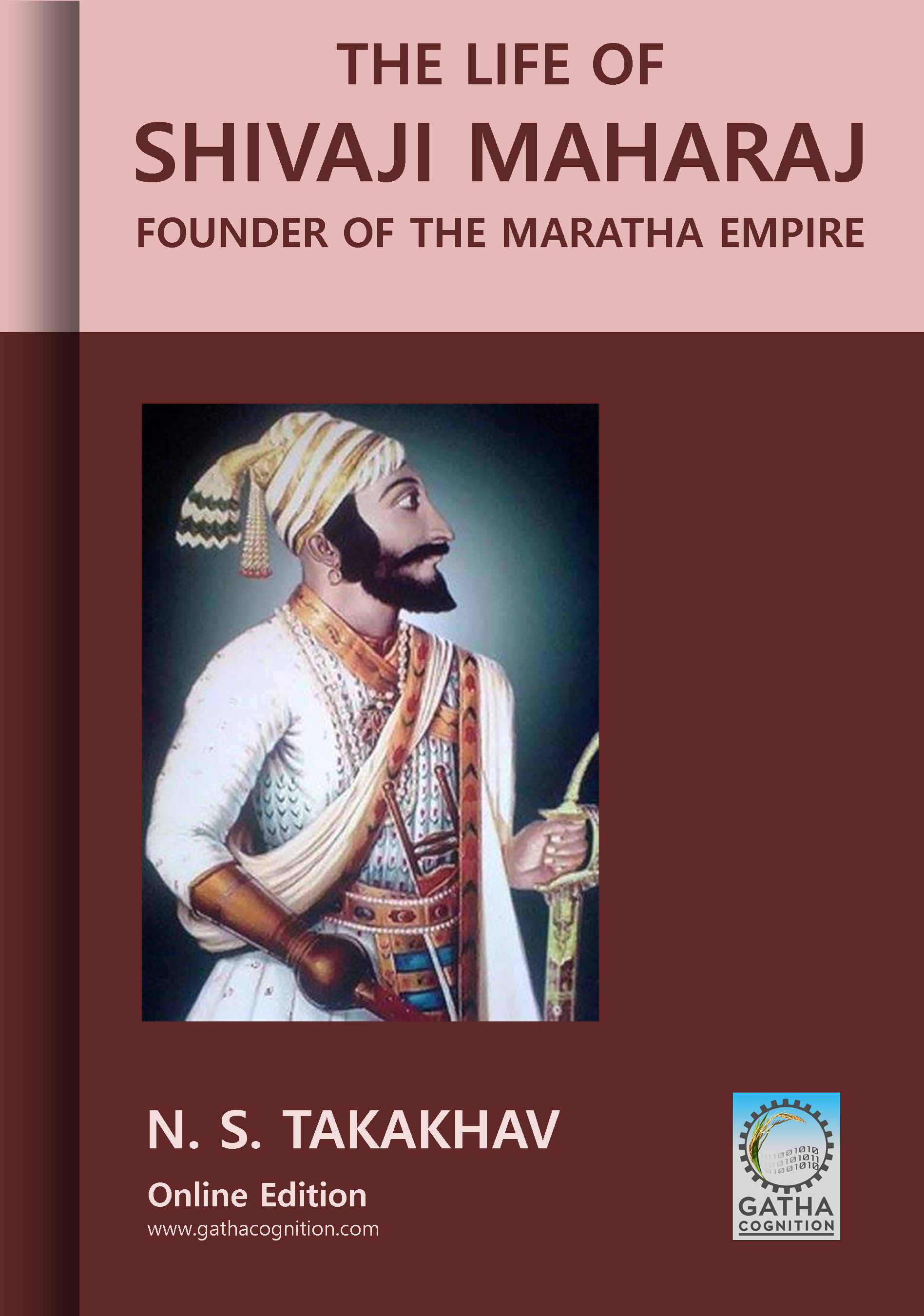
Book Open Access
The Life of Shivaji Maharaj: Founder of the Maratha Empire
Adapted from the original Marathi work by K.A. Keluskar
- Wilson College, Bombay
About this book
‘The Life of Shivaji Maharaj: Founder of the Maratha Empire’ is the story our national hero. Revd. Dr. N. Macnicol M.A., D. Litt., a distinguished missionary scholar of the United Free Church of Scotland Mission stated in his forward to this book that “Shivaji belongs to no class or caste; he is a national possession. He may be said indeed to have come to rebirth in the hearts of his countrymen, not of Maharashtra alone but of all India”. Prof. N. S. Takakhav, M. A., adopted originally worked by Mr. K. A. Keluskar and referred original sources of information used for this work. Dr. N. Macnicol has corrected proofs of the first edition.
We are cordially happy to make this Online Edition of this Global Possession for Global Community. Dr. Kiran Jadhav, the Editor contributed academic values to this critical task.
The book is arranged in chapters to navigate easily in HTML format using all electronic devices and PDF will be useful to take printouts.
----------------------
Preface by Professor. N.S. Takakhav,
At a time when the whole of the Indian Continent is entering upon a new phase of political life and bold schemes of social and political re-construction are being daily pressed for acceptance, no apology would seem to be necessary for the publication of a new life of Shivaji. For among the glittering multitude of mighty kings whose names adorn the pages of Indian History, the name of Shivaji stands forth in bold relief as the author of a momentous national revival that changed the destinies of India. And this is a fact allowed by all historians, even though the editors of the Rulers of India Series have chosen to ignore him and denied him a place in their Series, while including many other “Rulers” who were more or less mediocrities, when compared with the great Shivaji. If ever in the pre-British period of Indian History, there was anything that might be compared with the great national movements of Western countries, it was the political movement which laid the foundations of the Maratha Swarajya. And that movement would have been utterly destitute to all its national glory and significance, were it not for the genius and originality of one master mind who presided over the whole event, built a nation out of chaos and breathed life and purpose into the dead clay and disjecta membra of Maharashtra society and institutions.
Such a man was Shivaji. Of the empire which he built up, only a few fragments have escaped the ravages of time. The rest has crumbled down and gone the way that all great empires in the world have gone. But the spirit of it has remained behind. He has left no pyramids, no rock-cut temples, no inspired by the stirring events of the late war, when the Maratha soldiers were called upon to display their native valour on the battle-fields of the West, this work was undertaken at the special request of the author of the Marathi original, as a grateful tribute to the genius of the founder of the Maratha nation. At the time when this work was undertaken, there was no worthy biography in the English language of the life and career of the great King who during the night of Mahomedan despotism dreamt the dream of national independence and realized it. It seemed a standing reproach to the Indian community, with their newly awakened political consciousness, that there should be no biographical record, commensurate with the greatness of the national hero, in that language which has done more than anything else to unite us into a nation and stimulate our national aspirations.architectural marvels to attest his greatness. But the name of Shivaji still lives to kindle and inspire the growing manhood of Maharashtra.
This English version was taken in hand about seven years ago. As the work proceeded it was found necessary to make considerable alterations in the original Marathi text of Mr. Keluskar’s Life, as published in 1907. It was found necessary to take notice of the mass of new material and discoveries which have accumulated in the course of the last fourteen years. In its final draft the present English version has practically become a new and independent work and has already served as a basis for the second Marathi edition, which in a revised and considerably enlarged form, as compared to the first edition, was published by Mr. Keluskar early in 1921. This work has been thoroughly revised and retouched from time to time during the last seven years. It is quite up-to-date, so far as our knowledge of Shivaji and the men and things of his time extends and the conflicting theories that have been proposed as regards the purpose or policy for which he strove and the men of wisdom or action who counselled or co-operated in his plans.
While the preparation of this work was in its various stages of progress, three important English works on Shivaji appeared in print, one of which has already gone into a second edition. Some explanation would seem to be necessary to justify the publication of a fourth work on the same subject. The first and obvious answer is that none of these works can be called a faithful biography of Shivaji, that is to say, a biography which is at once full and exhaustive and traces the development of his life-work from beginning to end in chronological order. The work of Mr. Kincaid reviews the work of Shivaji as a fragment of the History of the Maratha People, that of Prof. Jadunath Sarkar discourses upon “Shivaji and his Times” and often forgets the hero while discoursing upon his “Times”, that of Prof. Rawlinson is avowedly a monograph, too meagre in its scope to comprise the life-work of a great her like Shivaji. The thanks of the Maratha reader are due to all these scholars for the new light they have thrown on many obscure points in the life of their national hero, and to Prof. Rawlinson and Mr. Kincaid in particular for the generous way in which they have interpreted the motives and character of the great King. The earliest of this triad is the Life of Shivaji by Principal Rawlinson. It is a generous appreciation of Shivaji’s work and character. But the monograph, besides being too meagre in size for the magnitude of the task, devotes a good deal of its contents to discussions upon somewhat irrelevant topics. The impression that remains after a perusal of the book is that the author’s purpose is to show that the new era of Shivaji after all inaugurated a new type of bureaucracy, and the author seems to suggest that from the times of Ashoka and Chandragupta down to present times, the bureaucratic form of government has prevailed in India and must inevitably prevail for all time. The author forgets that there are bureaucracies and bureaucracies and that a bureaucracy with a Shivaji at its head ceases to be a bureaucracy, both in form and substance. Mr. C. A. Kincaid, who writes in collaboration with Rao Bahadur D. B. Parasnis, has devoted some 170 pages of the first volume of his History of the Maratha People to the story of Shivaji. The authors have taken little notice of the stirring events of the career of Shahaji and have chosen to ignore many a controversy which has caused an acute tension of feeling among scholars. This history is full of legends and folklore tales and apparently attaches as much importance to them as to matters of serious history. Its highest virtue is its picturesqueness. Although Mr. Kincaid has repeated the orthodox version as to the date, when Shivaji enrolled himself as a disciple of Ramdas Swami, it is some consolation to think that Mr. Kincaid has not allowed the infatuation of the Ramdas cult to blind him to such an extent as to ascribe to the preceptor the credit of Shivaji’s glorious achievements. He has had sense enough to see, as some patriotic and over-zealous Maharashtra scholars have not that such a representation of the relations between the preceptor and the disciple would reduce the national hero to a mere puppet. The supreme merit of Mr. Kincaid’s work is his enthusiastic and unreserved admiration of the Maratha people.
Prof. Jadunath Sarkar’s “Shivaji and His Times” is the last of this triad[1]. It is a noble work marred with strange flaws. Mr. Kincaid’s History and Prof. Sarkar’s Shivaji stand at two opposite extremes of historical method and style. The one is romantic in conception and uncritical in method, the other is hypercritical in method and sceptical in its intellectual outlook. The merits of Sarkar’s work are great. He has had access to a wealth of Mahomedan and British sources and authorities, the very existence of which had not been previously suspected. The fundamental fault of the work is that it appears as an overflow of the vast amount of historical material he had collected for his monumental work upon Aurangzeb. His sympathies are with the Moguls and the commanders of the Mogul empire. His sympathies are with the British factors at Surat and Rajapur. His sympathies are anywhere except with Shivaji and his gallant companions. Shivaji has fallen into the back-ground. Sarkar’s paeans of praise are poured forth in unstinted measure, now in honour of Shaista Khan, now in honour of Jay Singh. He conducts his reader into the Mogul camp, he brings him in the wake of the Mogul armies and the Mogul standards. Shivaji is at best patronised here and there with a nodding familiarity and spoken of as a familiar underling with the name of “Shiva”. This is not intended, but such is the effect produced. The critical estimate of Shivaji’s character and work in the last seven pages of this work is an appreciative review of the character and life-work of the great King and is, strange to say, quite at variance with the hyper-critical denunciations expressed in the fourteen pages that immediately precede it, and on the whole gives the lie direct to many of the generalizations which are found interspersed in the earlier part of the work. By far the most valuable service rendered by Prof. Sarkar is his vindication of Shivaji from the charge of murdering Afzul Khan. Again he has not fallen into the error of exaggerating the influence of Ramdas Swami upon Shivaji. Indeed he seems to have gone to an opposite extreme and failed to recognize, in anything like a proper estimate, the intense spirituality of outlook which distinguished Shivaji among the nation-builders and rulers of India. Finally, it must be said of Prof. Sarkar’s work that it is arranged in too scrappy a manner to suit the purposes of a serious biography and hence arise the contradictions which are noticed above.
In the present work Shivaji is depicted as the director and entrepreneur of the greatest movement for the assertion of national liberty and independence that India has known in pre-British times. His character, his institutions and the greatness of his work are set forth at length in the 24th and in the concluding chapters. The prejudices against Shivaji on the part of the Mahomedan chroniclers are here shown to be of the same sort as those with which the student of Roman History becomes familiar when he finds Roman authors like Livy and Cicero passing uncalled for strictures upon Hannibal. There is indeed a close parallel between these two heroes. Both strove hard for the liberty and independence of their country from foreign aggression. Both were endowed with the most brilliant talents and genius. In both their powers of invention and resourcefulness baffled the understanding and vigilance of their enemies. Both have been denounced by biassed historians for their imaginary acts of treachery and cruelty. But the contrast between the environments of these two conquerors brings out the superior mettle of the Maratha hero. Hannibal had not to make an army, much less to make a nation. Shivaji had to make everything for himself in order to build the Maratha nation. And that he did build a nation and found an empire which lasted longer than the power of Carthage did after the death of Hannibal, is no little testimony to the superiority of the Maratha hero over that of Carthage. It has been the fashion in some quarters to compare Shivaji with great conquerors like Caesar, Alexander or Bonaparte, and a tendency is seen now and then to compare him with ardent but obscure patriots like Viriathus, Vercingetorix or Caractacus, or at best with King Alfred, Robert Bruce, or William Tell. But the fact is that he combined in himself the righteous purpose and patriotic fervour of leaders like Bruce and Alfred and Vercingetorix with the superior military genius and statesmanship that characterized the world’s great heroes like Caesar, Alexander, Hannibal and Bonaparte ; and in so far as these two different sets of qualities characterizing the two groups are found to unite together to a certain extent in the character of Hannibal alone, the latter seems to be the one unique military genius of the ancient world with whom we may compare Shivaji with an approximate measure of accuracy. But the truth is that the character and the life-work of the Maratha hero were both alike so unique, that it is idle to make any comparison.
The present work is an attempt to give a faithful likeness of Shivaji and an estimate of his great work, chiefly based upon the indigenous bakhar chronicles of the Marathas. Nearly all the Maratha chronicles have been laid under contribution, together with other authorities, which will be found cited in the foot-notes. Most of these foot-notes are of a critical kind, supplementing, illustrating, and giving the authorities for the statements made in the text. The works of Mr. Kincaid and Prof. Jadunath Sarkar have been of great use, and the latter is freely quoted, especially as regards his citations from the Factory Records in the India Office, which are not otherwise available in India. Of great use have been the writings of Mr. V. K. Rajwade and Rao Bahadur Parasnis, the reports of the Bharat Itihas Sanshodhak Mandali of Poona, the JedheShakavali or Chronology published by the late Mr. B. G. Tilak, and the Itihas Sangraha.
Attention may be invited to the following features in the present work:
- It gives a complete account of the career of Shahaji and a critical exposition of his attitude towards Shivaji.
- It gives a re-constructed version of the Chandra Rao More tragedy.
- It clears Shivaji from the charge of murdering Afzul Khan.
- It re-arranges the chronology of the events of Shaista Khan’s invasion, in the light of the Jedhe Chronology and the Mahomedan chronicles.
- It examines the relations between Shivaji and Dadaji Kondadov and between Shivaji and Ramdas Swami in the light of modern authorities and discoveries.
- It throws new light upon the naval battle of Khanderi, from British Factory Records and Correspondence, hitherto not handled by any previous historian of Shivaji.
- It re-constructs the military career of one of Shivaji’s great commanders, whose services have fallen into an unmerited oblivion, — Anandrao Bhonsle (Appendix 2).
- It re-constructs the career of one of Shivaji’s great plenipotentiaries at the Mogul Court-Ragho Ballal Korde-wrongly charged with murdering Chandrarao More (Appendix 4).
- It vindicates Shivaji from the charge of cruelty and treachery, by proving that the Mogul commanders were guilty than Shivaji.
- It gives a new explanation of Shivaji’s so-called plundering campaigns.
- It discusses the various theories of the late Justice Ranade, Rajwade, Kincaid and others about the origin of the Swarajya movement, its authorship, the relation of the Bhagwat School towards Swarajya and kindred topics.
I have to express my thanks to all the authors mentioned above for the assistance derived from their works, as also to Principal G. C. Bhate, Principal Rawlinson, Mr. G. S Sardesai, R. & O. Strachey. Mr. S. Dev, Mr. S. Sen, Mr. Vasudev Shastri Khare, and a host of others whose works have been quoted or made use of in different parts of this book. I have especially to thank the Rev. Dr. N. Macnicol, M. A., D. Litt. of the United Free Church of Scotland Mission, a distinguished scholar and a sympathetic critic, for kindly revising and correcting the MS. and the proofs and for the many valuable suggestions he made which have greatly advanced the usefulness of this biography. The sympathetic “Foreword” which he has so kindly contributed to this work may be taken not only as index of his genuine interest and sympathy in all Indian aspirations, but as a noble tribute to the greatness of our great national hero.
Bomaby Nitlkant S. Takakhav
6th May 1921
Contents
- Preface
-
pp. I-VI Open access
Preface
At a time when the whole of the Indian Continent is entering upon a new phase of political life and bold schemes of social and political re-construction are being daily pressed for acceptance, no apology would seem to be necessary for the publication of a new life of Shivaji. For among the glittering multitude of mighty kings whose names adorn the pages of Indian History, the name of Shivaji stand
10.21523/gcb4.1801 1,435 views 2018
-
pp. VII-VIII Open access
Publishers Note
The Publisher’s cordial thanks are due to Prof. N. S. Takakhav, M. A., for having readily undertaken this very difficult and arduous task. He as a student of history was not content with the original Marathi text. He went to the very sources of information from which it was compiled, and brought under contribution almost all the recent researches and discoveries regarding the life story of our nat
10.21523/gcb4.1802 1,120 views 2018
-
pp. IX-X Open access
Foreword
Mr. K. A. Keluskar has asked me to write a brief foreword to the English edition of his Life of Shivaji Maharaj, and I have consented to do so because of the high regard that I have for him both as a man and as a Marathi scholar and because of our long-standing friendship. I have no other claim than these give me to take it upon myself to introduce this book to the public. At the same time I feel
10.21523/gcb4.1803 977 views 2018
-
Chapter 1 pp. 1-11 Open access
Ancestry
Shivaji Maharaj, the illustrious founder of the Maratha Power, derived his descent from the renowned Bhonsle family. This noble Maratha house claimed an ancient Kshatriya origin. It is said that the family was transferred to the uplands of Maharashtra by a Rajput warrior, Devraj Maharana by name. The family tradition tells a long tale of chequered adventures and vicissitudes. In what is now known
10.21523/gcb4.1804 1,024 views 2018
-
Chapter 2 pp. 12-38 Open access
The Career of Shivaji
At the time when Shahaji succeeded to the mansab, the renowned Malik Ambar was at the head of the Nizam Shahi State. It is indispensable at this stage to have some general notion of the state of Ahmednagar, on the eve of its extinction. The town had fallen into the hands of the Moguls about 1600, and the illustrious Chand Bibi Sultana, whose noble defence of it had excited the admiration and envy
10.21523/gcb4.1805 2,445 views 2018
-
Chapter 3 pp. 39-49 Open access
The Childhood of Shivaji
We have already described in the last chapter how Jijabai far advanced in pregnancy was left behind at the fort of Shivneri, while Shahaji was being pursued by Lukhji Jadhav past the confines of the Nizamshahi kngdom. To look after his wife, Shahaji had detached from his secretarial staff three officers noted for their personal devotion towards himself. These were Balkrishnapant Hanumante, Shamrao
10.21523/gcb4.1806 2,187 views 2018
-
Chapter 4 pp. 50-61 Open access
The Education of Shivaji
A great career is determined by favorable circumstances for the growth of genius. It is also shaped in a great measure by a good education. Both these influences played a great part in moulding the mind and character of Shivaji. The first ten years of his life were spent in his mother’s company, an influence of most vital character on the life of a man. It is the age when the mind is most tender a
10.21523/gcb4.1807 1,846 views 2018
-
Chapter 5 pp. 62-67 Open access
The Preparation for Swarajya
The Marathi chroniclers are silent upon the early preparations of Shivaji in furtherance of his ambitious plans. That ambition in its essence comprehended the deliverance of his country from a very unbearable Mahomedan tyranny, the raising of the fabric of an independent national government, and the expulsion of Mahomedan bigotry from the land. The scanty material available on the subject has been
10.21523/gcb4.1808 1,255 views 2018
-
Chapter 6 pp. 68-80 Open access
The Beginnings of Swarajya
In the last chapter a brief sketch was attempted of the early preparations of Shivaji for the realization of his ambition: the exploration of mountain fastness and hill-forts, mountain paths and defiles, and the mustering together of a band of devoted friends and supporters. In this chapter we propose to trace his earliest activities as parts of a premeditated aggressive programme. At the outset w
10.21523/gcb4.1809 1,635 views 2018
-
Chapter 7 pp. 81-88 Open access
Development of Swarajya
In the last chapter we attempted to trace a faint outline of the pioneer labours of Shivaji as the founder of a sovereign power. In this chapter we shall follow the further expansion and development of his boldly conceived plans. The country enclosing the jahgir domain of Shivaji was, as we have already observed, in the hands of ambitious nobles, who owed more or less a sort of hereditary allegian
10.21523/gcb4.1810 1,456 views 2018
-
Chapter 8 pp. 89-96 Open access
Shahaji Entrapped
The disturbances caused by Shivaji in the Bijapur territory had been overlooked for two or three years; but the Kalyan affair was the last straw, and even that apathetic and indulgent government had now to bestir itself. For the plunder of the royal treasure on the way to the capital, the conquest of Kalyan and the out-lying forts, and the rumours that were now bruited abroad about Shivaji’s futur
10.21523/gcb4.1811 1,488 views 2018
-
Chapter 9 pp. 97-101 Open access
Relations with the Moguls 1650-57
The alliance between Shivaji and the Moguls was destined to be a deceptive move in Shivaji’s game of politics. By this diplomatic stroke he had cut a gordian knot which might have proved too serious for the resourcefulness of any statesman of the time. His readiness to enter the Mogul service was a feint that had deceived both the Bijapur and the Mogul governments. In reality he desired nothing of
10.21523/gcb4.1812 1,680 views 2018
-
Chapter 10 pp. 102-111 Open access
The Capture of Javli and other Events 1654-58
After the complete liberation of Shahaji from the Sultan’s watch at Bijapur and his return to the Karnatic, Shivaji revived the aggressive policy he had slackened in the interim. His object was now to win over from the sultan the entire region of the Konkan and the uplands of the ghats, and to round off these possessions with the conquest of new hill-forts. The news of these freshly awakened activ
10.21523/gcb4.1813 1,854 views 2018
-
Chapter 11 pp. 112-132 Open access
The Tragedy of Afzul Khan 1659
The Bijapur government had been waiting with patience. Fort after fort, district after district had passed from their inert grasp into the grip of the Maratha warrior. Their feudal vassals were being seduced to defection, the zealous Mores of Javli had paid for their loyalty with death and ruin, the Sawants of Wadi had been seduced from their allegiance to their traditional suzerains, the province
10.21523/gcb4.1814 3,225 views 2018
-
Chapter 12 pp. 133-144 Open access
Adil Shahi Nobles Discomfited
The terror of Shivaji’s name was now felt in all parts of the Bijapur kingdom. The defeat of Afzul Khan was followed by the rapid conquest of several forts and rural tracts in the neighbourhood. On the announcement of Afzul Khan’s invasion, the Abyssinian chief of Janjira had lost no time in laying siege to the Konkan forts of Tala and Ghosala. The report of Afzal Khan’s tragic end coming quickly
10.21523/gcb4.1815 1,807 views 2018
-
Chapter 13 pp. 145-152 Open access
The Bijapur Government on its Knees, 1661-62
The Bijapur Government was in a sullen mood. The disgraceful return of Sidi Johar and Fazal Khan had filled the sultan with indignation. In the first impulse of his wrath he announced his intention of taking the field in person against the Maratha leader. With a large army under his command, the sultan moved to Karhad. This movement had the immediate effect of stirring up those of his feudatories
10.21523/gcb4.1816 1,625 views 2018
-
Chapter 14 pp. 153-159 Open access
Re-union of Father and Son
It goes without saying that no person could have been in greater ecstasy at Shivaji’s successive triumphs and the crowning glory of the peace that made Bijapur a tributary to a vassal’s son than his father Shahaji. He was naturally most anxious to meet again a son whose valour and good fortune had well-nigh proved invincible. Frequent correspondence passed between father and son, the one reporting
10.21523/gcb4.1817 1,431 views 2018
-
Chapter 15 pp. 160-165 Open access
Sea Power
A long strip of the Konkan sea-coast was by this time under Shivaji. To secure the tranquillity of this great province, Shivaji had either destroyed or received the submission of the turbulent local nobility. Among these there was one who had still baffled Shivaji’s attempts at conquest. This was the Abyssinian state of Janjira. Shivaji had indeed fought many successful campaigns with the Abyssini
10.21523/gcb4.1818 1,550 views 2018
-
Chapter 16 pp. 166-178 Open access
The Campaign of Shaista Khan, 1660-63
While Aurangzeb continued as Viceroy of the Deccan, Shivaji had maintained a friendly and submissive attitude. For his raids upon Junnar and Aurangabad he had made his excuses and had received an assurance of pardon. Upon Aurangzeb’s departure for Delhi, Shivaji had sued for the restoration of territories which had once been part of Shahaji’s jahgir and had even asked for a free hand to make conqu
10.21523/gcb4.1819 2,582 views 2018
-
Chapter 17 pp. 179-186 Open access
The Sack of Surat and Barselor 1664-1665
On the retirement of the Rajah Jaswant Singh to Aurangabad, Shivaji mustered his forces in two concentration camps one at Kalyan and the other at Danda-Rajapuri, with the ostensible object of a campaign against the Portuguese at Cheul and Bassein and a final struggle with the Abyssinians of Janjira. The real motive for this concentration of his forces, however, was a sudden march upon Surat and th
10.21523/gcb4.1820 1,799 views 2018
-
Chapter 18 pp. 187-203 Open access
The Invasion of Raja Jay Singh
News of a more portentous crisis in his fortunes than any he had tided over in his hitherto triumphant career was destined to greet Shivaji’s ears immediately on his arrival at Raigad from the scene of his recent conquests in the Southern Konkan and Kanara. This was the bodeful invasion of the Mogul army under the command of two of the most illustrious generals of the empire, Mirza Raja Jay Singh
10.21523/gcb4.1821 1,560 views 2018
-
Chapter 19 pp. 204-223 Open access
Shivaji at the Mogul Court, 1666-67
When the decision to visit the imperial capital was finally made, Shivaji left the Mogul camp and proceeded to Raigad, where he had summoned his principal officers to communicate to them his intention. Not a few of them expressed their disapproval, pointing out that Aurangzeb was a sort of impious Titan, who never forgot his intrigues nor his enmities. To trust him was to take a leap in the dark.
10.21523/gcb4.1822 3,764 views 2018
-
Chapter 20 pp. 224-234 Open access
Re-conquests, 1667-69
No sooner did the news of Shivaji’s captivity after the sensational scene at the durbar reach the Deccan than the great officers, whom Shivaji had appointed as the high stewards of his kingdom during his absence, began to make retaliatory invasions of Mogul territory in the southern subhas. The announcement of Shivaji’s escape and presently his safe return put new life into the Maratha campaigns.
10.21523/gcb4.1823 1,515 views 2018
-
Chapter 21 pp. 235-252 Open access
Renewed Campaign Against the Moguls, 1670-72
The campaigns that Shivaji now undertook were conducted on a scale to which we have no parallel in his previous career. The first plan was the recovery of the important forts of Sinhagadh and Purandar, the possession of which by the Moguls enabled them to obstruct Shivaji’s free communication with Poona, Chakan and adjoining parts. Jay Singh had furnished the bravest of his Rajput soldiery to man
10.21523/gcb4.1824 1,734 views 2018
-
Chapter 22 pp. 253-260 Open access
Bijapur Wars Renewed, 1673-74
As related in a former chapter the wars with Bijapur had been concluded by a secret treaty between Shivaji and the chief minister of the Adil Shahi state, by which the latter had bound themselves to pay to Shivaji an annual tribute of three lakhs of rupees. From the conclusion of that treaty up to the date of the operations described in the last chapter the Bijapur government had faithfully paid t
10.21523/gcb4.1825 1,807 views 2018
-
Chapter 23 pp. 261-276 Open access
The Crowning of Shivaji, 1674
The victory of Hambirrao over Abdul Karim had cost many lives to the Bijapar army which remained appreciably crippled for some time. Neither was it possible to muster a new army against Shivaji, nor did a capable general offer himself for a renewal of the contest. For a long time to come, Khawas Khan thought it was imperative to let Shivaji alone. Nor was there any likelihood of trouble brewing fr
10.21523/gcb4.1826 4,102 views 2018
-
Chapter 24 pp. 277-305 Open access
The Wheels of Government
It is proper at this stage to review the institutions of Shivaji and the organization of his administrative machinery. The enthronement ceremony helped to deepen the foundations of his power; his constructive genius, to broaden and regulate it. In attempting this survey from such scanty material as is at our disposal, we may preface it with the observation that the administrative system hereinafte
10.21523/gcb4.1827 2,566 views 2018
-
Chapter 25 pp. 306-313 Open access
Renewed Wars with Bijapur and the Moguls, 1674-1676
We have already described in a previous chapter how Shivaji had made his reconciliation with Aurangzeb by prudent relations with Khan Jahan Bahadur, the subhedar of the Deccan, who had forwarded to the imperial presence Shivaji’s memorial for a peace, drafted in the conciliatory style which characterised his relations with the Moguls, while giving up nothing that was of practical advantage to him.
10.21523/gcb4.1828 1,378 views 2018
-
Chapter 26 pp. 314-346 Open access
The Karnatic Campaign, 1676-78
While Shivaji was taking rest during his sickness at Satara, the Karbhari or administrator of the jahgir estates of Venkoji, Raghunath Narayan Hanmante by name, came to pay him a visit. This officer was the son of Shahaji’s trusty minister, Naro Trimal Hanmante. Raghunath Hanmante had on his father’s demise succeeded to his position in Shahaji’s government. On the death of the Raja Shahaji, he was
10.21523/gcb4.1829 2,074 views 2018
-
Chapter 27 pp. 347-361 Open access
The Final Campaigns 1678-1680
The news of the great victories and conquests of Shivaji in the Karnatic campaign gave anything but pleasure to the haughty Aurangzeb. Shivaji had purchased his non-interference by an undertaking to pay tribute. He had bought over the Mogul governor Khan Jehan Bahadur and had been able to get him to play the tune he wanted. Aurangzeb did not make much of this armistice in the beginning. He was abs
10.21523/gcb4.1830 2,206 views 2018
-
Chapter 28 pp. 362-382 Open access
The English and the Abyssinians
Shivaji had sacked Rajapur in 1661, Surat for the first time in 1664, Karwar in 1665, Surat again in 1670, and Hubli in 1673. At all these places the British East India Company maintained factories, which came in for a share of the general misfortune, on account of the victor’s plunder or enforced contributions. The factory at Rajapur was abolished, soon after the passing of that port under Shivaj
10.21523/gcb4.1831 3,316 views 2018
-
Chapter 29 pp. 383-404 Open access
With Saint and Seer
The story that we have hitherto traced of this noble career is found chequered with many an incident of marvellous heroism, of romantic enterprise, of generous magnanimity, and of filial affection. It remains now to present succinctly in a brief review a few illustrations of the intense piety and spiritual experiences of the great king. The religious enthusiasm and fervour which characterized the
10.21523/gcb4.1832 2,326 views 2018
-
Chapter 30 pp. 405-413 Open access
The End, 1680
Shortly after the fortification of Khanderi, word was brought to Shivaji that a large amount of treasure was being sent under convoy from Delhi to Aurangabad, for the military operations of the Mogul power. Upon receipt of this intelligence, Shivaji set out with a chosen body of horse and veiling his movements in the greatest secrecy, attacked the convoy and securing the whole of the treasure from
10.21523/gcb4.1833 3,270 views 2018
-
Chapter 31 pp. 414-420 Open access
Shivaji’s Fortunes and Possessions
The life story of Shivaji has been told in the preceding chapters. It is proposed in the present chapter to make an attempt to estimate the extent of his power, possessions and wealth at the time of his death. Nor should it be quite an uninteresting subject to make such an audit of his wealth and possessions, seeing that it furnishes an index to the measure of his success in his ceaseless toils of
10.21523/gcb4.1834 2,161 views 2018
-
Chapter 32 pp. 421-464 Open access
Character
Introduction While tracing the record of this eventful career, which we have endeavoured to present, to the best of our ability, by a lucid exposition of the chronicle histories and other material bearing on the subject, the thoughtful reader can ponder in his own mind upon the talents and virtues that claim his tribute of praise, and pronounce an impartial judgment upon those faults and short-com
10.21523/gcb4.1835 1,626 views 2018
Bibliographic information
- Publisher
- Gatha Cognition
- Published
- 23 Sep 2017
- ISBN
- 978-81-932622-5-2
- Language
- English
- Editor in Chief
- Dr. Kiran Jadhav
Agasti Arts, Commerce and Dadasaheb Rupwate Science College, Akole. - Managing Editor
- Dr. Kalpana Bhagat
Gatha Cognition. - Chapters
- 37