Article Title :
Strategic Plan Formulation for the Tourism Sector of Bankura District using the SWOT and AHP Techniques 

8 (2024)
18-31
Strengths , weakness , Strategic plan , Analytic Hierarchy Process




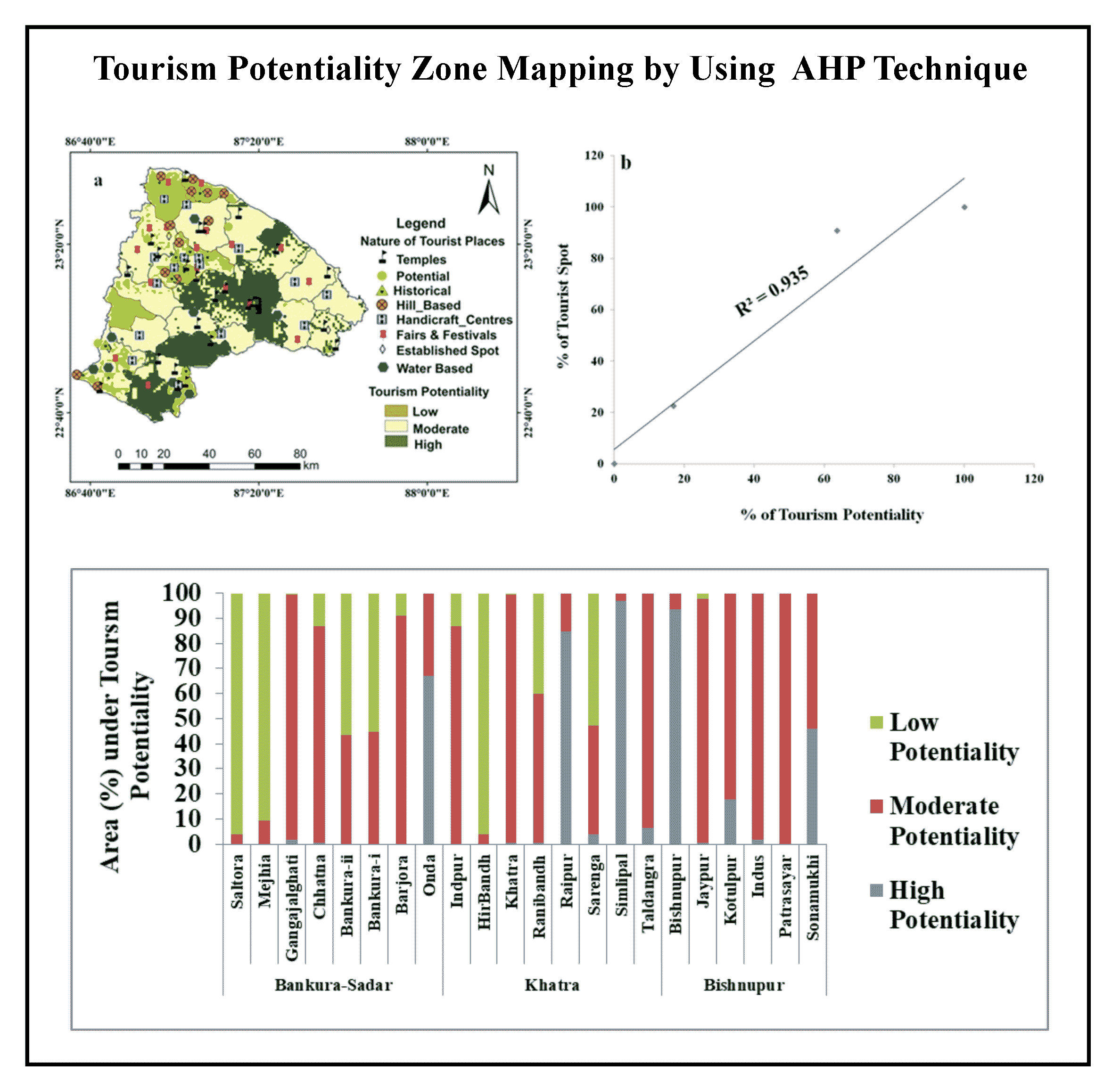
The strategic plan is important for the management of tourism resources in the particular region. However, the strategic planning for the Bankura District is still very far from being accomplished. The study was aimed to formulate the strategic plan for the Bankura District by combining the Analytic Hierarchy Process (AHP) and SWOT (Strength-Weakness-Opportunities-Threats) techniques. The methodology involved a five-step approach, which included the identification of SWOT factors, formulation of pair-wise comparison matrices and the strategy formulation using the TOWS (Threats-Opportunities-Weakness-Strengths) matrix. The data was collected both from the primary and secondary sources. The purposive sampling technique was used to interview the key stakeholders (800 tourists, 120 souvenir people and 87 tourist guides and hotel managers) and the non-participant observation technique were utilized to observe the nature of tourism in the study area. The findings of the research showed that the strength (S) and opportunity (O) factor obtained the highest priorities within the group. Therefore the S-O combination dominates in the strategic planning and management in the study area. The development of tourism may significantly contribute to the community members' feeling of pride in their area and culture by offering a supplemental source of revenue and livelihood with careful planning and implementation.

The strategic plan for the Bankura District was formulated using the SWOT and AHP techniques.
The purposive sampling technique was followed to interview the stakeholders.
The strength and opportunities have gained the highest weightages.
The development of tourism may significantly contribute to the community members' feeling of pride in their area.
Duro, J. A., 2018. Seasonality of tourism: A new decomposition. Tourism economics, 24(5), 615-621.
Garrido, F. J., 2016. Strategists and Strategos. Strategy and Management Business Review, 6(01). 2331-2903.
Nikolic, D., Spasic, J., Zivkovic, Z., Djordjevic, P., Mihajlovic, I. and Kangas, J., 2015. SWOT-AHP model for prioritization of strategies of the resort Stara Planina. Serbian Journal of Management, 10(2), 141-150.
Raha, S., Gayen, S. K., and Deb, S., 2024a. Demarcation of drought susceptibility zone in Bankura district, West Bengal using analytic hierarchy process and weighted sum technique. North-Eastern Geographer, 23(1). 40-61.
Sultana, S. and Khan, R. S., 2018. Factors determining tourism: A framework to promote tea tourism destination in Chittagong. Global Journal of Management and Business Research, 18(1), 2249-4588.
Weaver, D., 2015. Enlightened mass tourism as a ‘third generation' aspiration for the twenty-first century. In The Practice of Sustainable Tourism (pp. 11-23). Routledge .